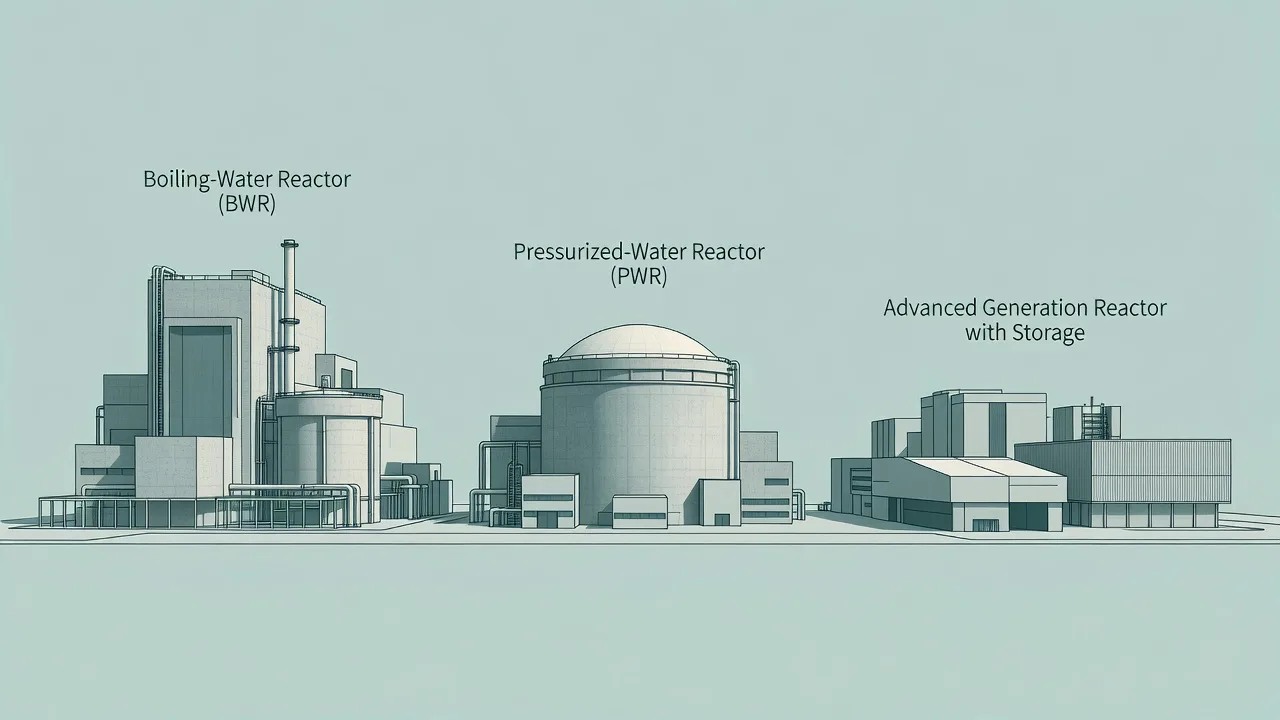
Three programs dominate the Western SMR race, and they are genuinely different bets: the BWRX-300 bets on licensing familiarity and being first, the AP300 bets on the AP1000's operating pedigree, and Natrium bets that storage and flexibility beat both. As of July 2026, two of the three are in construction — but only one has an operating licence application on file, and the race is about fleets, not first units.
Key facts
- BWRX-300 is furthest along — unit 1 in construction at Darlington, and the only one of the three with an operating licence application filed (June 2026)
- Natrium holds the first modern US commercial fast-reactor construction permit (March 2026) and broke ground in April 2026
- AP300 is in NRC pre-application with design certification anticipated around 2027, and has entered the UK Generic Design Assessment process
- Data as of July 2026; statuses below link to primary sources
The BWRX-300, defined
The BWRX-300 is GE Vernova Hitachi's 300 MWe boiling-water SMR — a simplified, natural-circulation descendant of the licensed ESBWR, running on standard fuel. Its edge is momentum: four approved units at Darlington, a filed operating licence, and a prospective 14-unit Polish fleet.
The AP300, defined
The AP300 is Westinghouse's 300 MWe single-loop pressurized-water SMR, deliberately built from the same passive safety systems and components as the AP1000 — a design with reactors operating today. Its pitch: no new technology risk at all, just a smaller package of something already running. The cost of that caution is time; it is the earliest-stage of the three.
Natrium, defined
Natrium is TerraPower's 345 MWe sodium-cooled fast reactor with molten-salt storage that flexes output to 500 MWe for 5.5+ hours. It is the only one of the three that changes what a nuclear plant does — load-following via storage — rather than just its size.
Side by side
| BWRX-300 | AP300 | Natrium | |
|---|---|---|---|
| Vendor | GE Vernova Hitachi | Westinghouse | TerraPower |
| Type | Boiling-water reactor | Pressurized-water reactor | Sodium fast reactor + salt storage |
| Output | 300 MWe | 300 MWe | 345 MWe (500 MWe peak, 5.5+ h) |
| Fuel | Standard LEU (GNF2) | Standard LEU | HALEU |
| Licensing status | Construction underway; operating licence filed (CNSC, Jun 2026) | NRC pre-application; UK GDA entered | NRC construction permit (Mar 2026) |
| Construction | Darlington unit 1 (of 4) in progress | None | Kemmerer, WY — started Apr 2026 |
| First power target | End of the decade | ~2030s (certification ~2027 first) | ~2031 (construction complete Feb 2031 est.) |
| Order pipeline | Poland ×14 proposed; US/UK/SE Asia interest | UK/Europe/N. America prospects | Kemmerer; follow-on US sites discussed |
| The bet | First and familiar | AP1000 pedigree, zero novelty | Flexibility + storage |
Which matters when
Buying certainty on schedule? BWRX-300 — it is the only design whose remaining risk is execution rather than licensing.
Buying for a wind- or solar-heavy grid? Natrium — the storage island is the product; the reactor is the engine behind it.
Buying for a fleet decision in the 2030s? The AP300 becomes interesting precisely because it is late: by the time it certifies (~2027 target), Darlington will be generating data on whether SMR economics work at all, and AP1000 operating experience keeps accumulating.
Watching fuel risk? Only Natrium needs HALEU; the two water-cooled designs run on fuel supply chains that exist today.
Current state (July 2026)
Deployment order today: BWRX-300, Natrium, AP300. The gap that matters next is Darlington's operating licence hearing and Kemmerer's nuclear-island start — and whether Poland's CfD turns the BWRX-300 from a project into a product line. Full landscape: Small modular reactors: the complete guide.
Correction (15 July 2026): an earlier version of this article's introduction and Key facts described the BWRX-300 as the only design in construction. Natrium has been in construction at Kemmerer, Wyoming since April 2026 — as this article's own comparison table and FAQ correctly stated. Both passages have been amended to say the BWRX-300 is the furthest along and the only design with an operating licence application on file. The error was flagged by TerraPower.
Background
Natrium is TerraPower's advanced plant design: a 345 MWe sodium-cooled fast reactor coupled to molten-salt thermal storage that can boost output to 500 MWe for more than five hours. Its March 2026 NRC construction permit was the first for a commercial non-light-water US power reactor in more than 40 years, and construction of the first unit began in April 2026 at Kemmerer, Wyoming, on the site of a retiring coal plant, with completion expected by early 2031. The announced pipeline beyond Kemmerer includes agreements covering up to eight plants for Meta's data centers, further PacifiCorp units, and UK deployment through the Generic Design Assessment. (As of August 2026.) Read the Natrium explainer.
The BWRX-300 is GE Vernova Hitachi's 300 MWe boiling-water small modular reactor, derived from the NRC-licensed ESBWR and fueled with GNF2 fuel already in commercial use. Unit 1 at Ontario Power Generation's Darlington site — the first Western SMR to reach construction — is being built with four units approved there totalling about 1,200 MW, and Poland's Orlen Synthos Green Energy is seeking state financing for 14 units across three sites. (As of August 2026.) Read the BWRX-300 explainer.
Questions
- Which of the three is furthest along?
- The BWRX-300: unit 1 is in construction at Darlington and OPG applied for its operating licence in June 2026. Natrium began construction in April 2026; the AP300 is still in pre-licensing.
- What's the main difference between AP300 and BWRX-300?
- Reactor type and maturity: the AP300 is a pressurized-water design derived from the operating AP1000, still in pre-application; the BWRX-300 is a boiling-water design already in construction.
- Why choose Natrium over the water-cooled options?
- Storage and flexibility: its molten-salt tanks let a 345 MWe reactor deliver 500 MWe when prices spike — but it needs HALEU fuel and carries more first-of-a-kind risk.
Sources
- BWRX-300 Reactor in Darlington, Ontario — GE Vernova
- AP300 SMR — Westinghouse
- Westinghouse AP300 pre-application activities — US NRC
- Westinghouse Initiates UK Generic Design Assessment Process for the AP300 — Nuclear Industry Association
- NRC Issues Construction Permit for TerraPower's Natrium Advanced Reactor — US Department of Energy
- TerraPower Commences Construction on America's First Utility-Scale Advanced Nuclear Power Plant — TerraPower
About Nuclear News Network
Nuclear News Network (NNN) is an independent publication covering the global nuclear energy sector — reactor construction, SMRs, fuel supply, policy, operations and fusion. NNN publishes a daily brief, same-day analysis of major developments, and reference guides used across the industry. Articles are produced by the NNN Newsroom, an editorial automation system with human oversight, under the publication's editorial standards. Ruben Seoane is the founder and main editor of NNN.