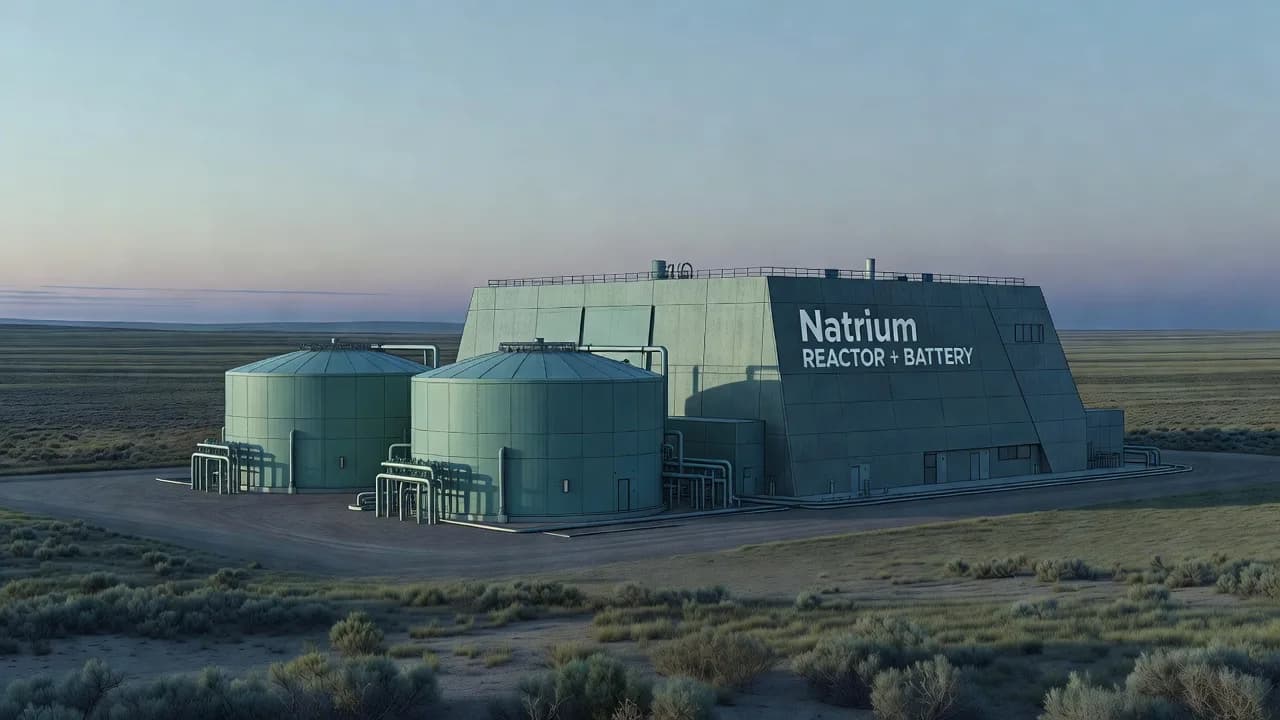
Natrium is TerraPower's answer to the question nuclear has never handled well: what if the grid doesn't want constant output? The design couples a 345 MWe sodium-cooled fast reactor with molten-salt thermal storage that can push delivered power to 500 MWe for more than five hours — a nuclear plant that behaves like baseload and a battery at once. In 2026 it stopped being a concept: the NRC issued its construction permit on March 4, and ground broke at Kemmerer, Wyoming on April 23.
Key facts
- 345 MWe sodium-cooled fast reactor + molten-salt storage, boostable to 500 MWe for 5.5+ hours
- The March 4, 2026 NRC construction permit was the first for a commercial non-light-water US power reactor in more than 40 years — completed in 18 months against a 27-month schedule
- Construction at Kemmerer, Wyoming began April 23, 2026, on the site of a retiring coal plant
- The owner expects construction complete by February 2031, with roughly 1,600 workers at peak and about 250 permanent jobs
- In July 2026 TerraPower became the first advanced-reactor company admitted to INPO, the operator-standards body of the existing US fleet
How it works
Sodium instead of water changes almost everything. Liquid sodium runs near atmospheric pressure — no massive pressure vessel or containment sized for steam explosions — and carries heat so well that the reactor can shed decay heat passively. A fast neutron spectrum burns fuel more efficiently, though it requires HALEU (high-assay low-enriched uranium), a supply chain still being built in the West.
The signature move is separating the nuclear island from the power island. The reactor heats a salt loop; the salt banks energy in storage tanks; the turbine draws on the tanks. The reactor never load-follows — the tanks do. That means the most expensive part of the plant runs at full capacity around the clock while the output flexes with electricity prices, which is exactly the profile a wind-heavy grid like Wyoming's pays a premium for.
Why Kemmerer matters
Kemmerer 1 is a stack of firsts: first US utility-scale advanced reactor in construction, first commercial fast-reactor permit of the modern era, and the flagship test of coal-to-nuclear transition — the plant sits next to a retiring coal unit whose grid connection and workforce it inherits. It is also, technically, slightly above the IAEA's 300 MWe SMR threshold: Natrium is best read as the leading edge of the broader advanced-reactor wave rather than a classic SMR — which is also why its milestones are watched by everyone in the SMR field anyway.
From one plant to a fleet
The 2026 milestones read like a company preparing to operate, not just build. Excavation and early works at Kemmerer Unit 1 progressed through the summer with the energy-storage island moving ahead of the nuclear island. In July, TerraPower joined the Institute of Nuclear Power Operations — the first advanced-reactor developer inside the body that sets operating standards for the existing US fleet, and a signal regulators and buyers read as operational seriousness. The order pipeline runs through a January 2026 agreement with Meta for up to eight plants serving data centers, PacifiCorp's forecast of two more units by 2033, utility agreements in Utah and Kansas, and entry into the UK's Generic Design Assessment in February 2026. Fuel is the constraint TerraPower manages most publicly: four parallel HALEU tracks spanning Centrus enrichment, fuel fabrication in North Carolina, a Framatome metallization pilot that produced its first uranium pucks in November 2025, and a long-term supply deal starting 2028.
Common misconceptions
"Sodium reactors are experimental." Fast reactors have decades of operating history (EBR-II in Idaho ran from 1964 to 1994); what's new is the commercial licensing and the storage pairing, not the physics.
"It's a bigger bet than water-cooled SMRs." Different bet: water-cooled designs like the BWRX-300 minimize licensing risk; Natrium accepts more first-of-a-kind risk in exchange for storage, flexibility, and fuel efficiency. The comparison is the point — see BWRX-300 vs AP300 vs Natrium.
Current state (August 2026)
Construction is underway at Kemmerer with the energy-storage island proceeding ahead of the nuclear island and the owner's stated construction-completion expectation holding at early 2031. TerraPower is now an INPO member — the first advanced-reactor company inside the fleet's operating-standards body — and its commercial pipeline (Meta, PacifiCorp, Utah, Kansas, the UK) makes Natrium the advanced design with the most credible path from one plant to many. HALEU supply remains the program's watch item; see NNN's HALEU explainer for the fuel-chain map.
Background
Natrium is TerraPower's advanced plant design: a 345 MWe sodium-cooled fast reactor coupled to molten-salt thermal storage that can boost output to 500 MWe for more than five hours. Its March 2026 NRC construction permit was the first for a commercial non-light-water US power reactor in more than 40 years, and construction of the first unit began in April 2026 at Kemmerer, Wyoming, on the site of a retiring coal plant, with completion expected by early 2031. The announced pipeline beyond Kemmerer includes agreements covering up to eight plants for Meta's data centers, further PacifiCorp units, and UK deployment through the Generic Design Assessment. (As of August 2026.)
Questions
- What is the Natrium reactor?
- TerraPower's advanced plant design: a 345 MWe sodium-cooled fast reactor coupled to molten-salt thermal storage that can boost output to 500 MWe for more than five hours — nuclear that load-follows like a gas peaker.
- Does TerraPower have a fast neutron reactor?
- Yes. Natrium's core is a sodium-cooled fast-neutron (fast-spectrum) reactor — the physics lineage of EBR-II, which ran in Idaho from 1964 to 1994. Its March 2026 construction permit was the first for a commercial US fast reactor in the modern era, and the plant is now in construction at Kemmerer, Wyoming.
- Is Natrium a small modular reactor (SMR)?
- Not strictly. At 345 MWe it sits just above the IAEA's 300 MWe SMR threshold, so it's best classed as an advanced (non-light-water) reactor — though it competes for the same buyers and is usually discussed alongside SMRs like the BWRX-300 and AP300.
- Why does the storage matter?
- It lets the reactor run flat-out (where nuclear economics are best) while the plant's electrical output flexes with the grid — selling more power exactly when wind and solar drop off.
- When will it operate?
- Construction at Kemmerer, Wyoming began in April 2026 and is expected to take about five years; the owner has told the NRC it expects construction complete by early 2031.
- Who will buy Natrium plants beyond Kemmerer?
- The stated pipeline includes a January 2026 agreement with Meta covering up to eight plants for data centers, two additional PacifiCorp units forecast by 2033, and utility agreements in Utah and Kansas, with UK deployment under Generic Design Assessment since February 2026.
Sources
- TerraPower Commences Construction on America's First Utility-Scale Advanced Nuclear Power Plant — TerraPower
- NRC Issues Construction Permit for TerraPower's Natrium Advanced Reactor — US Department of Energy
- NRC Approves the Natrium Reactor Construction Permit — TerraPower
- TerraPower's Kemmerer 1 Enters Construction: Timeline of the Natrium Project's Road to First Power — POWER Magazine
- TerraPower becomes first advanced reactor company to join INPO — American Nuclear Society
About Nuclear News Network
Nuclear News Network (NNN) is an independent publication covering the global nuclear energy sector — reactor construction, SMRs, fuel supply, policy, operations and fusion. NNN publishes a daily brief, same-day analysis of major developments, and reference guides used across the industry. Articles are produced by the NNN Newsroom, an editorial automation system with human oversight, under the publication's editorial standards. Ruben Seoane is the founder and main editor of NNN.