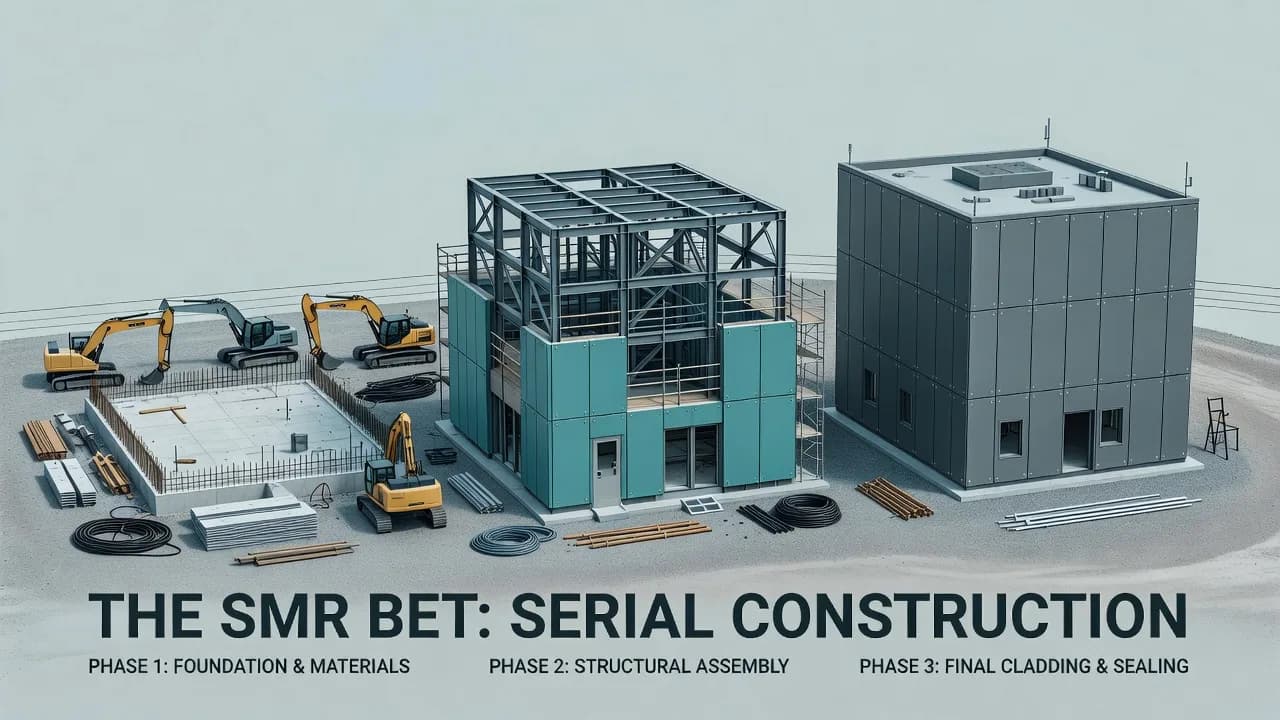
Small modular reactors (SMRs) are nuclear power plants that produce up to roughly 300 MWe per module — about a third of a conventional reactor — designed so that major components can be built in factories and assembled on site rather than constructed as bespoke megaprojects. The promise is serial production: build the same unit many times, get faster and cheaper each time. Two designs already generate commercial power in China and Russia. In the West, the first construction sites are in Ontario and Wyoming.
Key facts
- The IAEA defines SMRs as reactors of up to 300 MWe per module, factory-fabricated and transportable to site
- The OECD Nuclear Energy Agency counts 127 SMR designs worldwide, 74 in active development
- Two commercial SMRs already generate power: China's HTR-PM (December 2023) and Russia's Akademik Lomonosov (May 2020)
- Only one design holds full US NRC design certification: NuScale's module, certified January 2023, with its uprated 77 MWe US460 receiving Standard Design Approval in May 2025
- The first Western SMR is under construction: GE Vernova Hitachi's BWRX-300 at OPG's Darlington site, targeting first power by the end of 2030
- TerraPower's Natrium plant broke ground in Kemmerer, Wyoming in April 2026 — the first US utility-scale advanced reactor to enter construction
How it works
A conventional reactor is a one-off civil-engineering project: a gigawatt-scale nuclear island poured and welded on site, with a safety case written for that site. SMRs invert the model. The nuclear steam-supply system is designed as a repeatable product. Heavy components — reactor vessels, steam generators, containment modules — are fabricated in a factory, shipped, and assembled on a smaller footprint. Many designs rely on passive cooling that needs no operator action and no off-site power: natural circulation, gravity-fed water, or a metal coolant that keeps transferring heat after the pumps stop.
The physics is still fission. Uranium-235 (or, in a few fast-spectrum designs, a uranium-plutonium mix) splits, heats a coolant, and that heat makes steam or drives a power-conversion loop. What changes is the coolant, the fuel form, and the size of the economic bet.
Light-water SMRs shrink proven pressurized- or boiling-water technology and keep today's low-enriched uranium fuel. That is why they lead on licensing familiarity. The BWRX-300 (GE Vernova Hitachi, 300 MWe) is a natural-circulation boiling-water reactor; Westinghouse's AP300 packages AP1000 passive safety at 300 MWe; NuScale's 77 MWe module holds the only full US design certification; Holtec's SMR-300 is in NRC environmental review for Palisades.
Advanced (non-light-water) designs change the coolant to unlock higher temperatures, storage, or fuel recycling. TerraPower's Natrium pairs a sodium-cooled fast reactor with molten-salt thermal storage. X-energy's Xe-100 is a high-temperature gas-cooled reactor firing TRISO pebbles for industrial heat as well as electricity. Kairos Power's Hermes plants use molten fluoride salt. Lead-cooled designs from Russia's BREST programme and Europe's Newcleo and Blykalla sit in the same family. These trade a well-known licence path for new capabilities — and, usually, a need for HALEU.
Microreactors are the small end of the same idea, typically up to about 10 MWe, built to move. They are aimed at a military base, a mine, a remote grid or a single data hall rather than a utility fleet. Several US test units reached first criticality in 2026 under DOE authorization; that is not the same as an NRC commercial operating licence.
The trade-off is baked in. A small reactor produces less revenue per licence, per operator, and per acre. The entire SMR bet is that repetition — the learning curve of building the same unit again and again — outruns the lost economies of scale. That bet is unproven, which is why serial programmes matter more than any single first-of-a-kind.
For a decision-oriented look at the three highest-profile Western contenders, see BWRX-300 vs AP300 vs Natrium.
The numbers
| Metric | Value | Context |
|---|---|---|
| IAEA size cutoff | up to 300 MWe per module | Vendors still apply the SMR label to some larger factory-built units, including the 470 MWe Rolls-Royce SMR |
| Designs tracked | 127 designs, 74 in active development | OECD NEA digital dashboard; most remain paper |
| Operating commercial plants | 2 | China's HTR-PM (2023) and Russia's Akademik Lomonosov (2020) |
| First Western FOAK target | end of 2030 | OPG Darlington BWRX-300 unit 1, if the schedule holds |
| Only US NRC design certification | NuScale, January 2023 | 50 MWe module certified; 77 MWe US460 received Standard Design Approval in May 2025 |
| Conditional data-center offtake | 45 GW | IEA tally of announced deals, not financed steel |
Common misconceptions
"SMRs will be cheaper than large reactors." First units are more expensive per megawatt, not less. A 300 MWe plant still needs a licence, a security force, a fuel contract and a switchyard, and it spreads those fixed costs over fewer megawatts. The cost thesis is a learning curve: factory jigs, repeatable civil works, and a supply chain that has already made the vessel once. Until Darlington's later units, Wylfa's follow-ons, or a fourteen-unit Polish order actually land, the cheaper-than-large claim is a forecast.
"No SMRs exist yet." Two commercial plants are already on the grid. China's HTR-PM has been in commercial operation since December 2023. Russia's Akademik Lomonosov has supplied heat and power to Pevek since 2020. What does not exist yet is a Western commercial SMR in power operation — and that is a narrower, more useful sentence.
"Every SMR needs HALEU." Light-water designs use the same low-enriched uranium as today's fleet. HALEU is a constraint for sodium fast reactors, high-temperature gas reactors and most microreactors, not for the BWRX-300, AP300, SMR-300 or NuScale US460. Mixing the two is how a fuel bottleneck for advanced reactors gets misread as a bottleneck for "SMRs."
"A data-center deal is a plant." The IEA's 45 GW of conditional offtake is a stack of term sheets, not steel. It shows that AI loads have pulled nuclear into procurement conversations. It does not mean 45 GW of small reactors are financed, licensed, or pouring concrete. Nature's August 2026 Outlook made the same distinction: demand is real; cost, fuel, waste and regulation are still open.
Who is building SMRs
The field is global, and the operating plants are not in North America. The OECD NEA's latest snapshot counted 127 designs, with 74 under active development. The World Nuclear Association keeps a design database and a project tracker; both show the same gap the ranking on NNN's top SMR developers is built to measure — many renderings, few construction sites. Developers with steel in the ground, a licence in hand, or a funded first plant, by headquarters:
| Developer | Design | HQ | Output | Status (Sept 2026) |
|---|---|---|---|---|
| CNNC | HTR-PM; Linglong One (ACP100) | China | ~210 MWe HTGR; 125 MWe PWR | HTR-PM commercial since Dec 2023; Linglong One in pre-commissioning at Changjiang |
| Rosatom | KLT-40S; RITM-200N; BREST-OD-300 | Russia | 35 MWe ×2; 55 MWe; 300 MWe | Akademik Lomonosov operating at Pevek; RITM-200N civil works in Yakutia and Jizzakh, Uzbekistan; BREST-OD-300 under construction |
| GE Vernova Hitachi | BWRX-300 | US / Japan | 300 MWe | Civil construction at OPG Darlington; operating-licence application filed; TVA Clinch River permit in NRC review; Poland 14-unit bid |
| TerraPower | Natrium | US | 345 MWe (500 MWe peak) | Nuclear construction at Kemmerer, Wyoming; Hyundai E&C EPC for up to eight fleet units |
| Kairos Power | Hermes / Hermes 2 | US | demonstration / power-producing FOAK | Safety-related construction at Oak Ridge; Hermes 2 groundbreaking April 2026 |
| Rolls-Royce SMR | UK SMR | UK | 470 MWe | Funded three-unit Wylfa contract; UK GDA Step 3; no nuclear concrete yet |
| NuScale / RoPower | US460 | US / Romania | 77 MWe ×6 (462 MWe plant) | Only NRC-certified SMR design; FID on Doicești |
| X-energy | Xe-100 | US | 80 MWe | Seadrift construction permit in NRC review; TRISO-X fuel plant licensed; Centrus HALEU supply |
| Holtec | SMR-300 | US | 300 MWe | Palisades new-build in NRC environmental review; UK GDA Step 2 complete |
| Oklo | Aurora / Groves | US | microreactor class | Groves first criticality Aug 2026 under DOE authorization; Aurora-INL broke ground |
| Westinghouse | AP300; eVinci | US | 300 MWe; microreactor | AP300 still in NRC pre-application; eVinci zero-power criticality Aug 2026 |
| EDF / NUWARD | NUWARD | France | redesign in progress | Second phase of European review complete; FOAK delayed after a 2024 reset |
| KHNP / KAERI | SMART / i-SMR | South Korea | ~100–170 MWe | Domestic and export programmes; Korean yards also supply vessels and EPC for other vendors' plants |
| Blykalla | SEALER | Sweden | lead-cooled | Lead-cooled demonstration path in Sweden |
| Newcleo | LFR | UK / France / Italy | lead-cooled | European lead-fast programme with fuel-cycle ambitions |
| Saltfoss Energy | CMSR | Denmark | molten salt | Korean engineering services contracted for MSR development |
| NPCIL / NTPC | Bharat Small Reactor | India | ~220 MWe PHWR derivative | Government-backed small-reactor programme built on PHWR operating experience |
The table is not a catalogue of every memorandum of understanding. CNEA's CAREM prototype in Argentina reached advanced civil works then stalled on funding. Last Energy, Aalo, Radiant, Antares, Valar and BWXT are moving hardware on the microreactor track — including DOE-authorized criticalities and the Army's Janus programme — but they are not yet utility plants. Buyers in Africa are sizing a $105 billion, 15 GW market by 2035; that is demand, not a named FOAK. NNN ranks the Western field separately in top SMR developers, 2026.
Current state (September 2026)
The operating scoreboard is still two plants, both outside the G7: HTR-PM and Akademik Lomonosov. The construction scoreboard is no longer a rendering. China's Linglong One is in pre-commissioning at Changjiang, with commercial operation still targeted for 2026 and not yet recorded as grid-connected in IAEA PRIS as of mid-year. Russia's BREST-OD-300 and the first export RITM-200N at Jizzakh are in civil works. In the West, Darlington unit 1 is the BWRX-300's first-of-a-kind, OPG's operating-licence application is in front of the CNSC, and TVA's Clinch River permit is in the last stretch of NRC review. Natrium is in nuclear construction at Kemmerer, with a Hyundai E&C fleet framework sitting behind the FOAK. Rolls-Royce SMR has a funded three-unit job at Wylfa and no nuclear concrete yet. NuScale finally has a project that took FID, in Romania. X-energy is waiting on a construction permit, not a design idea.
The demand signal is louder than the build signal. The IEA's 45 GW offtake figure and the Africa $105 billion market map describe buyers and governments positioning for modules that mostly do not exist yet. The next eighteen months of milestones — Linglong One grid connection, Darlington's civil progress, Natrium nuclear-island work, Clinch River's commission vote, Seadrift's permit, Wylfa site works — will separate the handful of deployable designs from the other hundred and twenty.
Latest NNN coverage
- Analysts size Africa's SMR market at $105B, 15 GW by 2035 — September 2026
- Nature Outlook puts SMRs at center of AI power debate — August 2026
- US Army picks five vendors for Janus microreactors — August 2026
- Westinghouse eVinci microreactor reaches zero-power criticality — August 2026
- TerraPower names Hyundai E&C as EPC for up to eight Natrium reactors — August 2026
- Oklo's Groves reactor reaches first criticality in Texas — August 2026
- IEA says data-center SMR deals hit 45 GW — July 2026
- Poland's Orlen Synthos seeks CfD backing for 14 BWRX-300 SMRs — July 2026
- OPG seeks licence to operate first G7 small modular reactor — June 2026
Related reading
Start with the design pages if you want hardware rather than the category: the BWRX-300, Natrium, and the side-by-side BWRX-300 vs AP300 vs Natrium. The Western ranking by construction and licences is top SMR developers, 2026. Fuel constraints for the advanced half of the field are in HALEU, explained and TRISO fuel, explained. The US construction list is every nuclear plant under construction in the US; the licence path those plants still have to walk is NRC reactor licensing, explained. Microreactor testing has its own venue in the DOME test bed.
Questions
- What is a small modular reactor?
- A nuclear reactor producing up to about 300 MWe per module — roughly a third of a conventional plant — designed so major components can be factory-built and assembled on site, per the IAEA definition. Vendors also apply the label to some larger factory-built units, such as the 470 MWe Rolls-Royce SMR.
- How does an SMR work?
- Most SMRs split uranium in a controlled chain reaction, the same physics as today's large plants. The difference is packaging: an integral or compact nuclear steam-supply system is manufactured in a factory, shipped, and assembled on a smaller site, often with passive cooling that needs no pumps or off-site power. Light-water designs use ordinary LEU fuel; many advanced designs need HALEU or TRISO fuel.
- Are any SMRs operating today?
- Yes, but not in the West. China's HTR-PM pebble-bed plant at Shidao Bay entered commercial operation in December 2023, and Russia's Akademik Lomonosov floating plant — two KLT-40S reactors — has supplied Pevek since May 2020. No Western commercial SMR is in power operation yet.
- Which SMR is furthest along in the West?
- GE Vernova Hitachi's BWRX-300 at Ontario Power Generation's Darlington site: civil construction is underway, OPG has applied for a 20-year operating licence, and first power is targeted for the end of 2030. It would be the first operating SMR in a G7 country.
- When will the first Western SMRs generate power?
- Darlington's first BWRX-300 targets completion by the end of 2030. TerraPower's Natrium plant in Wyoming expects construction complete around 2031. Kairos Power's Hermes 2 demonstration at Oak Ridge is aimed at commercial operation around 2030. Those are first-of-a-kind dates, not fleet dates.
- Are SMRs cheaper than large reactors?
- Unproven. First-of-a-kind units cost more per megawatt than a large plant because they forfeit economies of scale. The bet is that factory repetition drives costs down a learning curve. The first serial programs — Darlington's four units, Poland's proposed fourteen, Rolls-Royce's three at Wylfa — are the test.
- Do all SMRs need HALEU fuel?
- No. Light-water SMRs such as the BWRX-300, AP300, Holtec SMR-300 and NuScale US460 use conventional low-enriched uranium. High-assay low-enriched uranium is specified by many advanced designs — Natrium, Xe-100, most microreactors — and that fuel is still at demonstration scale in the United States.
- What is the difference between an SMR and a microreactor?
- Microreactors are a subset of SMRs, typically up to about 10 MWe, designed to be transportable and to serve a military base, mine, remote grid or single data hall. SMRs as a class go up to about 300 MWe per module and are usually site-built from factory modules. Several U.S. microreactor test units reached first criticality in 2026 under DOE authorization, not NRC commercial licences.
Sources
- What are Small Modular Reactors (SMRs)? — IAEA
- Small Modular Reactors — IAEA
- There are now 127 different SMR designs, finds NEA report — World Nuclear News
- NEA Small Modular Reactor Digital Dashboard — OECD Nuclear Energy Agency
- NRC Certifies First U.S. Small Modular Reactor Design — US Department of Energy
- BWRX-300 Reactor in Darlington, Ontario — GE Vernova
- OPG applies for operating licence for BWRX-300 SMR — World Nuclear News
- TerraPower Commences Construction on America's First Utility-Scale Advanced Nuclear Power Plant — TerraPower
- Chinese HTR-PM demo begins commercial operation — World Nuclear News
- Chinese SMR completes non-nuclear steam start-up test — World Nuclear News
- Nuclear Power in China — World Nuclear Association
- Peer review of floating nuclear plant ranks it on par with Russia's top units — World Nuclear News
- Rolls-Royce SMR secures contractual certainty to build Europe's first SMR fleet — Rolls-Royce SMR
- Contract signed for delivery of UK's first SMRs — World Nuclear News
- Data centre electricity use surged in 2025 — International Energy Agency
- Romania's coal-to-NuScale SMR conversion secures FID — POWER Magazine
- Kairos Power breaks ground on Hermes 2 demonstration plant — Kairos Power
- Fourth shell of BREST-OD-300 peripheral cavity installed — World Nuclear News
- Uzbekistan, Russia mark SMR construction progress — World Nuclear News
- Small Modular Reactor (SMR) Design Database — World Nuclear Association
- Second phase of Nuward review completed — World Nuclear News
- Saltfoss enlists Korean services for MSR development — World Nuclear News
About Nuclear News Network
Nuclear News Network (NNN) is an independent publication covering the global nuclear energy sector — reactor construction, SMRs, fuel supply, policy, operations and fusion. NNN publishes a daily brief, same-day analysis of major developments, and reference guides used across the industry. Articles are produced by the NNN Newsroom, an editorial automation system with human oversight, under the publication's editorial standards. Ruben Seoane is the founder and main editor of NNN.