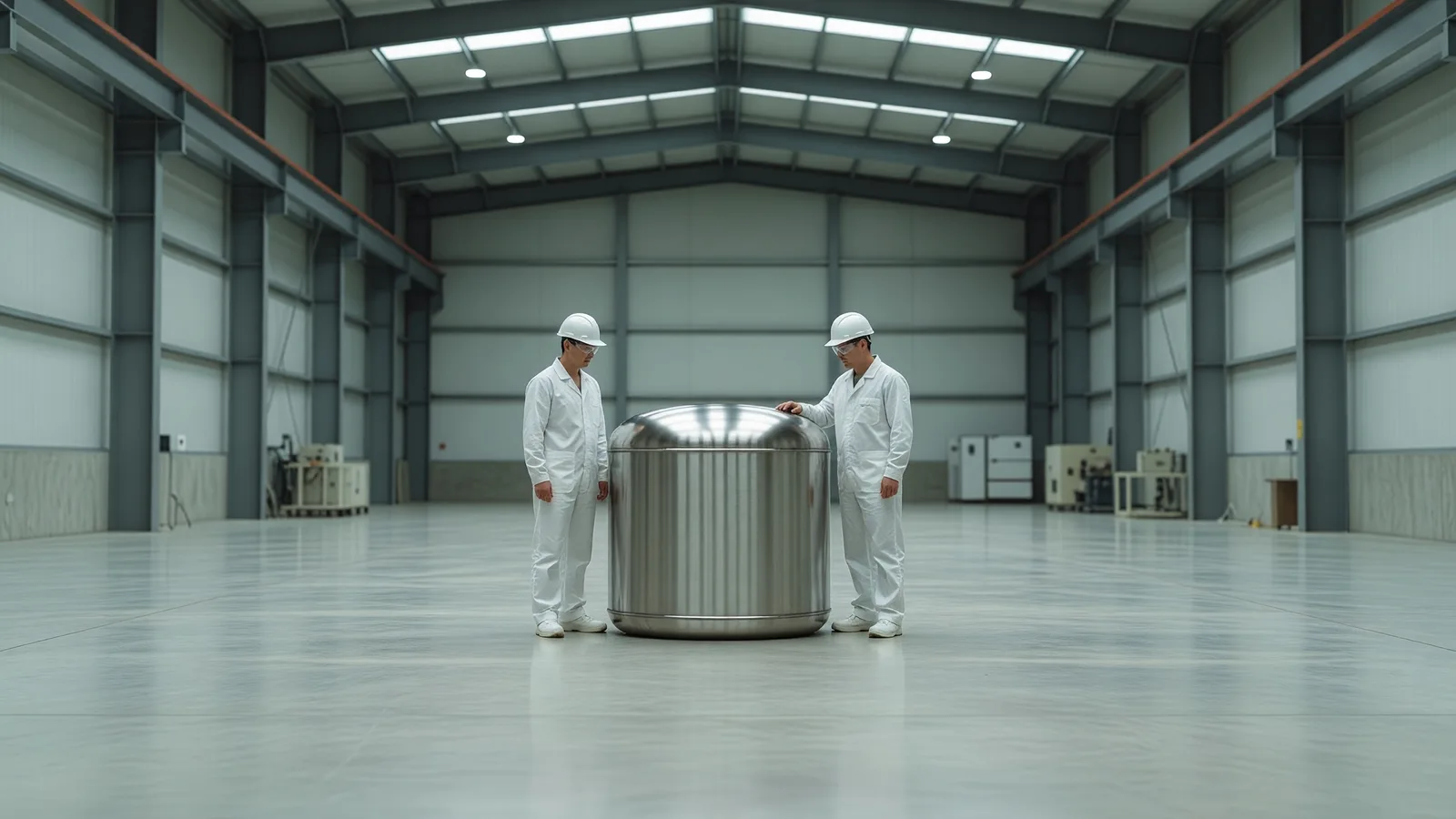
France-headquartered Newcleo has filed a Regulatory Engagement Plan with the United States Nuclear Regulatory Commission for its LFR-AS-200, a 200 MWe lead-cooled fast reactor. The filing matters because it moves the design from presentation mode into NRC pre-application work, where technical claims, schedules, and regulatory expectations start to harden.
Key facts
- Newcleo's Regulatory Engagement Plan sets out the company's proposed pre-application engagement framework with the U.S. Nuclear Regulatory Commission for the future licensing of the LFR-AS-200.
- The LFR-AS-200 is the commercial 200 MWe version of Newcleo's lead-cooled fast reactor design.
- Newcleo said it submitted a letter of intent on 23 February and began early NRC interactions in March.
- The company says the U.S. program also includes an associated MOX fuel fabrication facility.
- Newcleo says its international R&D program includes work with national laboratories in Italy, France and Japan to support the safety case.
What happened
Newcleo's REP is a roadmap for how the company wants to work with NRC staff before any formal application lands on the agency's desk. The NRC-hosted document lays out the proposed licensing approach and an indicative schedule for technical submissions and interactions. It is the blueprint for earning a license, not the license itself. That matters because a narrow, well-scoped REP can keep later design review from drifting.
World Nuclear News reported that Newcleo filed a letter of intent on 23 February and began early NRC interactions in March. Those discussions help the agency familiarize staff with the proposed facility designs and safety approach while giving Newcleo a chance to surface issues early.
The technical pitch is a 200 MWe lead-cooled fast reactor aimed at both electricity and process heat. Newcleo says the target market includes data centers, hydrogen production, cement, and steel. Its MOX fuel cycle is central to the story because the company wants to position the design as a way to turn recovered or surplus nuclear materials into usable energy.
Why it matters
Licensing is the market. A reactor design does not become commercially relevant in the United States until it has an executable NRC path, and Newcleo's REP says the company is serious about building one.
The filing also shows how an international advanced-reactor vendor enters the U.S. market on U.S. terms. Newcleo is headquartered in France, but its regulatory target is the NRC, so it has to meet U.S. expectations on safety, quality assurance, and documentation from the start.
That fits the broader NNN thesis that process is the product. Our coverage of NRC targets faster nuclear licensing with NEPA streamlining proposal showed regulators trying to remove friction from the review path. Our core analysis on why the license path is the product now argued that the strongest companies are the ones that make licensing legible, not just innovative. Newcleo's REP is a live example.
There is a market signal here too. New Jersey's new 1,100 MW procurement framework shows that buyers are beginning to turn policy support into actual demand structures. For vendors, that combination matters: a clearer buyer side and a clearer licensing side.
Background
Lead-cooled fast reactors are attractive because lead's properties support compact designs and strong passive safety claims. They are also harder to license, because the NRC has to assess a technology that sits well outside the light-water fleet it knows best.
Newcleo says its international R&D program with national laboratories in Italy, France and Japan backs the safety case with experimental work and validation data, not just theory. The company also pitches the reactor to industrial users that need firm low-carbon power and heat, so the licensing plan is part of the go-to-market strategy.
That is why the REP matters: it is more than paperwork, and it is the first public proof point that Newcleo is building a real U.S. review framework.
What's next
Newcleo now has to keep NRC engagement moving, refine the design package, and line up the associated MOX fuel facility work. Watch for further public materials, more U.S. licensing staffing, and the next round of technical submissions.
If the process advances, Newcleo will have converted a concept into a regulatory program. If it stalls, the REP will still have shown exactly where the licensing bottlenecks are.
Questions
- What did Newcleo file with the NRC?
- A Regulatory Engagement Plan that lays out how the company intends to work with NRC staff before any formal licensing application for the LFR-AS-200.
- Does this mean the reactor is licensed?
- No. It starts pre-application engagement. The company still has to complete technical submissions, NRC review, and the formal licensing process.
- Why does the 200 MWe rating matter?
- It places the LFR-AS-200 in the small advanced reactor class that Newcleo wants to sell to power users needing clean electricity and industrial heat.
Sources
About Nuclear News Network
Nuclear News Network (NNN) is an independent publication covering the global nuclear energy sector — reactor construction, SMRs, fuel supply, policy, operations and fusion. NNN publishes a daily brief, same-day analysis of major developments, and reference guides used across the industry. Articles are produced by the NNN Newsroom, an editorial automation system with human oversight, under the publication's editorial standards. Ruben Seoane is the founder and main editor of NNN.