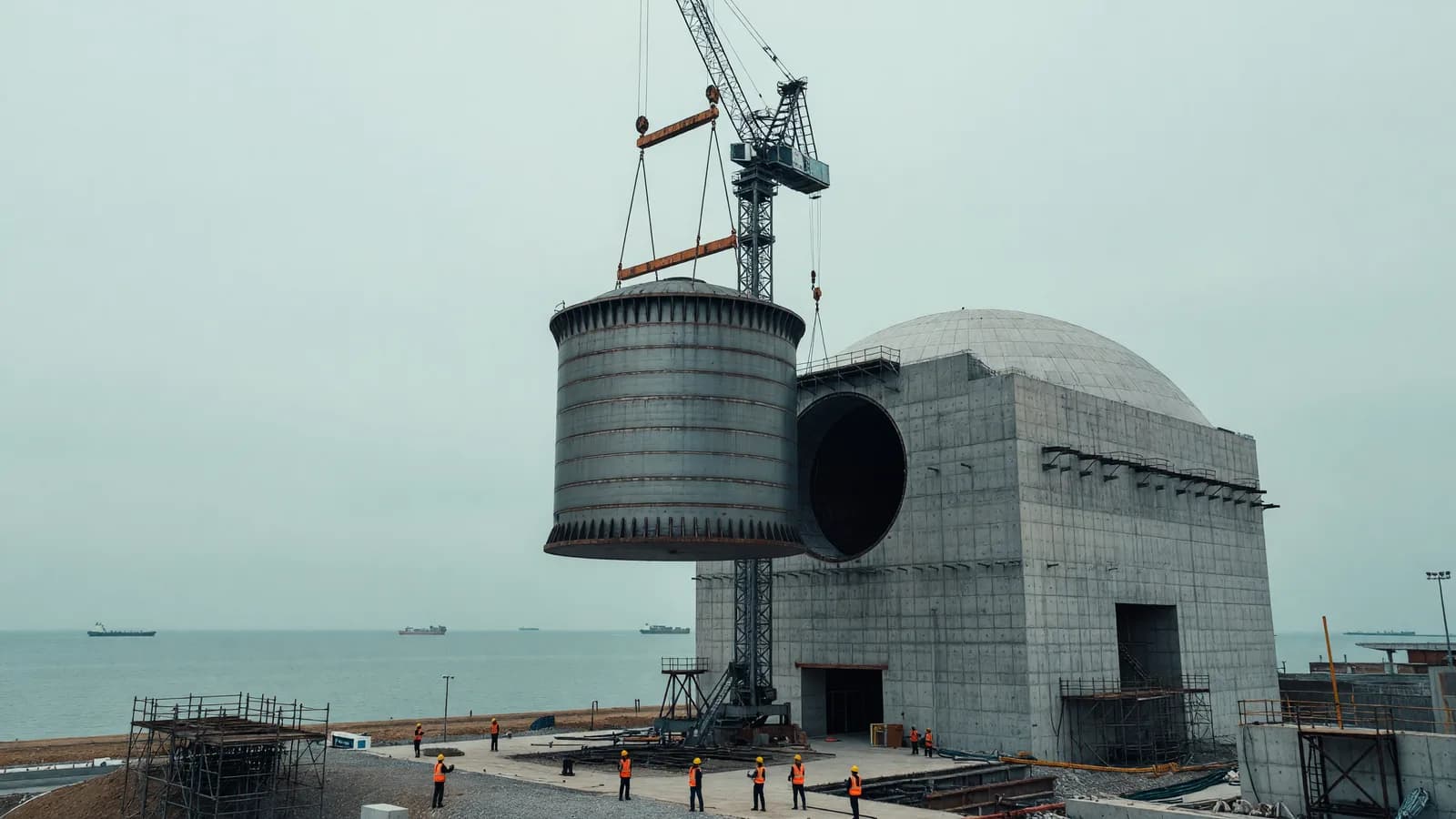
China General Nuclear has installed the reactor pressure vessel at Lufeng unit 1 in Guangdong, pushing the six-unit site into a more equipment-heavy phase. The milestone matters because Lufeng is the first nuclear project in eastern Guangdong, and CGN says the full plant could eventually generate about 52 TWh a year (World Nuclear News).
Key facts
- World Nuclear News reported on 14 July 2026 that the reactor pressure vessel has been installed at Lufeng unit 1.
- The vessel is the high-strength steel cylinder that will house the reactor core, vessel internals, coolant flow path and control rods (World Nuclear News).
- CGN said the install marks "the beginning of the peak period" for main system equipment in the nuclear island of unit 1 and lays the foundation for later main-pipeline work (World Nuclear News).
- Lufeng units 1-4 were approved in September 2014 as four 1,250 MWe CAP1000 reactors, the Chinese version of Westinghouse's AP1000 (World Nuclear News).
- Once all six units are operating, CGN says Lufeng should generate about 52 TWh, reduce standard coal consumption by almost 16 million tonnes and cut carbon dioxide emissions by more than 42 million tonnes (World Nuclear News).
What happened
The reactor pressure vessel is the core pressure boundary of a light-water reactor. It is the thick steel cylinder that holds the reactor core and the internal structures that support and stabilize it, while also providing the coolant flow path and guiding the movement of control rods (World Nuclear News). When that component is in place, the project has moved beyond generic civil construction and into a much more specific phase of nuclear island assembly.
That is why CGN's language matters. The company said the installation marks "the beginning of the peak period" for main system equipment in the nuclear island of unit 1 and provides a solid foundation for the next set of steps, including the installation of the main pipelines (World Nuclear News). In plain English: the site is now entering the part of the job where the heavy hardware, not just the concrete, starts to define the schedule.
Lufeng is not a one-reactor story. The site was approved in September 2014 for four 1,250 MWe CAP1000 reactors, the Chinese version of Westinghouse's AP1000 (World Nuclear News). Later, in April 2022, China approved two Hualong One units at the same site; first concrete for unit 5 followed on 8 September 2022 and unit 6 on 26 August 2023, and the reactor vessel for unit 6 was installed in February this year (World Nuclear News).
The result is a site with multiple build tracks running in parallel. Units 5 and 6 are expected to begin operating in 2027 and 2028, respectively, while units 1 and 2 are scheduled for 2030 and approval for units 3 and 4 is still pending (World Nuclear News). That staggered schedule is important because it shows how Chinese nuclear projects often evolve: not as a single start-to-finish block, but as a rolling industrial program that keeps adding scope as approvals land.
Why it matters
A reactor-vessel lift is a useful milestone because it is hard to fake. By the time a site is handling one of the largest pressure-boundary components in the plant, the project has already cleared a long sequence of engineering, licensing, logistics and construction steps. That does not mean the job is done. It does mean the project is materially farther along than the early-stage announcements that usually dominate nuclear news.
Lufeng also matters because it shows how China keeps turning permitting into hardware. The first phase of the project was approved more than a decade ago, but the site did not stop there. It gained additional units in a later approval round, and now the buildout is visibly moving through the equipment-installation stage. In a sector where schedules are often stretched by supply-chain bottlenecks and licensing drift, that kind of continuity is a competitive advantage.
The site's scale is part of the story too. If all six units reach operation, CGN says Lufeng will generate about 52 TWh a year, while avoiding almost 16 million tonnes of standard coal consumption and more than 42 million tonnes of carbon dioxide emissions (World Nuclear News). Those are not abstract planning numbers; they are the output and emissions claims that define why coastal nuclear buildouts still matter in power-system terms.
There is also a design-lineage angle here. The CAP1000 units at Lufeng are the Chinese version of Westinghouse's AP1000 (World Nuclear News), which makes the project relevant to the same broader question NNN keeps returning to: which reactor designs are proving repeatable, and which are still just concepts? NNN's SMR explainer shows why repeatability matters, BWRX-300 vs AP300 vs Natrium compares how vendors try to package that repeatability, and NRC lets Westinghouse seek AP1000 design certification renewal shows how valuable a durable licensing lineage can be.
Background
Lufeng is the first nuclear power project in eastern Guangdong Province (World Nuclear News). That geography matters because the coastal provinces are where China has tended to concentrate many of its large nuclear buildouts: close to load centers, close to ports and industrial supply chains, and easier to fit into a long-term grid-planning strategy than a one-off inland project.
The sequence at Lufeng also shows how mixed the modern Chinese nuclear portfolio has become. The older CAP1000 units and the newer Hualong One units are sharing the same site, but they are not sharing the same timeline. Units 5 and 6 were approved later than units 1-4 and are closer to the finish line, while units 1 and 2 are now entering the equipment-heavy phase after first safety-related concrete and vessel installation (World Nuclear News). That is a reminder that nuclear capacity additions rarely arrive in neat batches, even when the same utility or developer owns the site.
For readers following the industrial side of nuclear, the important pattern is that Lufeng is now past the point of abstract policy and into the point of visible hardware. The concrete, steel and installation sequence is what turns a six-unit plan into a real power station. The longer the site keeps clearing those milestones, the more credible the eventual output numbers become.
What's next
The next milestones will come from continued installation work in unit 1's nuclear island, further heavy-lift activity across the later units and the still-pending approvals for units 3 and 4 (World Nuclear News). If the schedule holds, unit 5 is still targeting 2027, unit 6 is targeting 2028, and units 1 and 2 are targeting 2030 (World Nuclear News).
What to watch now is whether Lufeng can keep converting large hardware deliveries into integrated installation without slipping the critical path. If it can, the site will remain one of the clearest examples of how a major nuclear buildout moves from paper to steel to power.
Questions
- What did China General Nuclear install at Lufeng unit 1?
- China General Nuclear installed the reactor pressure vessel, the steel vessel that houses the core, internals, coolant flow path and control rods.
- Why does this milestone matter?
- It signals a shift from civil construction toward nuclear island equipment installation. That usually means the project is deeper into the critical path and closer to integrated work.
- How large is the full Lufeng buildout?
- Lufeng is planned as a six-unit site. If all six units operate, CGN says the plant could generate about 52 TWh a year, avoid almost 16 million tonnes of coal and more than 42 million tonnes of CO2.
Sources
- Reactor vessel installed at Lufeng unit 1 — World Nuclear News
About Nuclear News Network
Nuclear News Network (NNN) is an independent publication covering the global nuclear energy sector — reactor construction, SMRs, fuel supply, policy, operations and fusion. NNN publishes a daily brief, same-day analysis of major developments, and reference guides used across the industry. Articles are produced by the NNN Newsroom, an editorial automation system with human oversight, under the publication's editorial standards. Ruben Seoane is the founder and main editor of NNN.