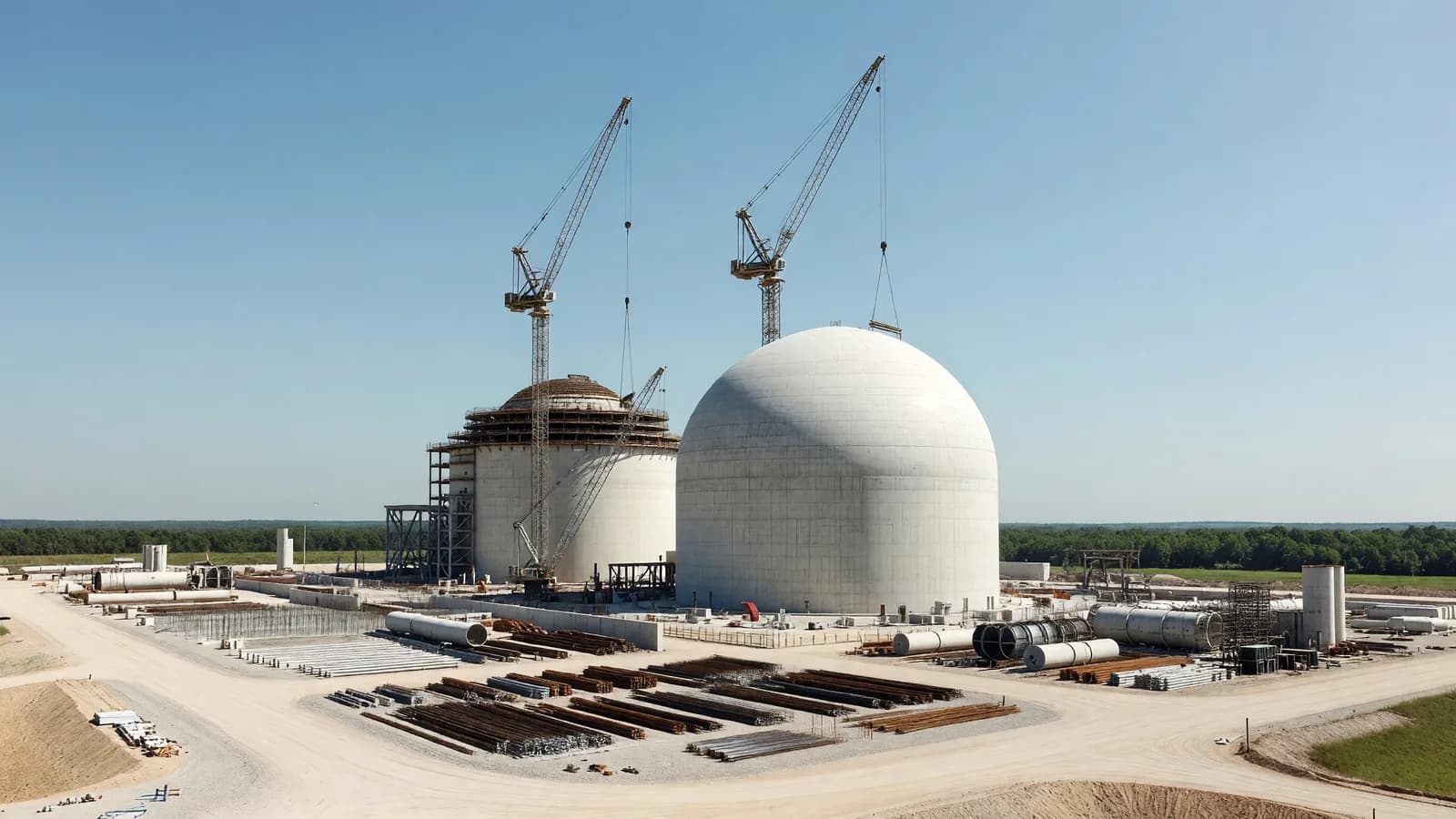
Westinghouse Electric — the reactor vendor jointly owned by Cameco and Brookfield — has confidentially filed a draft registration for an initial public offering, and used the moment to lay out a pipeline of up to 91 potential AP1000 reactors totalling roughly 105 GWe. It is a public-markets bet that the nuclear new-build revival is a durable supercycle, not a headline.
Key facts
- Westinghouse is owned by Cameco (49%) and Brookfield Renewable Partners (51%), which acquired it for about $8 billion enterprise value in 2023.
- The partners confidentially submitted a draft S-1 registration; share count, price, and timing are undetermined.
- Cameco's materials document up to 91 potential AP1000 units (~105 GWe) across global markets.
- Westinghouse technology underpins 417 reactors worldwide; it supplied the first commercial PWR at Shippingport in 1957.
- Overnight cost is put at $20-26 billion per near-term unit, falling to $14-17 billion for Nth-of-a-kind.
What happened
According to World Nuclear News, Cameco disclosed the confidential draft registration ahead of its quarterly results call, stressing that under US Securities and Exchange Commission rules it is "extremely limited" in what it can say. CEO Tim Gitzel confirmed the filing without committing to a size or date; the offering "would be subject to market and other conditions." Power Engineering reported the same filing under the frame of surging nuclear demand.
The more substantive disclosure was the demand picture behind the IPO. Cameco's marketing document sets out a pipeline of 91 potential AP1000 reactors totalling about 105 GWe, ordered by how close each opportunity is to a final investment decision. The near-term tranche includes up to 10 US units supported by the Department of Energy's American Nuclear Supply Chain Loans (commercial operation by the mid-2030s) and up to 10 more via a 2025 Cameco-Brookfield-US Department of Commerce partnership (mid-to-late 2030s). Further out are front-end engineering projects in the Netherlands, Slovenia, Finland/Sweden and the US, plus up to 51 units across Canada, India, Saudi Arabia, Slovakia, the US and other European countries into the early 2040s.
Why it matters
An IPO turns Westinghouse's order book into a public-markets thesis. The company is not a start-up with a paper reactor; its AP1000 is a licensed, operating design — Vogtle 3 and 4 are running — and it claims one of the largest installed technology bases in the industry. Floating it invites public investors to price the durability of the new-build revival that NNN tracks in its US construction tracker.
The pipeline numbers are the pitch. If even a fraction of 91 units reaches final investment decision, Westinghouse becomes a multi-decade equipment-and-services annuity. The costs Cameco cited — $20-26 billion overnight per near-term unit, easing toward $14-17 billion at Nth-of-a-kind, on ~66-month builds — are the sceptic's counter: AP1000 economics still hinge on repeat-build learning that the US has struggled to sustain. Global Managing Director Dominic Kieran argued the order matters: a "sustained demand of at least two reactor units per year" is what unlocks the cost declines.
Background
Westinghouse's corporate history is a cautionary arc that the IPO tries to close. Brookfield acquired the company out of bankruptcy in 2018; Cameco joined as a strategic partner in the roughly $8 billion 2023 deal, pairing a uranium producer with a reactor vendor. The bankruptcy was driven by fixed-price AP1000 construction losses at Vogtle and the abandoned V.C. Summer project — the exact execution risk a public offering now asks investors to look past, on the argument that the design is complete and the supply chain is being rebuilt through DOE loans and government partnerships. Recent NNN coverage of Westinghouse's AP1000 exemption clearance tracks the licensing side of that rebuild.
What's next
Watch for the public S-1 that would replace the confidential draft, revealing financials, share structure, and valuation — and whether Cameco and Brookfield sell down or retain control. The strategic tell will be conversions: how many of the 91 pipeline units move from feasibility and FEED to firm orders and final investment decisions. Kieran said that for a "couple" the partners are already seeing momentum. As Cameco's COO framed it: "Nobody needs to fear nuclear new build — in fact, we need to embrace it." The IPO asks the market to put a number on that conviction.
Questions
- Who owns Westinghouse and who is taking it public?
- Westinghouse Electric is owned by a strategic partnership of Cameco (49%) and Brookfield Renewable Partners (51%), which bought it for about $8 billion enterprise value in 2023. They have confidentially filed a draft registration for a proposed IPO of its stock.
- How big is the disclosed AP1000 pipeline?
- Cameco's marketing materials document up to 91 potential AP1000 reactors totalling roughly 105 GWe across global markets, ordered by proximity to final investment decision.
- What does an AP1000 cost and how long to build?
- Cameco cited overnight capital costs of about $20-26 billion per near-term unit, falling to $14-17 billion for Nth-of-a-kind, with construction of around 66 months from first nuclear concrete to operation, reducing 20-30% for repeat builds.
- Is the IPO confirmed?
- No. The filing is a confidential draft registration; share count, price, and timing are undetermined and subject to market and SEC conditions. CEO Tim Gitzel said Cameco is 'extremely limited' in what it can say.
Sources
- Cameco announces IPO plan for Westinghouse — World Nuclear News
- Westinghouse Electric files for IPO as nuclear demand grows — Power Engineering
About Nuclear News Network
Nuclear News Network (NNN) is an independent publication covering the global nuclear energy sector — reactor construction, SMRs, fuel supply, policy, operations and fusion. NNN publishes a daily brief, same-day analysis of major developments, and reference guides used across the industry. Articles are produced by the NNN Newsroom, an editorial automation system with human oversight, under the publication's editorial standards. Ruben Seoane is the founder and main editor of NNN.