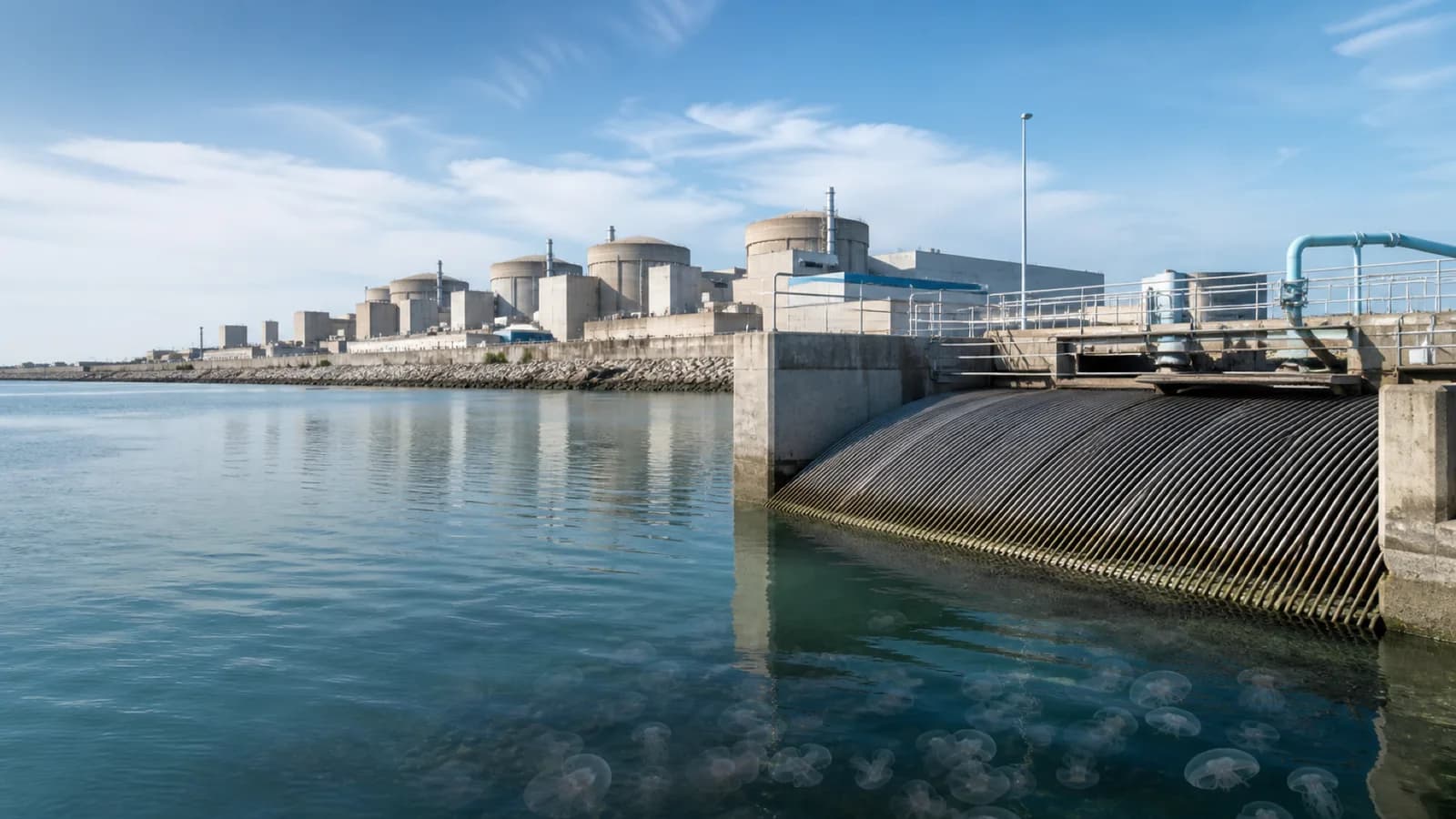
Electricité de France took three reactors at the six-unit Gravelines nuclear power station offline after jellyfish clogged seawater cooling pumps, cutting the site's available output to one unit at full power plus a fourth at half output. EDF said the disruption did not affect facility, personnel or environmental safety.
Key facts
- Gravelines has six reactors rated at 910 MW net each.
- Three reactors shut down and a fourth was reduced to 50% output, leaving one unit at full power; the sixth was already in scheduled maintenance.
- EDF said the event had no impact on facility, personnel or environmental safety.
- France recorded a 15.6% shortfall in nuclear production on 9 August, according to Agence France-Presse calculations based on EDF data.
- EDF said three Gravelines reactors were shut down by a jellyfish influx in August 2025, after the animals clogged drum screens in the water-pumping system.
What happened
The latest disruption began when a large number of jellyfish entered the seawater intake system at Gravelines, near Dunkirk in northern France. The animals clogged pumps used to supply cooling water, according to NucNet's account of an EDF statement. EDF took three reactors offline on 10 August and cut a fourth unit's output by half. One reactor continued at full power, while the sixth was already offline for planned maintenance.
That operating pattern matters because the site is large even by French standards. At 910 MW net per reactor, the three reactors removed from service represented a nominal 2,730 MW of generating capacity before accounting for the fourth unit's derating. The immediate effect was therefore a substantial loss of available output from one station, even though the event was contained within the plant's cooling-water intake equipment.
EDF said the situation had no impact on the safety of the facilities, its personnel or the environment. That distinction is important. A reactor can shut down because a support system is unavailable without the event becoming a radiological accident. In this case, the reported problem was the ability to draw cooling water through the intake system, and the response was to reduce or stop generation while the blockage was managed.
Why it matters
Gravelines is a useful example of the difference between nuclear safety and nuclear availability. The plant's reactors are designed to respond to abnormal conditions by reducing power or shutting down. That protects the equipment, but it does not make the lost electricity disappear from the grid. France was already dealing with reduced nuclear output: NucNet reported a 15.6% production shortfall on 9 August, before the current Gravelines closures.
The timing also lands in a year when French reactors have faced pressure from hot weather and drought. Warmer water can reduce the margin available for discharging heat, while low river levels can constrain plants that rely on inland water sources. A coastal station such as Gravelines avoids some river-flow limits, but it remains exposed to what arrives with the seawater. Cooling systems are industrial infrastructure, and industrial infrastructure has to deal with marine biology as well as pumps, screens and electrical equipment.
The event is also a reminder that a plant's nominal capacity is not the same as dependable output at every hour. Readers following NNN's operations and safety coverage will see the same issue in a different form at Zaporizhzhia, where repeated off-site power losses have tested the systems that keep a shut-down plant cooled. At Gravelines, the problem is a blocked intake rather than a damaged grid, but both cases show why operating margin depends on supporting systems beyond the reactor vessel.
Background
Gravelines has six pressurized-water reactors, each rated at 910 MW net. The station uses seawater for cooling, with intake equipment that screens marine material before water reaches the plant's cooling systems. Jellyfish can accumulate quickly at those screens, restricting flow and forcing operators to clear the system or lower reactor output.
This is not the first jellyfish-related outage at Gravelines. EDF said in its 2026 half-year results transcript that three reactors had to shut down in August 2025 after an invasion clogged drum screens in the water-pumping system. EDF also said its teams now follow jellyfish movements and have organized a response after that earlier event.
The plant's repeated exposure puts a practical limit on easy explanations. The jellyfish are not "causing" a reactor accident; they are creating a cooling-water obstruction that operators must handle conservatively. The grid consequence can still be serious. Three units offline at the same time means fewer megawatts available, more work for other generators and potentially higher reliance on imports or market purchases if the outage lasts.
For broader grid context, NNN's nuclear versus natural-gas baseload explainer covers why availability and fuel security matter alongside a plant's nameplate rating. Gravelines is a concrete case: the reactors are valuable because they can produce large amounts of electricity, but that value depends on the whole cooling chain remaining usable.
What's next
The immediate watchpoint is how quickly EDF clears the seawater pumps and returns the three reactors to service. The company will also need to assess whether the latest influx requires changes to monitoring, screening or response procedures before the next period of heavy marine activity. No restart timetable was included in the reported account.
The second watchpoint is the French power balance. If the Gravelines units return quickly, the event may remain a short availability hit. If the outage persists alongside heat-related restrictions elsewhere, the lost output will matter more. The clean reading for now is narrow: a marine blockage caused a major temporary reduction in generation, while EDF reported no impact on nuclear, worker or environmental safety.
Questions
- Why did jellyfish shut down reactors at Gravelines?
- A large influx of jellyfish clogged pumps in the seawater cooling system. EDF took three reactors offline and reduced a fourth to half output while one unit remained at full power.
- Was this a nuclear safety incident?
- EDF said the event had no impact on facility safety, personnel safety or the environment. The disruption affected cooling-water intake and electricity production, not a reported radioactive release.
- How large is the Gravelines plant?
- Gravelines has six reactors rated at 910 MW net each, according to NucNet's report citing EDF and plant data.
- Has Gravelines seen this problem before?
- Yes. NucNet reported that the plant was temporarily taken offline a year earlier after jellyfish clogged its seawater pumping stations.
Sources
- Three Units Taken Offline At France’s Gravelines After Jellyfish Clog Pumps — NucNet
- 2026 Half-year results — Electricité de France
About Nuclear News Network
Nuclear News Network (NNN) is an independent publication covering the global nuclear energy sector — reactor construction, SMRs, fuel supply, policy, operations and fusion. NNN publishes a daily brief, same-day analysis of major developments, and reference guides used across the industry. Articles are produced by the NNN Newsroom, an editorial automation system with human oversight, under the publication's editorial standards. Ruben Seoane is the founder and main editor of NNN.