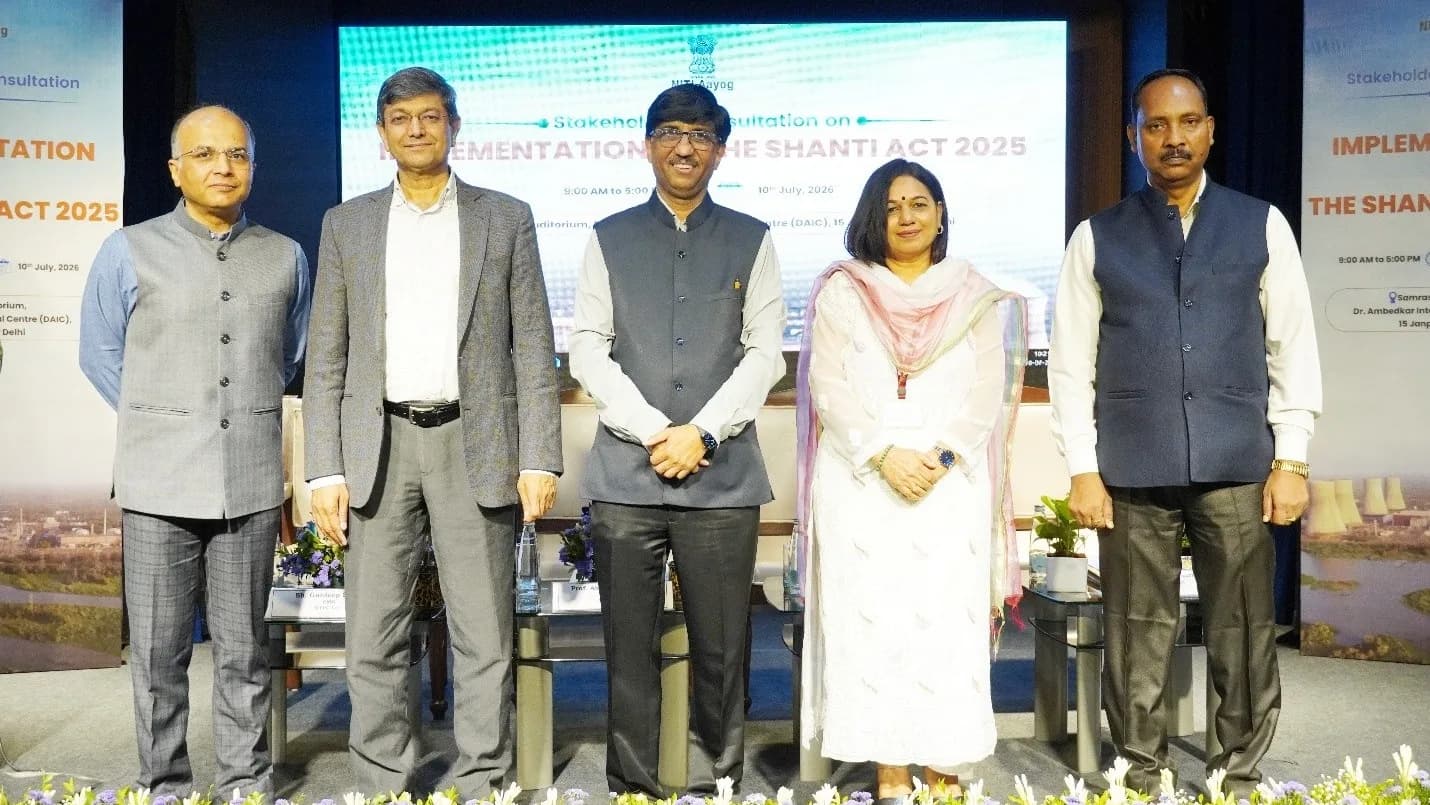
NITI Aayog's July 10 consultation in New Delhi on implementing the SHANTI Act 2025 says a lot about where India's nuclear debate is headed. The meeting was not about a single reactor or a shiny announcement. It was about the plumbing around the sector, and that may be the more important story. The release frames the day around three workstreams: rules and regulation, finance and insurance, and manufacturing and capacity building.
Key facts
- The consultation took place on 10 July 2026 in Samrasta Auditorium at the Dr. Ambedkar International Centre in New Delhi
- PIB Delhi published the release the next morning, on 11 July 2026
- The press release names eight leaders and officials, including Prof. Abhay Karandikar, Sh. Pankaj Agrawal, Sh. Ghanshyam Prasad, and Sh. Gurdeep Singh
- The consultation was split into three critical areas: legislative and regulatory framework, finance and insurance, and manufacturing and capacity building
- The legislative segment focused on draft rules, regulations, and related FDI policy provisions designed to attract foreign capital while safeguarding domestic interests
What happened
The official line from PIB Delhi is straightforward: NITI Aayog brought together policymakers, regulators, researchers, and industry to discuss how the SHANTI Act 2025 should actually work. The press release does not announce a reactor, a tender, or a construction milestone. It announces a process. That is the point.
The consultation was chaired by Prof. Abhay Karandikar, Member of NITI Aayog, and the room included senior people from the Ministry of Power, the Central Electricity Authority, NTPC, the Department of Atomic Energy, and the Atomic Energy Regulatory Board. That mix matters. India was not treating this as a narrow legal seminar. It was putting planning, safety, utility execution, and industrial capacity into the same conversation.
The structure of the day tells the same story. The first segment dealt with the legislative and regulatory framework, including the SHANTI Act's draft rules and the FDI provisions tied to them. The second dealt with finance, insurance, and public perception. The third dealt with manufacturing, operations, supply chain resilience, and workforce development. In other words, the discussion moved from who can invest, to who carries the risk, to who can build the hardware and staff the industry.
One line in the release stands out because it gets to the heart of the matter. The goal was not just to open the door to capital, but to work out how foreign capital can be attracted while safeguarding domestic interests. That is the hard part. If the rules are too loose, the government risks political pushback. If they are too tight, the sector never gets off the whiteboard.
The release also mentions public awareness and community trust, which is easy to overlook but probably should not be. Nuclear policy often gets talked about as if the main challenge is engineering. It is not. Engineering is difficult, but so are liability, financing, vendor depth, and public acceptance. A consultation that puts those pieces on the table is a sign that the government understands the real bottlenecks.
Why it matters
India has been talking about nuclear expansion for years. What changes a sector is not the talking. It is the point at which the policy conversation becomes operational. That is what makes this meeting worth paying attention to. The country is trying to move from a broad willingness to involve private money toward an actual framework that tells investors, utilities, manufacturers, and regulators what happens next.
That matters because nuclear projects fail in predictable ways. A plant can have a good design and still stall if the financing stack is shaky. It can have political support and still struggle if insurers will not price the risk. It can have a local champion and still get stuck if the supply chain is too thin. The SHANTI Act consultation signals that NITI Aayog is looking at the whole chain rather than assuming one good policy sentence will solve everything.
There is also a wider lesson here for readers tracking the global buildout. Our SMR explainer shows how small modular reactors are sold not just as reactors, but as an industrial model. BWRX-300 vs AP300 vs Natrium shows how design choices bleed into licensing, manufacturing, and cost. India's SHANTI Act discussion sits upstream of that. Before a country can pick hardware, it has to decide how the market and the state will share the work.
Our coverage of the NRC's NEPA streamlining proposal points to the same truth from the U.S. side. The important battles in nuclear are often procedural. The projects that move are the ones where the regulator, the utility, the vendor, and the financier all know what the next step is. When that happens, the sector feels less like a series of exceptions and more like an industry.
Background
The PIB release is careful to frame the consultation around implementation, not ideology. That is useful. It suggests the government is past the stage of asking whether private capital belongs in nuclear at all. The question now is how to structure it. That shift is more consequential than it sounds, because the shape of the rules will determine whether the sector attracts serious money or only gestures.
It also helps explain why the agenda included finance, insurance, and workforce development alongside rules and regulations. Those are not side issues. They are the operating system. If the insurance framework is unclear, a developer cannot price a project. If the supply chain is thin, the project stays imported and expensive. If the workforce is not there, every plant becomes a training exercise with concrete around it. That is why the consultation matters even without a new project attached.
The release's list of attendees reinforces the point. NITI Aayog, the Ministry of Power, the Central Electricity Authority, NTPC, the Department of Atomic Energy, and the Atomic Energy Regulatory Board are not decorative names. They are the institutions that would have to make the policy real. If their people are already in the room, the next conversation is less about philosophy and more about drafting, sequencing, and accountability.
For the hardware side of the story, see our SMR explainer and the BWRX-300, AP300, and Natrium comparison. For the policy-and-process side, the NRC's NEPA rewrite coverage remains a useful reference point. Together they show the same pattern: nuclear progress usually starts with paperwork before it reaches a site fence.
What's next
The next thing to watch is whether this consultation turns into published draft rules, FDI clarifications, or a follow-up round of stakeholder drafting. The press release says the views gathered will help strengthen the implementation framework of the SHANTI Act 2025. That is encouraging, but the real test is whether the next document is a policy note or a rulebook.
If India gets this right, the SHANTI Act may end up being remembered less as a slogan and more as the point where the nuclear conversation moved from "should we?" to "exactly how do we do this?"
Questions
- What did NITI Aayog actually do?
- It convened a stakeholder consultation on implementing the SHANTI Act 2025, not a plant approval or a reactor launch.
- Why does the meeting matter?
- Because it treated capital, insurance, manufacturing, and workforce planning as implementation issues, not side notes.
- Who was in the room?
- The press release names NITI Aayog, the Ministry of Power, the Central Electricity Authority, NTPC, the Department of Atomic Energy, and the Atomic Energy Regulatory Board, plus industry and research stakeholders.
Sources
- NITI Aayog Convened a Stakeholder Consultation on Implementation of the SHANTI Act 2025 — Press Information Bureau, Government of India
About Nuclear News Network
Nuclear News Network (NNN) is an independent publication covering the global nuclear energy sector — reactor construction, SMRs, fuel supply, policy, operations and fusion. NNN publishes a daily brief, same-day analysis of major developments, and reference guides used across the industry. Articles are produced by the NNN Newsroom, an editorial automation system with human oversight, under the publication's editorial standards. Ruben Seoane is the founder and main editor of NNN.