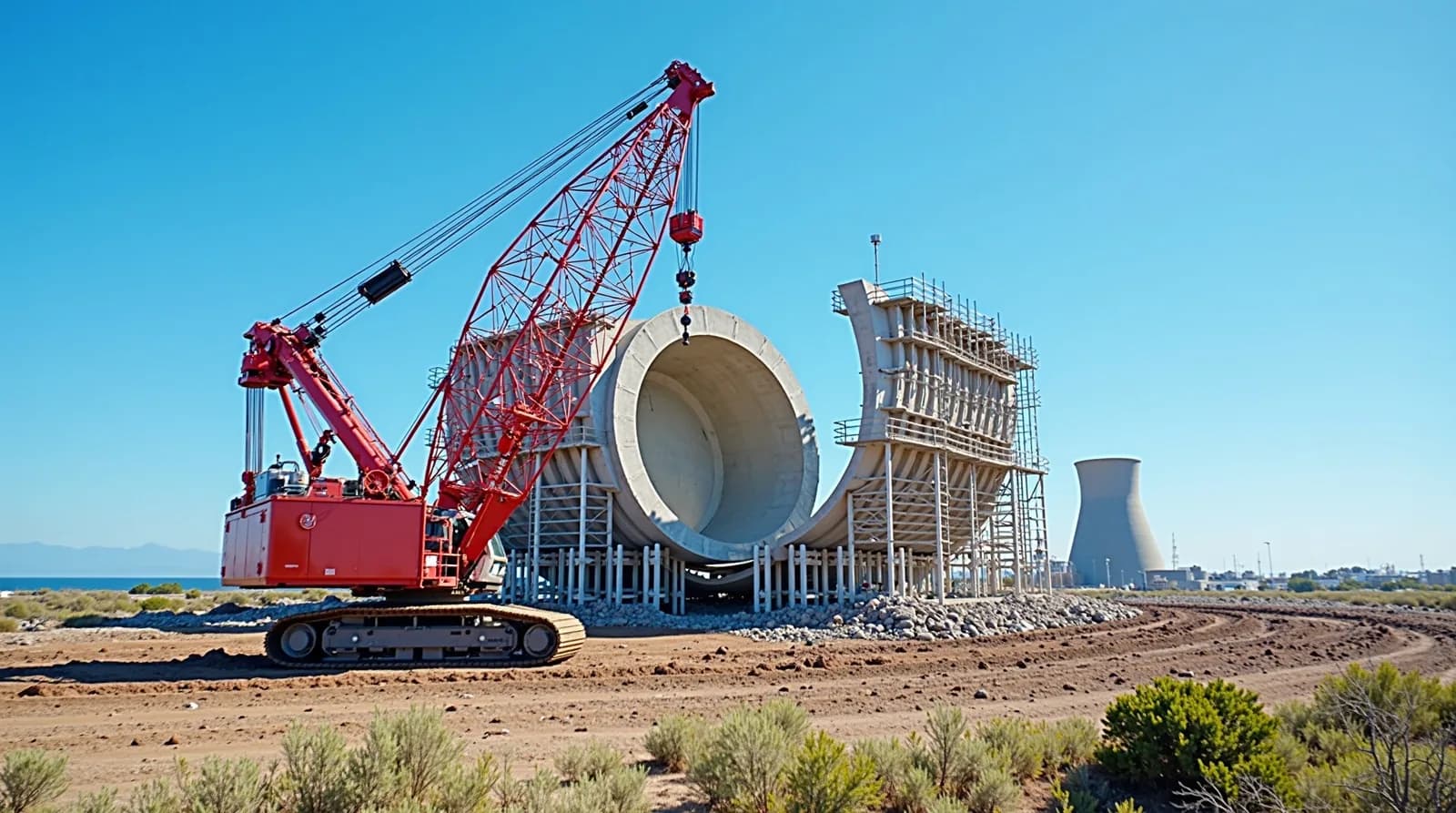
Nuclear decommissioning — the dismantling, decontamination and site release of shut-down reactors — is a working market worth roughly $8–11 billion a year in 2026, and it is about to get bigger. 220 power reactors are permanently shut down worldwide, Europe's dismantling pipeline alone is valued above $120 billion, and US decommissioning trust funds have swollen to around $100 billion. Yet the market's strangest feature in 2026 is that its inputs have started walking back out the door: for the first time ever, plants in decommissioning are being restarted.
Key facts
- Global market estimates for 2026 cluster between $8.5bn and $11bn, with Fortune Business Insights projecting $9.4bn in 2026 growing to $12.9bn by 2034 (4.05% CAGR)
- 220 reactors are permanently shut down worldwide per IAEA data — the US leads with 41, the UK follows with 36
- About 18 US commercial power reactors are in active decommissioning under NRC oversight, backed by trust funds totalling roughly $100bn
- Europe's decommissioning pipeline is valued at over $120bn, the largest regional share of the market
- In June 2026 Sellafield Ltd awarded a £2.9bn ($3.9bn) contract for the next phase of the UK's largest cleanup; in July, Lithuania opened a €400m tender to dismantle the Ignalina reactor core
How big is the market, really?
Ask five research houses and you get five numbers, because "decommissioning" can mean anything from reactor dismantling alone to the full back end of the fuel cycle. Fortune Business Insights puts the market at $9.4bn in 2026, reaching $12.9bn by 2034. Straits Research starts lower ($8.5bn) but projects much faster growth to $25.7bn by 2034. Wider services-inclusive definitions already exceed $11bn. The honest read: high single-digit billions per year today, with every serious forecast pointing up — driven by aging fleets, Germany's completed phase-out, and a first generation of US plants reaching the end of SAFSTOR dormancy.
The money behind the market is more concrete than the market-size estimates. US licensees must pre-fund dismantling through NRC-regulated decommissioning trust funds, which have grown from $64.7bn in 2018 to roughly $100bn — growth driven largely by markets, not contributions. That pool is the revenue base for every US decommissioning contractor, and the NRC's own inspector general flagged in late 2025 that oversight of fund adequacy could be tightened.
The players
The US commercial market consolidated around three specialists that buy or take over shut plants outright, betting they can dismantle them for less than the trust fund holds:
Holtec runs decommissioning at Oyster Creek (New Jersey), Pilgrim (Massachusetts) and Indian Point (New York), where reactor vessel segmentation continues toward completion by 2041. Holtec is also the market's crossover story: it filed publicly for an IPO in July 2026, built on a business that spans dry-cask storage, decommissioning, the Palisades restart and its SMR-300 new-build program — a portfolio that treats a shut reactor site as an asset, not a liability.
NorthStar bought Vermont Yankee from Entergy in 2019 along with its $500m trust fund, and is finishing physical dismantling in 2026 — ahead of its original 2030 schedule. Its Accelerated Decommissioning Partners joint venture with Orano USA was built to repeat the model at other US sites.
EnergySolutions is decommissioning Kewaunee (Wisconsin) toward a 2031 completion, alongside a long track record of waste disposal at its Clive, Utah facility.
The engineering majors — Westinghouse, AECOM, Bechtel, AtkinsRéalis (formerly SNC-Lavalin) and Orano — compete for the government-funded legacy programs that dwarf any single commercial job: Sellafield Ltd in the UK (where a £2.9bn contract for the next phase was awarded in June 2026), EWN in Germany, and TEPCO's Fukushima Daiichi program, the most technically complex decommissioning project on Earth.
The pipeline
The active project list gives the market its texture:
- San Onofre (California) — the largest US dismantling underway: an eight-year, $4.7bn project now 84% complete, with containment dome removal starting in late 2026 and finish targeted for end-2028.
- Vermont Yankee (Vermont) — NorthStar's flagship, physical work completing in 2026; the town is already weighing site reuse options including a data center or new reactor.
- Kewaunee (Wisconsin) — EnergySolutions, completion expected by 2031.
- Sellafield (UK) — the deepest single-site program in the West; the June 2026 £2.9bn award is one of the largest decommissioning contracts in UK history.
- Ignalina (Lithuania) — a €400m international tender to dismantle the Soviet-era RBMK reactor core opened in July 2026, part of the EU-funded closure megaproject.
- Germany — immediate dismantling of the phased-out fleet makes the 2020s–2030s a congested, contractor-hungry period across more than 30 units.
Behind these sits the long tail: SAFSTOR sites like Duane Arnold's original 2080 schedule, UK AGR stations estimated at £3.1–8bn each to decommission, and every operating reactor that will eventually join the queue — unless it doesn't.
The restart wrinkle
The defining 2026 story is the pipeline running in reverse. Palisades (Michigan) became the first US commercial reactor ever to transition from decommissioning status back to operations, targeting a return to service in early 2026 behind a $1.52bn federal loan guarantee. Three Mile Island Unit 1 — now Constellation's Crane Clean Energy Center — is on a parallel track for 2027, boosted by a FERC waiver granted in June 2026 and a 20-year Microsoft power deal.
Add life extensions — Sizewell B out to 2055 is the template — and data-center demand for every megawatt of firm power, and the near-term US pipeline of new decommissioning projects is thinner than it looked in 2022. The market's growth now leans more heavily on Europe's committed phase-outs, government legacy sites and the long global tail than on fresh US shutdowns.
What to watch
Three markers will tell you where this market goes next. First, Holtec's IPO pricing: it is the first pure-play test of what public markets pay for a decommissioning-plus-restart-plus-SMR portfolio. Second, trust-fund oversight: if the NRC tightens adequacy rules following its inspector general's audit, the economics of buying shut plants change. Third, site release and reuse: Vermont Yankee's redevelopment debate previews the real endgame — decommissioned sites with grid interconnections are increasingly valuable land, whether for data centers or new reactors.
Decommissioning used to be nuclear's epilogue. In 2026 it reads more like a chapter break — and for a growing set of sites, the story picks back up.
Questions
- How big is the nuclear decommissioning market in 2026?
- Between roughly $8bn and $11bn globally in 2026, depending on scope. Fortune Business Insights puts it at $9.4bn growing to $12.9bn by 2034; wider service definitions reach $11bn with faster growth. Europe's multi-decade pipeline alone exceeds $120bn.
- How many nuclear reactors are being decommissioned?
- 220 power reactors are permanently shut down worldwide per IAEA data (as of early 2026), led by the US with 41 and the UK with 36. About 18 US commercial reactors are in active decommissioning under NRC oversight.
- Who are the biggest nuclear decommissioning companies?
- In the US commercial market: Holtec (Oyster Creek, Pilgrim, Indian Point), NorthStar (Vermont Yankee, with Orano in Accelerated Decommissioning Partners) and EnergySolutions (Kewaunee). Government programs run through Sellafield Ltd in the UK, EWN in Germany and TEPCO at Fukushima.
- Who pays for nuclear decommissioning?
- In the US, licensees fund it through NRC-mandated decommissioning trust funds built up during operation — worth a combined ~$100bn. Government legacy programs like Sellafield and Fukushima are taxpayer- or utility-funded.
- Why are some plants leaving decommissioning?
- Surging power demand has made shut reactors valuable again. Palisades became the first US plant ever to return from decommissioning to operations, and Three Mile Island Unit 1 (Crane) targets a 2027 restart — each restart removes a project from the near-term pipeline.
Sources
- Nuclear Decommissioning Market Size, Industry Share | Forecast, 2026-2034 — Fortune Business Insights
- PRIS — Permanent Shutdown Reactors by Country — IAEA
- Locations of Power Reactor Sites Undergoing Decommissioning — US NRC
- Decommissioning Nuclear Facilities — World Nuclear Association
- Decommissioning San Onofre Nuclear Generating Station — Southern California Edison
- Europe faces $120bn nuclear decommissioning wave amid energy transition — Innovation News Network
- Holtec Nuclear Corp — Form S-1 — US SEC
- Palisades nuclear plant restart plans pushed back to early 2026 — Michigan Public
- Constellation's Three Mile Island nuclear restart gets boost with FERC waiver — Utility Dive
About Nuclear News Network
Nuclear News Network (NNN) is an independent publication covering the global nuclear energy sector — reactor construction, SMRs, fuel supply, policy, operations and fusion. NNN publishes a daily brief, same-day analysis of major developments, and reference guides used across the industry. Articles are produced by the NNN Newsroom, an editorial automation system with human oversight, under the publication's editorial standards. Ruben Seoane is the founder and main editor of NNN.