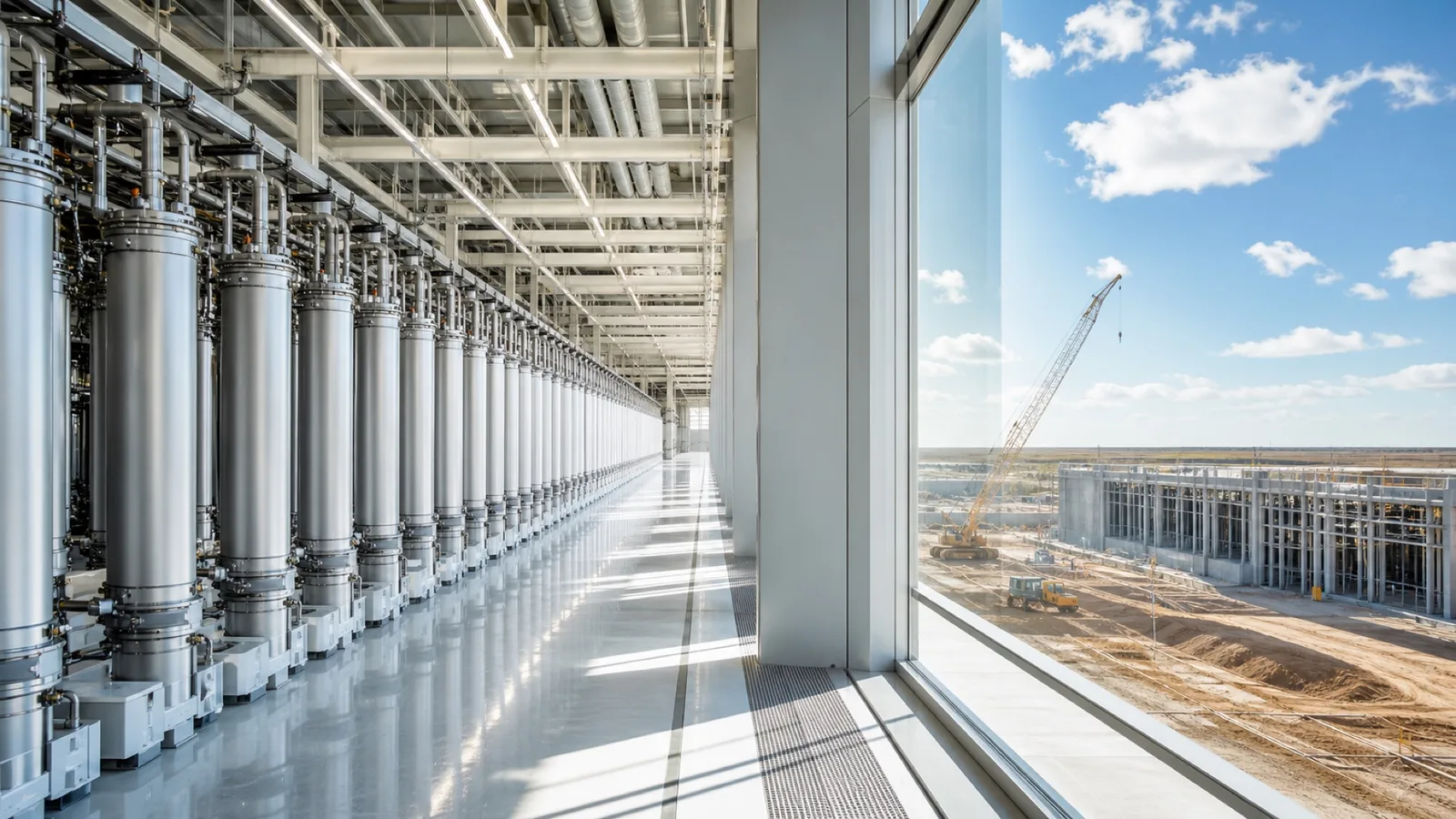
Urenco USA has broken ground on a major expansion of its commercial enrichment plant in Eunice, New Mexico. The project is designed to add 2.1 million separative work units (SWU) of capacity, with first production planned for 2032, making it one of the clearest physical bets yet on a larger US nuclear fuel market.
Key facts
- The project adds 2.1 million SWU through 24 gas-centrifuge cascades.
- Initial cascades are scheduled to start production in 2032, with more installed through 2036.
- Urenco says the expansion will support 300–600 peak construction jobs and 70 long-term operating jobs.
- The National Enrichment Facility already has 4.3 million SWU of annual capacity, with another 700,000 SWU under construction for completion in 2027.
- Urenco says total investment at the site will rise to more than $8 billion.
What happened
Urenco USA marked the start of work on a new enrichment plant at the National Enrichment Facility. US Energy Secretary Chris Wright attended the groundbreaking and toured the Eunice site with Urenco CEO Boris Schucht. The ceremony follows Urenco’s June announcement that it would expand US capacity by nearly 50% through a multi-billion-dollar investment.
The planned addition uses the company’s established gas-centrifuge technology. Urenco says the new plant will contain 24 cascades, with the first cascades starting production in 2032 and additional capacity coming online through 2036. In enrichment, a cascade is a connected group of centrifuges arranged to raise the concentration of uranium-235. The output is measured in SWU, a measure of the separative work needed to enrich uranium rather than a direct measure of tonnes produced.
Urenco said the expansion is backed by long-term customer contracts and is being developed without public funding. The company expects the project to support between 300 and 600 jobs during peak construction and about 70 permanent operating positions. It also said the investment at the Eunice site will rise to substantially more than $8 billion.
Why it matters
The project addresses a supply-chain constraint that sits upstream of every reactor fuel order. Most operating reactors use low-enriched uranium, generally enriched above natural uranium’s roughly 0.7% uranium-235 concentration and below 5%. Enrichment capacity is therefore an industrial service that has to be available before fuel fabricators can make assemblies.
Urenco’s existing National Enrichment Facility began operations in 2010 and has a stated capacity of 4.3 million SWU per year. The company is already adding 700,000 SWU in a separate project due for completion in 2027. The new 2.1 million SWU expansion is a second, larger step, and its 2032 start date shows the long lead time of enrichment infrastructure.
The timing is also shaped by policy. The United States has prohibited imports of Russian-enriched uranium from January 2028, according to World Nuclear News. That deadline does not by itself create a new plant, but it changes the commercial value of capacity in the United States and allied markets. Utilities need contracts and suppliers that can deliver before and after the restriction takes effect.
NNN’s coverage of Centrus’s $900 million HALEU task order tracks a parallel part of the fuel-cycle rebuild. Centrus is working on high-assay low-enriched uranium for advanced reactors; Urenco’s announced expansion is primarily a conventional commercial enrichment project. Together, the two stories show that the US fuel challenge has more than one layer: established reactors need LEU, while many new designs need HALEU.
Background
A centrifuge enrichment plant does not make finished fuel. It takes uranium in a chemical form suitable for enrichment and separates uranium isotopes. The enriched product then moves through conversion, fuel fabrication and quality-control steps before it becomes reactor fuel. That distinction matters because adding SWU capacity improves one part of the chain, not the whole chain.
The Eunice facility is currently the only commercial uranium enrichment plant operating in the United States, according to the WNN report. Urenco says it supplies about one-third of the enrichment needs of US commercial nuclear power plants from the existing facility, with the balance relying on overseas capacity. The expansion is therefore intended to increase domestic resilience while serving a market Urenco expects to grow.
The project also illustrates the difference between a public demonstration and a private industrial investment. Urenco says customers backed the expansion with long-term contracts, allowing the company to proceed without public funding. That is an important signal, although construction and commissioning still have to prove the project’s schedule and cost assumptions.
What’s next
The immediate watchpoints are construction of the new plant, completion of the separate 700,000-SWU addition in 2027 and the first new cascades planned for 2032. Regulators, suppliers and customers will then have to coordinate commissioning and the movement of enriched product into the downstream fuel chain.
The larger test is whether contracted capacity arrives before US reactor demand accelerates. If the cascades enter production on schedule, Urenco will have added a substantial domestic source just as the Russian-import restriction and new-reactor pipeline put more pressure on fuel availability.
Questions
- How much capacity will Urenco add in New Mexico?
- Urenco says the expansion will add 2.1 million separative work units of annual enrichment capacity through 24 gas-centrifuge cascades.
- When will the Urenco expansion produce uranium?
- Initial cascades are planned to start production in 2032, with additional cascades installed through 2036.
- Why does the project matter for the US?
- It expands domestic commercial enrichment as US reactor demand grows and imports of Russian-enriched uranium are prohibited from January 2028.
Sources
- Urenco breaks ground for new enrichment capacity — World Nuclear News
- Uranium Enrichment — World Nuclear Association
About Nuclear News Network
Nuclear News Network (NNN) is an independent publication covering the global nuclear energy sector — reactor construction, SMRs, fuel supply, policy, operations and fusion. NNN publishes a daily brief, same-day analysis of major developments, and reference guides used across the industry. Articles are produced by the NNN Newsroom, an editorial automation system with human oversight, under the publication's editorial standards. Ruben Seoane is the founder and main editor of NNN.