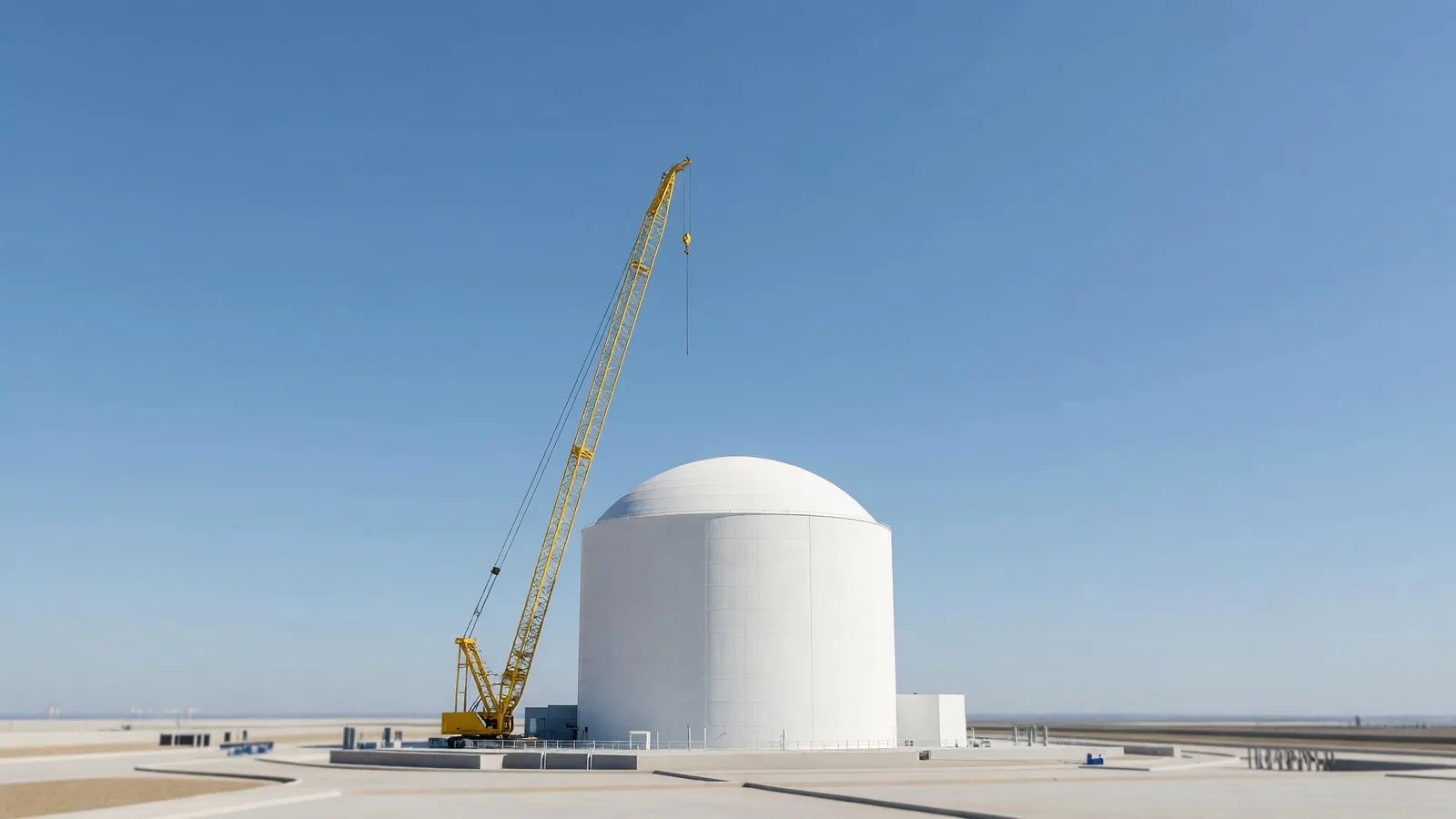
The United States and South Korea have outlined Project Power, a framework for eight large reactors at unspecified US sites, with $120 billion allocated to the proposed program. The mix is six Westinghouse AP1000s and two Korea-designed APR1400s; the announcement sets out a cooperation plan, not eight approved or financed construction projects.
Key facts
- Project Power covers six AP1000 units and two APR1400 units.
- The governments say $120 billion is allocated, with $100 billion for overnight construction costs and $20 billion for contingency reserves.
- The plan proposes cooperating on a $10 billion advance payment by the end of 2026, subject to applicable domestic legal requirements.
- The eight-unit framework does not identify specific sites, schedules or final commercial terms.
What happened
The US Department of Commerce announced the agreement on September 30 as part of a wider strategic investment arrangement between Washington and Seoul. Under Project Power, the governments intend to build six AP1000 reactors and two APR1400 reactors in the United States. The announcement includes Westinghouse Electric Company, Korea Electric Power Corporation (KEPCO) and Korea Hydro & Nuclear Power (KHNP) among the signatories.
The headline figure is large, but its structure matters. Commerce describes $120 billion as the total allocated to the nuclear project, with $100 billion assigned to overnight construction costs and $20 billion to contingency reserves. Those reserves count toward the investment figure; they are not a separate funding pool on top of it.
The plan also calls for the countries to cooperate on transferring a $10 billion advance payment by year-end. Commerce says the money would primarily support early purchases of long-lead items, while explicitly tying the transfer to domestic legal requirements. No public project schedule or site list accompanies the framework. The parties say they will announce individual projects as sites, schedules and commercial terms are settled.
The arrangement contemplates a potential significant minority equity investment in Westinghouse by Korean companies, whose identities and terms remain to be negotiated. That is distinct from a completed equity transaction. No named Korean investor or final ownership terms appear in the Commerce announcement.
There is also a technology-rights complication around the APR1400 portion. Cameco, which owns 49% of Westinghouse, said the framework contemplates a one-time waiver tied to the 2025 settlement of Westinghouse's intellectual-property dispute with KEPCO and KHNP. As World Nuclear News reported, the proposed waiver would allow up to two APR1400s in the US, with Westinghouse expected to receive value through licensing, engineering, procurement, subcontracting and fuel services. The governments' public fact sheet, however, describes the two designs and overall framework without supplying project-level contracts.
Why it matters
Project Power joins reactor supply, construction capability and financing in a single bilateral framework. The AP1000 is a US-designed reactor already operating in the country, while the APR1400 would be a new design entrant to the US market. The project therefore raises practical questions about licensing, intellectual-property arrangements, supply-chain allocation and who carries cost and schedule risk on each site.
The arrangement is connected to a US policy target: having 10 new large reactors with complete designs under construction by 2030. Commerce presents the eight proposed units as contributing to that goal. But a framework count is not the same as a construction start. The announcement still leaves open the locations and commercial commitments needed to move each reactor toward a license and build decision.
For the companies involved, a real order book could support factory capacity and long-lead manufacturing years before concrete is poured. The proposed advance payment is meant to help start that work. Its effect depends on the legal approvals, procurement decisions and project agreements that have yet to be published. Until those appear, the $120 billion should be read as a program allocation attached to an outline, rather than evidence that eight plants have secured final investment decisions.
Background
The proposal follows a long-running contest over the rights to build Korean-designed reactors abroad. Westinghouse's dispute with KEPCO and KHNP was settled in 2025, according to Cameco's account of the new framework; the contemplated waiver appears to create a route for a limited number of APR1400s in the US. The details will matter commercially because the framework puts a US vendor and Korean companies in overlapping roles as technology owners, builders and suppliers.
This is broader than the US–Japan–South Korea plan for small modular reactor deployment, which focused on cooperation to support SMR projects in third countries. Project Power instead proposes large reactors inside the United States. NNN has also tracked federal efforts to finance the components behind a domestic buildout in its guide to DOE nuclear funding; Project Power adds a bilateral supply-and-project framework to those US financing efforts.
The deal also sits within a broader US–South Korea package that includes other energy projects. The nuclear component should be assessed on its own milestones: named sites, applications, contracts, financing and confirmed construction dates. A high aggregate figure cannot answer those project-level questions.
What's next
The near-term test is whether the proposed $10 billion advance transfer proceeds by the end of 2026 and whether the governments identify the initial sites and participating Korean firms. Individual reactor projects still need commercial terms and the relevant domestic approvals. Watch for those documents; they will show whether Project Power becomes a build schedule or remains a framework agreement.
Questions
- What is Project Power?
- Project Power is a US–South Korea cooperation framework covering eight proposed US nuclear plants: six AP1000 units and two APR1400 units.
- Are the eight reactors approved for construction?
- The framework does not name project sites or schedules, and it says individual projects will be announced as commercial terms are finalized.
- How much funding is associated with Project Power?
- The governments say $120 billion is allocated, including $100 billion in overnight construction costs and $20 billion in contingency reserves.
Sources
- Korea and the United States Announce Historic Strategic Investment Projects — U.S. Department of Commerce
- Fact Sheet: Korea and the United States Announce Historic Strategic Investment Projects — U.S. Department of Commerce
- USA, South Korea targeting six AP1000 and two APR1400 units — World Nuclear News
About Nuclear News Network
Nuclear News Network (NNN) is an independent publication covering the global nuclear energy sector — reactor construction, SMRs, fuel supply, policy, operations and fusion. NNN publishes a daily brief, same-day analysis of major developments, and reference guides used across the industry. Articles are produced by the NNN Newsroom, an editorial automation system with human oversight, under the publication's editorial standards. Ruben Seoane is the founder and main editor of NNN.