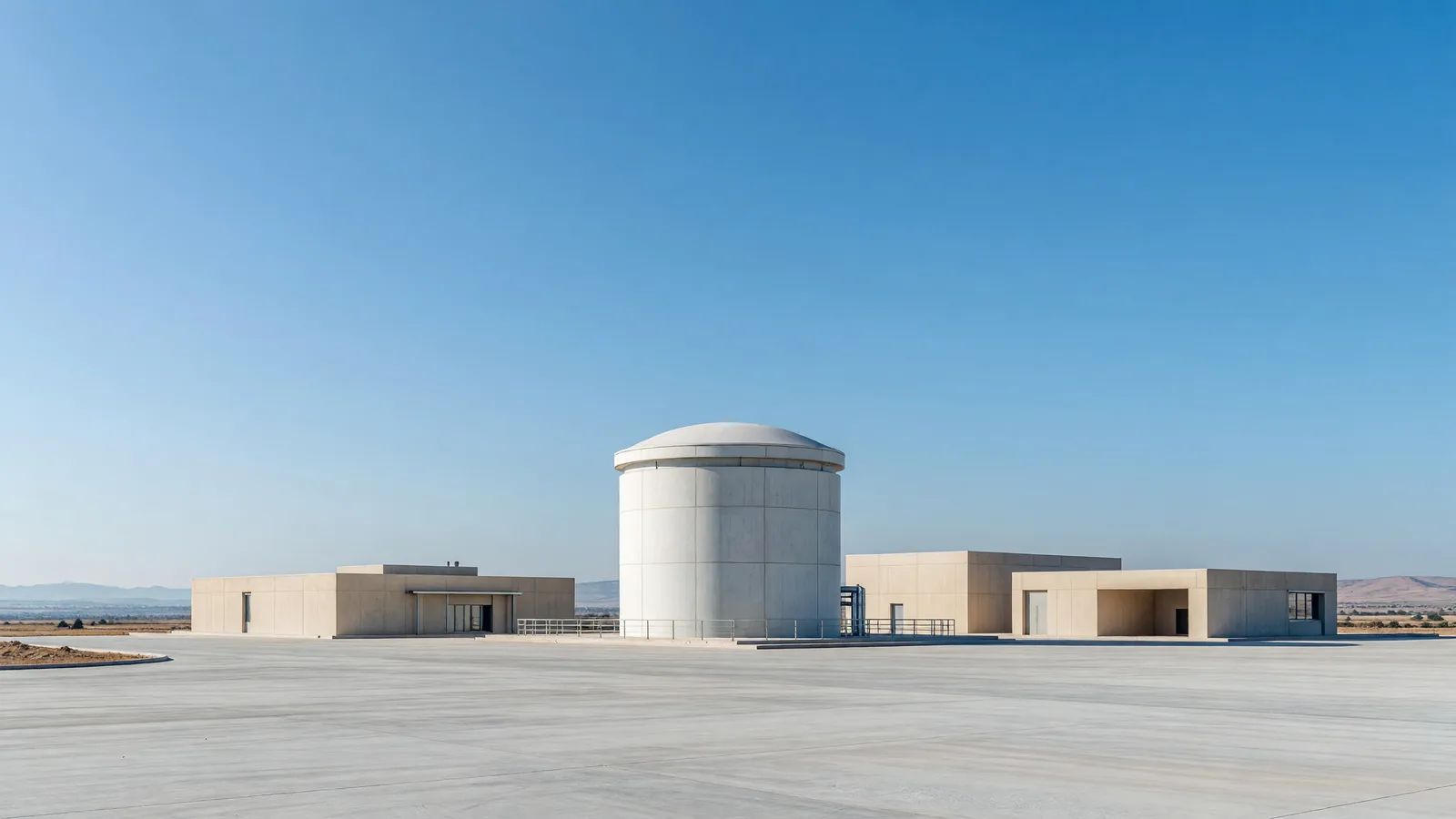
India's Nuclear Power Corporation of India Limited and Bhabha Atomic Research Centre released the detailed project report for their 55 megawatt-electric SMR-55 on October 1, putting a formal project document behind one of the country's smaller indigenous reactor concepts. The release is a development milestone, not evidence that construction has been authorized or scheduled.
Key facts
- NPCIL says the SMR-55 Detailed Project Report was officially released on October 1, 2026. NPCIL announcement
- The SMR-55 is a 55 MWe design; the Department of Atomic Energy listed it among three indigenous reactor projects in a March 2026 parliamentary reply. Department of Atomic Energy via PIB
- NPCIL describes the concept as a pressurised-water reactor intended for remote power, data centres and industrial captive generation. NPCIL announcement
- The government said SMR-55 had received in-principle approval, and proposed its lead unit for the Tarapur site in Maharashtra. Department of Atomic Energy via PIB
- A December 2025 government reply listed a ₹20,000 crore national SMR mission allocation and targeted indigenous SMR operation by 2033; that is a programme-level target, not an SMR-55 commissioning date. Department of Atomic Energy via PIB
What happened
NPCIL announced the report's release in a post on its official account on October 4. It said the report was signed by Raghupati Roy, NPCIL's project director for the Advanced Reactor Project, and Joe Mohan, director of BARC's Reactor Projects Group. NPCIL Chairman and Managing Director V. Rajesh and BARC Director Vivek Bhasin attended the signing, according to the announcement. NPCIL announcement
The post describes SMR-55 as an indigenous, compact pressurised-water reactor and names four possible applications: electricity for remote or off-grid locations, power for energy-intensive data centres, captive generation for heavy industry, and industrial decarbonisation. These are proposed uses. The announcement does not identify customers, a site-specific construction schedule, a procurement package or a date for first power. NPCIL announcement
NPCIL's announcement did not link the report itself. The release therefore confirms that a project report exists and has been formally released, but public details remain limited. Neither the post nor the available government replies provide the report's cost estimate, engineering specifications, licensing plan or a unit-by-unit schedule. Those omissions matter: a project report is a planning document, not proof that a plant has passed each decision gate needed to begin construction.
Why it matters
The SMR-55 adds a compact light-water option to India's domestic reactor development programme. If pursued, the smaller unit could be considered at sites and for industrial loads that do not call for a conventional multi-unit station. But those are use cases named by NPCIL, not signed deployment plans. The near-term test is whether the project moves from a report and in-principle approval into a sanctioned project with a defined site, budget and licensing path.
India's wider small-reactor policy combines several designs that should not be conflated. In a March 2026 answer to Parliament, the Department of Atomic Energy listed the 220 MWe Bharat Small Modular Reactor (BSMR-200), the 55 MWe SMR-55 and a high-temperature gas-cooled reactor of up to 5 MWth for hydrogen production. The lead units were described as technology demonstrations at Department of Atomic Energy sites. Department of Atomic Energy via PIB
That same reply said the SMR-55 project had in-principle approval. For BSMR-200, it described a further administrative and financial approval process, showing that the projects were at different stages. It also proposed Tarapur Atomic Power Station as the location for the BSMR-200 and SMR-55 lead units. The report release is therefore a step forward in project definition, while the government record still sets out additional gates between concept development and building work. Department of Atomic Energy via PIB
Background
The national policy framework is ambitious, but it should be read at the right level. A December 2025 Department of Atomic Energy reply said the Union Budget had allocated ₹20,000 crore for the design, development and deployment of SMRs and set an aim to operationalise indigenous designs by 2033. It also listed Tarapur as the proposed site for the SMR-55 lead unit. The document does not assign that target year to this specific reactor, so 2033 should not be treated as an SMR-55 delivery commitment. Department of Atomic Energy via PIB
NPCIL and BARC have complementary roles in India's programme: the corporation is the state nuclear operator and project developer, while BARC is the Department of Atomic Energy's research centre. Their joint effort sits alongside India's larger pressurised-heavy-water reactor buildout. NNN's earlier reporting on India's Mahi Banswara PHWR procurement covers that larger-unit track; the SMR explainer sets out how smaller reactors fit into the international programme. A separate India-Australia uranium supply story covers another prerequisite for a bigger fleet: fuel supply.
The distinction between the 55 MWe SMR-55 and the 220 MWe BSMR-200 is practical, not just a naming detail. They are separate designs with different output and project status. The March parliamentary reply also listed a third, heat-focused concept for hydrogen production. Grouping all three under the government's SMR mission can make the programme sound more mature or uniform than the public documents support.
What's next
The next evidence to watch is a public version of the SMR-55 report or a government update that specifies its design basis, project cost, site status, approvals and procurement route. A further milestone would be administrative and financial sanction, followed by the applicable environmental and nuclear-safety reviews. No construction-start date for SMR-55 was given in the October release.
For now, the October 1 release makes the project more concrete on paper. Whether that paperwork turns into a build will depend on decisions and documents that have not yet been announced.
Questions
- What is India's SMR-55?
- SMR-55 is an indigenous 55 MWe pressurised-water reactor design being developed by NPCIL and BARC. India has proposed its lead unit at Tarapur, Maharashtra.
- Does release of the project report mean construction will start?
- No. NPCIL says the detailed project report was released, while a March 2026 government reply listed only in-principle approval for SMR-55. The two are not the same as a construction start authorization.
- Where is the proposed SMR-55 lead unit?
- A December 2025 Department of Atomic Energy reply to Parliament said the lead SMR-55 unit was proposed for the Tarapur Atomic Power Station site in Maharashtra.
- What uses are being considered for SMR-55?
- NPCIL lists remote and off-grid electrification, energy-intensive data centres, captive power for heavy industry and industrial decarbonisation among the proposed applications.
Sources
- NPCIL post on release of the SMR-55 Detailed Project Report — Nuclear Power Corporation of India Limited
- India's SMR Push: NPCIL and BARC Release SMR-55 DPR — Nuclear.IN Magazine
- Parliament question: Deployment of Small Modular Reactors (SMRs) — Press Information Bureau, Department of Atomic Energy
- Parliament question: Construction of Small Modular Atomic Reactors — Press Information Bureau, Department of Atomic Energy
- India's SMR Push: NPCIL and BARC Release SMR-55 DPR — Nuclear.IN Magazine
About Nuclear News Network
Nuclear News Network (NNN) is an independent publication covering the global nuclear energy sector — reactor construction, SMRs, fuel supply, policy, operations and fusion. NNN publishes a daily brief, same-day analysis of major developments, and reference guides used across the industry. Articles are produced by the NNN Newsroom, an editorial automation system with human oversight, under the publication's editorial standards. Ruben Seoane is the founder and main editor of NNN.