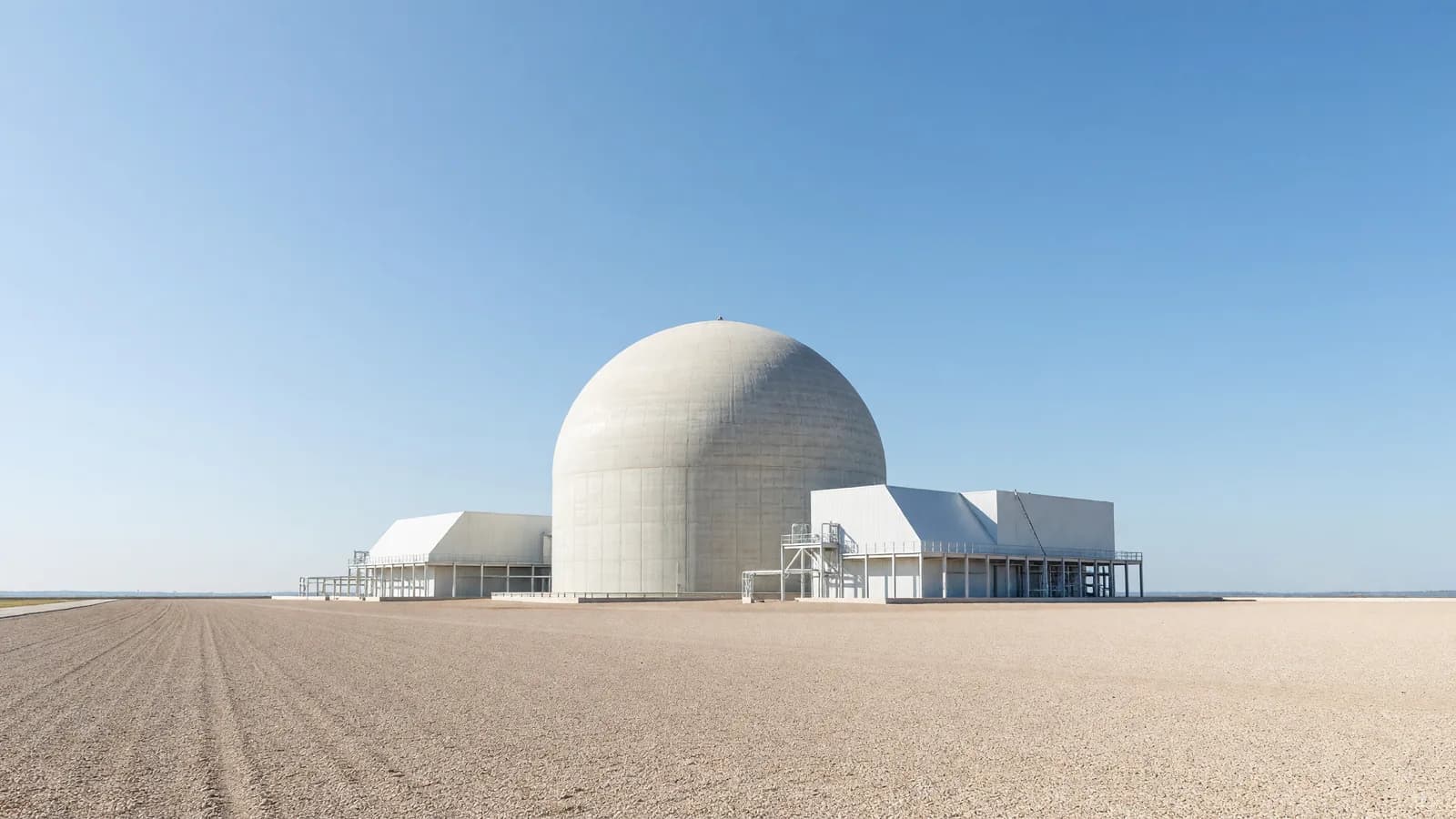
The AP1000 is Westinghouse's large pressurized water reactor, rated at about 1.1 gigawatts of electric capacity per unit. Two operate at Plant Vogtle in Georgia; a federal financing program announced in 2026 could support long-lead equipment purchases for ten more, though those proposed units are not all under construction.
Key facts
- The AP1000 produces about 1.1 gigawatts of electricity per unit, according to the U.S. Department of Energy.
- The U.S. Nuclear Regulatory Commission identifies Vogtle Unit 3 as a pressurized water reactor using the AP1000 design.
- Vogtle Unit 4 entered commercial operation on April 29, 2024; Unit 3 followed in 2023, completing the U.S. project to add two AP1000s.
- DOE's June 2026 announcement described a conditional $17.5 billion loan commitment for long-lead purchases tied to five potential projects and ten reactors, not ten construction starts.
What the AP1000 is
The AP1000 is a third-generation pressurized water reactor (PWR). Like other PWRs, it uses water under high pressure in the reactor coolant system to carry heat away from the fuel without boiling in the primary loop. Steam generators transfer that heat to a separate water circuit, where steam drives a turbine and generator. The turbine island is conventional power-plant equipment; the nuclear island contains the reactor vessel, coolant loops and safety systems.
Westinghouse's design is rated at roughly 1.1 gigawatts electric. That is a utility-scale generating unit, not a small modular reactor. The International Atomic Energy Agency describes SMRs as reactors with a power capacity of up to 300 megawatts electric per module. The AP1000's name refers to its approximate output class, not an exact guaranteed net output at every site; delivered capacity and plant configuration depend on design and operating conditions.
The word "modular" can cause confusion. AP1000 construction uses factory-fabricated modules and integrated assemblies, but the reactor remains a large unit built for a conventional grid connection. Its modules are a construction method, not evidence that it belongs in the SMR category.
Passive safety, without the shorthand
The design's prominent feature is its use of passive safety systems. Westinghouse says these systems use natural forces, including gravity and natural circulation, to respond to certain accident conditions. In principle, that can reduce reliance on powered pumps and operator action during the initial response to some events.
"Passive" does not mean the plant runs without electricity, staff or maintenance. Operators still control the station, inspect equipment, maintain emergency procedures and respond to conditions outside the assumptions built into the design. Regulators assess the design and the specific plant; a feature described by the vendor is not, by itself, a safety finding.
The NRC certifies reactor designs and licenses individual plants. Its public page for Vogtle Unit 3 identifies the reactor type and links the unit to the AP1000 design certification. Design certification standardizes a design's approved safety basis, while a combined license authorizes construction and conditional operation at a named site after required inspections and tests. Licensing does not guarantee a schedule or eliminate construction risk.
The U.S. operating record
Vogtle Units 3 and 4, near Waynesboro, Georgia, are the first AP1000 units to enter commercial service in the United States. Unit 3 began operating in 2023. Georgia Power announced Unit 4's commercial operation on April 29, 2024, and the U.S. Energy Information Administration put its capacity at 1,114 megawatts. The pair completed an expansion that took years longer than the original schedule and faced substantial cost increases, a record that matters to any utility considering another project.
The construction experience cuts both ways. The units provide operating experience with the design and its supply chain in the U.S. market. At the same time, Vogtle shows that a standard design does not make a first-of-a-kind domestic build quick or simple. Workforce availability, component fabrication, project management, licensing, and financing all affect delivery. Those constraints are not resolved by reactor design alone.
DOE's June 2026 financing announcement puts the AP1000 at the center of a new procurement effort. The department said its conditional commitment would support up to five loans, each for two reactors at a potential project site, to buy long-lead equipment. DOE described the program as intended to accelerate delivery and rebuild the domestic supply chain. The proposal is a financing and procurement step. It does not mean utilities have completed all project approvals, started construction, or secured final project schedules.
How it compares with smaller designs
The AP1000 produces substantially more power per unit than designs classified as small modular reactors. That scale can suit large utility systems with the transmission network, financing capacity and demand to absorb a gigawatt-class addition. It also concentrates construction exposure: a delay or outage at a single large unit affects more capacity than the same event at one smaller module.
SMR developers argue that smaller units can be built in series and placed closer to particular loads. That remains a different construction and deployment proposition. For a comparison of current designs and their status, see NNN's small modular reactor guide and reactor project tracker. NNN has also covered DOE's nuclear funding programs and the economics of nuclear versus natural gas for baseload power.
What's next
The next test for the AP1000 in the United States is whether proposed procurement translates into specific projects with owners, sites, financing, permits and construction schedules. DOE's conditional loan commitment can help finance early purchases, but utilities and project partners still have to make investment decisions and execute the work. Long-lead orders may reduce a project's wait for major components; they cannot substitute for a complete design, qualified suppliers, trained crews or a construction license.
For readers comparing project announcements, the distinction is simple: operating plants generate electricity; projects under construction have begun licensed work at a site; conditional financing and equipment procurement are earlier steps. The AP1000 has a U.S. operating pair at Vogtle and a potential pipeline beyond it. How much of that pipeline becomes new generating capacity will depend on decisions and milestones still ahead.
Questions
- What is an AP1000 reactor?
- The AP1000 is Westinghouse's pressurized water reactor design, with a net electrical output of about 1.1 gigawatts per unit. It uses passive safety systems that rely on gravity, natural circulation and stored water rather than powered pumps for certain accident responses.
- How many AP1000 reactors operate in the United States?
- Two AP1000 units operate at Plant Vogtle in Georgia: Unit 3 entered commercial service in 2023 and Unit 4 in 2024. The NRC lists Vogtle 3 as an AP1000; Georgia Power records Unit 4's commercial-operation date as April 29, 2024.
- Are ten more AP1000 reactors under construction in the United States?
- No. DOE announced a conditional $17.5 billion loan commitment in June 2026 to support long-lead supply-chain purchases for up to ten reactors across five potential projects. That program is not evidence that ten reactors have begun construction.
- How is the AP1000 different from a small modular reactor?
- The AP1000 is a large reactor rated at about 1.1 gigawatts per unit, while small modular reactor designs are generally defined by the IAEA as up to 300 megawatts electrical per module. The AP1000 uses factory-fabricated modules, but it is not an SMR.
- What does passive safety mean in an AP1000?
- Passive systems use physical forces such as gravity and natural circulation to move cooling water or remove heat after certain events. They reduce reliance on powered equipment for specified safety functions, but do not remove the need for operators, procedures, maintenance or regulatory oversight.
Sources
- AP1000 Pressurized Water Reactor — Westinghouse
- Vogtle Electric Generating Plant, Unit 3 — U.S. Nuclear Regulatory Commission
- Vogtle Unit 4 enters commercial operation — Georgia Power
- Department of Energy Announces American Nuclear Supply Chain Loans — U.S. Department of Energy
- Small modular reactors (SMR) — International Atomic Energy Agency
- Vogtle Unit 4 begins commercial operation — U.S. Energy Information Administration
About Nuclear News Network
Nuclear News Network (NNN) is an independent publication covering the global nuclear energy sector — reactor construction, SMRs, fuel supply, policy, operations and fusion. NNN publishes a daily brief, same-day analysis of major developments, and reference guides used across the industry. Articles are produced by the NNN Newsroom, an editorial automation system with human oversight, under the publication's editorial standards. Ruben Seoane is the founder and main editor of NNN.