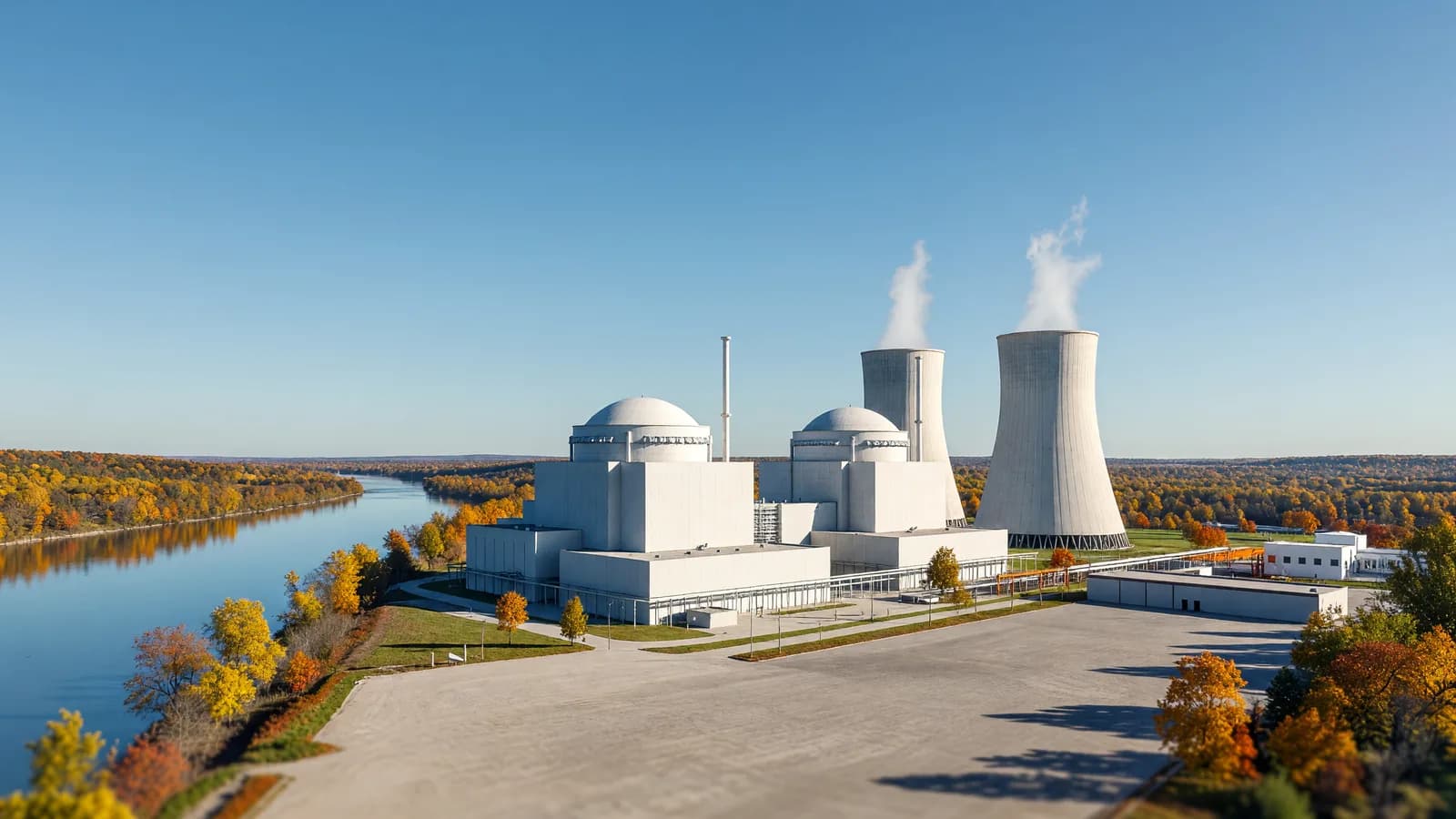
Six NNN nuclear reports published from October 5 through October 10 show a sector advancing on several different clocks: existing-plant upgrades tied to long-term power demand, early procurement for a Polish new build, and commissioning steps at Akkuyu. The week’s lead was the US Department of Energy’s conditional financing offer for Vistra’s operating plants; it is a proposed credit commitment, not money already disbursed or upgrades already completed.
Key facts
- DOE announced a conditional loan commitment of up to $4.2 billion for upgrades at Vistra’s Beaver Valley, Davis-Besse and Perry plants; proposed uprates could add 433 MW.
- Google and Constellation signed a 20-year agreement intended to add 890 MW through equipment upgrades at 11 existing reactors, with the first increase expected by 2028.
- Poland began a procurement process for six long-lead components for its first AP1000 while the final construction contract remains under negotiation.
- Akkuyu Unit 1 completed primary-circuit hydraulic tests at a reported 24.5 MPa; hot functional tests remain ahead.
- ITER received the ninth and final vacuum-vessel sector for its tokamak core, while assembly and commissioning work continue.
- India’s NPCIL and BARC released the project report for their 55-MWe SMR-55; the release is not a construction authorization.
1. DOE offers Vistra up to $4.2 billion for nuclear uprates
The US Department of Energy announced a conditional loan commitment of up to $4.2 billion for modernization and uprates at Beaver Valley in Pennsylvania and Davis-Besse and Perry in Ohio. DOE says the work could add 433 MW and preserve nearly 4 GW of existing generation. The headline amount remains conditional: Vistra must meet technical, legal, environmental and financial requirements before financing is finalized, and the announcement does not establish a construction schedule. The proposal stands out for directing federal credit toward additional output from operating reactors rather than a new-build project. Read NNN’s report on the Vistra financing offer.
2. Google and Constellation target 890 MW in uprates
Google and Constellation signed a 20-year agreement intended to support equipment and technology upgrades at 11 operating nuclear units and add 890 MW to the PJM grid. The first increase is expected by 2028, but the companies have not announced a unit-by-unit schedule or capacity breakdown. A separate 15-year supply agreement covers 2,700 MW from existing generation; that contracted supply is not an additional capacity figure. The deal links long-term electricity demand to investment in the existing fleet, with delivery still to be demonstrated. Read NNN’s coverage of the Google-Constellation agreement.
3. Poland starts long-lead procurement for its first AP1000
Polskie Elektrownie Jądrowe commissioned Westinghouse to begin procurement work for six long-lead nuclear-island components for the planned Lubiatowo-Kopalino plant. The initial process covers engineering documentation, quality plans, supplier selection and materials; it does not mean all six components are in production. Poland’s final EPC contract negotiations continue, and the project still faces regulatory and construction gates. The step is a supply-chain milestone intended to protect schedule, not a construction start. Read NNN’s report on Poland’s AP1000 procurement.
4. Akkuyu 1 completes primary-circuit hydraulic tests
Akkuyu Unit 1 completed hydraulic testing of its primary circuit at a reported peak pressure of 24.5 MPa, clearing a commissioning check before hot functional testing. The cold test checks the integrity and cleanliness of the system linking the reactor, pumps, steam generators and connecting pipes. The next hot-test campaign is expected to run the main circulation pumps at higher temperatures, but fuel loading, regulatory authorization and electricity generation remain separate future milestones. Read NNN’s Akkuyu Unit 1 commissioning update.
5. ITER receives its final vacuum-vessel sector
ITER received the ninth and final sector for its tokamak vacuum vessel at Cadarache in southern France. The component completes a major procurement sequence and puts the large sectors needed for the core machine on site, but teams still need to position and join them and install other systems. The assembled vessel is planned to be 19.4 meters across and 11.4 meters high; ITER’s research machine is designed to study fusion conditions, not to generate electricity for the grid. Read NNN’s report on ITER’s final sector delivery.
6. India releases the SMR-55 project report
India’s Nuclear Power Corporation of India Limited and Bhabha Atomic Research Centre released the detailed project report for their indigenous 55-MWe SMR-55 design. The report adds definition to one of India’s small-reactor concepts, but public information on cost, licensing plans, procurement and a project schedule remains limited. A project report is not a construction start: the next evidence would be project sanction, defined approvals and a site-specific implementation plan. Read NNN’s report on the SMR-55 project document.
What to watch next week
For the existing-fleet announcements, watch for final financing terms, plant-specific upgrade scopes and schedules that turn projected megawatts into approved work. In Poland, the key tests are the EPC contract and regulatory process alongside procurement; at Akkuyu and ITER, look for documented outcomes from the next commissioning and assembly steps. For SMR-55, publication of technical details and project approvals would clarify how far the report moves the concept toward a build.
Questions
- What was the biggest nuclear story this week?
- The US Department of Energy announced a conditional loan commitment of up to $4.2 billion for upgrades at Vistra's Beaver Valley, Davis-Besse and Perry plants. It is not a closed loan, and the proposed work remains subject to conditions.
- How many NNN reports are included in this roundup?
- Six NNN reports published from October 5 through October 10, 2026, selected for their significance across financing, plant upgrades, new-build supply chains, commissioning and fusion research.
- Are all the announced capacity additions already available?
- No. DOE's 433-MW estimate for Vistra and the 890-MW target in the Google-Constellation agreement are proposed additions tied to future plant upgrades, not capacity already delivered.
Sources
- Energy Department Announces $4.2 Billion Investment to Boost Nuclear Power — US Department of Energy
- Google and Constellation Announce Agreement to Bring 890 MW of New Nuclear Capacity to PJM Grid — Constellation Energy
- PEJ and Westinghouse Begin Long-Lead Item Procurement Process — Westinghouse Electric Company
- Hydraulic tests completed at Turkey's Akkuyu 1 — World Nuclear News
- A remarkable chapter draws to a close — ITER Organization
- NPCIL post on release of the SMR-55 Detailed Project Report — Nuclear Power Corporation of India Limited
About Nuclear News Network
Nuclear News Network (NNN) is an independent publication covering the global nuclear energy sector — reactor construction, SMRs, fuel supply, policy, operations and fusion. NNN publishes a daily brief, same-day analysis of major developments, and reference guides used across the industry. Articles are produced by the NNN Newsroom, an editorial automation system with human oversight, under the publication's editorial standards. Ruben Seoane is the founder and main editor of NNN.