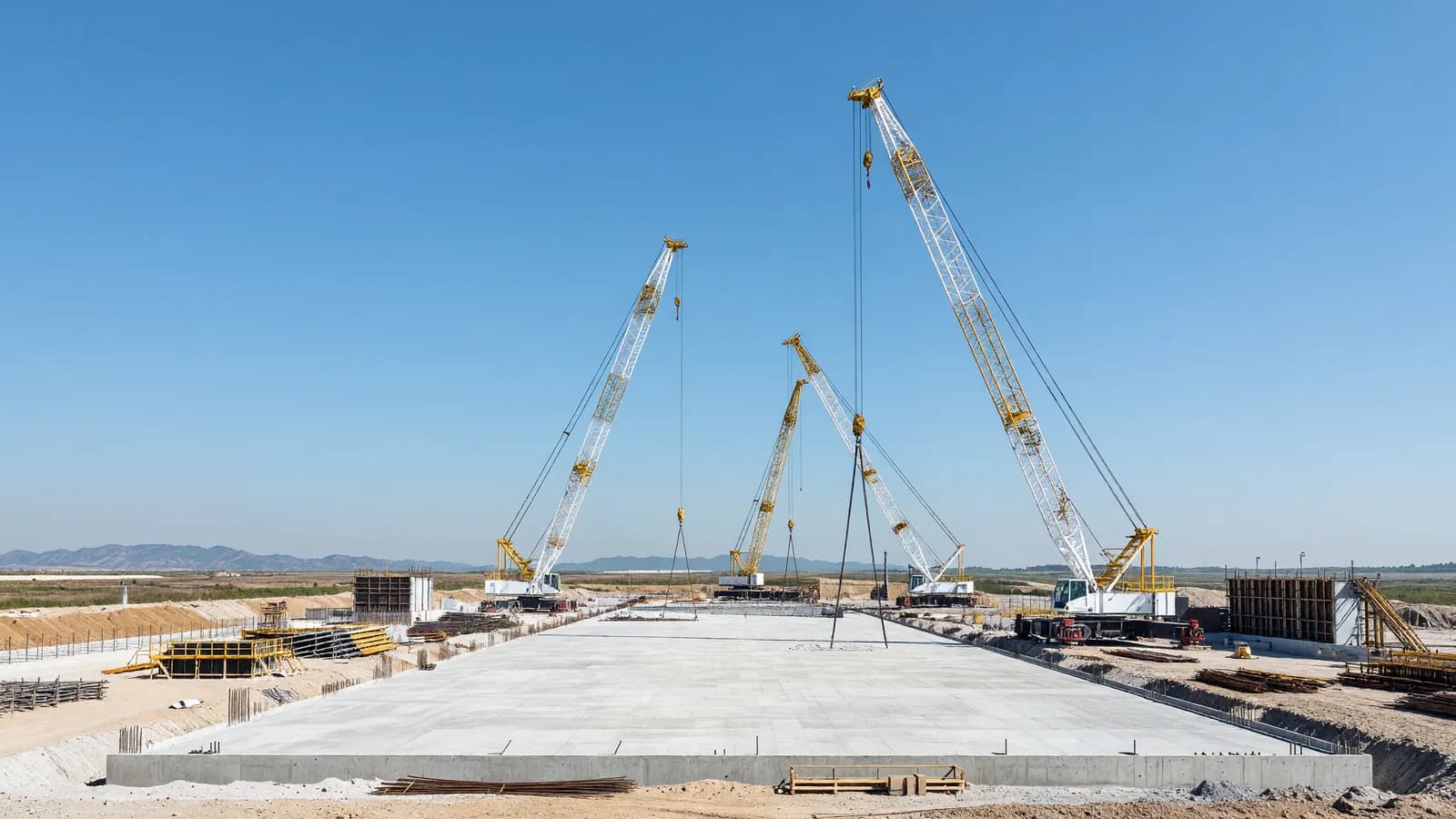
State Power Investment Corporation (SPIC) has started construction of Bailong Nuclear Power Plant Unit 2 with the first concrete pour for its nuclear island, a milestone that puts a second CAP1000 unit at the Guangxi site into active construction. The initial pour was expected to use 6,637 cubic metres of concrete, marking the start of the reactor's main civil works.
Key facts
- First nuclear-island concrete was poured at 18:27 on September 27, 2026, according to CCTV coverage carried by SPIC's Weibo channel.
- The initial pour was planned at 6,637 cubic metres over 58 hours.
- Bailong 2 is a 1,250-MW CAP1000 pressurized-water reactor, China's version of Westinghouse's AP1000.
- Bailong's six-unit plan totals 8.62 GWe; the first phase comprises two CAP1000 units.
What happened
SPIC began the nuclear-island first concrete pour at Bailong 2 at 18:27 local time on Sunday, September 27. World Nuclear News reported the milestone on Monday, citing a CCTV report circulated on SPIC's official Weibo channel. In nuclear construction, first concrete for the nuclear island marks the formal start of construction for an individual power reactor under the International Atomic Energy Agency's milestone convention.
The pour was planned to run for about 58 hours and place 6,637 cubic metres in the foundation. That is the reactor's nuclear-island base, not the conventional or turbine island. The difference matters: Bailong 2's conventional-island base was poured in August, an earlier project milestone reported separately. The September event concerns the structure that will support the reactor building and related nuclear-island facilities.
Bailong 2 is the second unit in Phase I at the SPIC project on the Jiangshan Peninsula in Fangchenggang City, in southern China's Guangxi Zhuang Autonomous Region. The project uses the CAP1000, a Chinese version of the Westinghouse AP1000 pressurized-water reactor. SPIC's first unit at the site reached its nuclear-island first-concrete milestone in December 2025, so the new pour advances the paired-unit build rather than launching an entirely new site.
Why it matters
The milestone shifts Unit 2 from preparation and excavation into the long civil-construction phase. A first pour is an identifiable start point, but it does not say when the reactor will be completed. The announced 58-hour placement concerns one concrete operation; it should not be read as a construction schedule for the plant as a whole.
The two-unit first phase is part of a larger planned site. SPIC has described Bailong as a six-unit project with 8.62 GWe of planned installed capacity. The first phase uses two 1,250-MW CAP1000 reactors, while later phases have been associated with four larger CAP1400 units. Those later units remain part of the site plan, not reactors newly brought into construction by this week's event.
That distinction is useful as China adds projects in successive approval and construction waves. NNN has reported on the State Council's approval of eight reactors across four Chinese sites. That approval was a government decision about future projects. Bailong 2's first concrete is a different kind of evidence: crews have begun placing the structural material for a specific reactor. Plans, approvals and construction starts are separate stages, and each carries a different level of commitment.
Background
Bailong sits near Fangchenggang, a coastal city in Guangxi near China's border with Vietnam. The project is planned as a six-unit station, with two CAP1000 reactors in its first phase. World Nuclear News reported the first unit's nuclear-island pour in December 2025; Unit 2's pour now brings both Phase I reactors into construction.
The CAP1000 is based on the AP1000 design developed by Westinghouse, adapted for China's domestic programme. It is part of a broader national buildout that combines repeated deployments of domestic reactor designs with projects based on technology developed through international cooperation. NNN's account of China's expansion by construction and fleet scale traces how new approvals translate into a growing pipeline. The new-builds and small modular reactors hub tracks these projects and related construction milestones.
Bailong's schedule will be shaped by more than the foundation pour. Construction has to proceed through the reactor building, equipment installation, systems testing, fuel loading and commissioning. Unit 1 provides a nearby reference point, but schedules can diverge as work progresses, and the project announcement does not specify an operating date for Unit 2.
What's next
The next visible indicators will be completion of the initial foundation pour, follow-on nuclear-island structures and installation of major equipment. SPIC has not announced a unit-specific commercial-operation date in the report of the first concrete milestone. Watch for an updated construction schedule and subsequent milestones that show whether the two-unit first phase is progressing in parallel.
For now, the clear fact is narrower: Bailong 2 has crossed into nuclear-island construction. The planned 6,637-cubic-metre pour provides a concrete measure of this step, while completion and start-up remain several construction and testing phases away.
Questions
- What happened at Bailong Unit 2?
- First concrete was poured for the nuclear island of Bailong Unit 2 at 18:27 on September 27, 2026, marking the start of construction under the IAEA milestone definition.
- How much concrete is planned for the first pour?
- The initial nuclear-island pour was expected to use 6,637 cubic metres over about 58 hours, according to World Nuclear News citing CCTV coverage carried by SPIC's Weibo channel.
- What reactor design is Bailong 2?
- Bailong 2 is a 1,250-MW CAP1000 pressurized-water reactor, China's version of the Westinghouse AP1000 design.
- How many units are planned at Bailong?
- The full Bailong site in Guangxi is planned for six units with a combined installed capacity of 8.62 GWe; the first phase covers two CAP1000 reactors.
Sources
- First concrete poured for Bailong 2 nuclear power unit — World Nuclear News
- China begins construction of two new nuclear power units — World Nuclear News
- China approves construction of eight more reactors — World Nuclear News
About Nuclear News Network
Nuclear News Network (NNN) is an independent publication covering the global nuclear energy sector — reactor construction, SMRs, fuel supply, policy, operations and fusion. NNN publishes a daily brief, same-day analysis of major developments, and reference guides used across the industry. Articles are produced by the NNN Newsroom, an editorial automation system with human oversight, under the publication's editorial standards. Ruben Seoane is the founder and main editor of NNN.