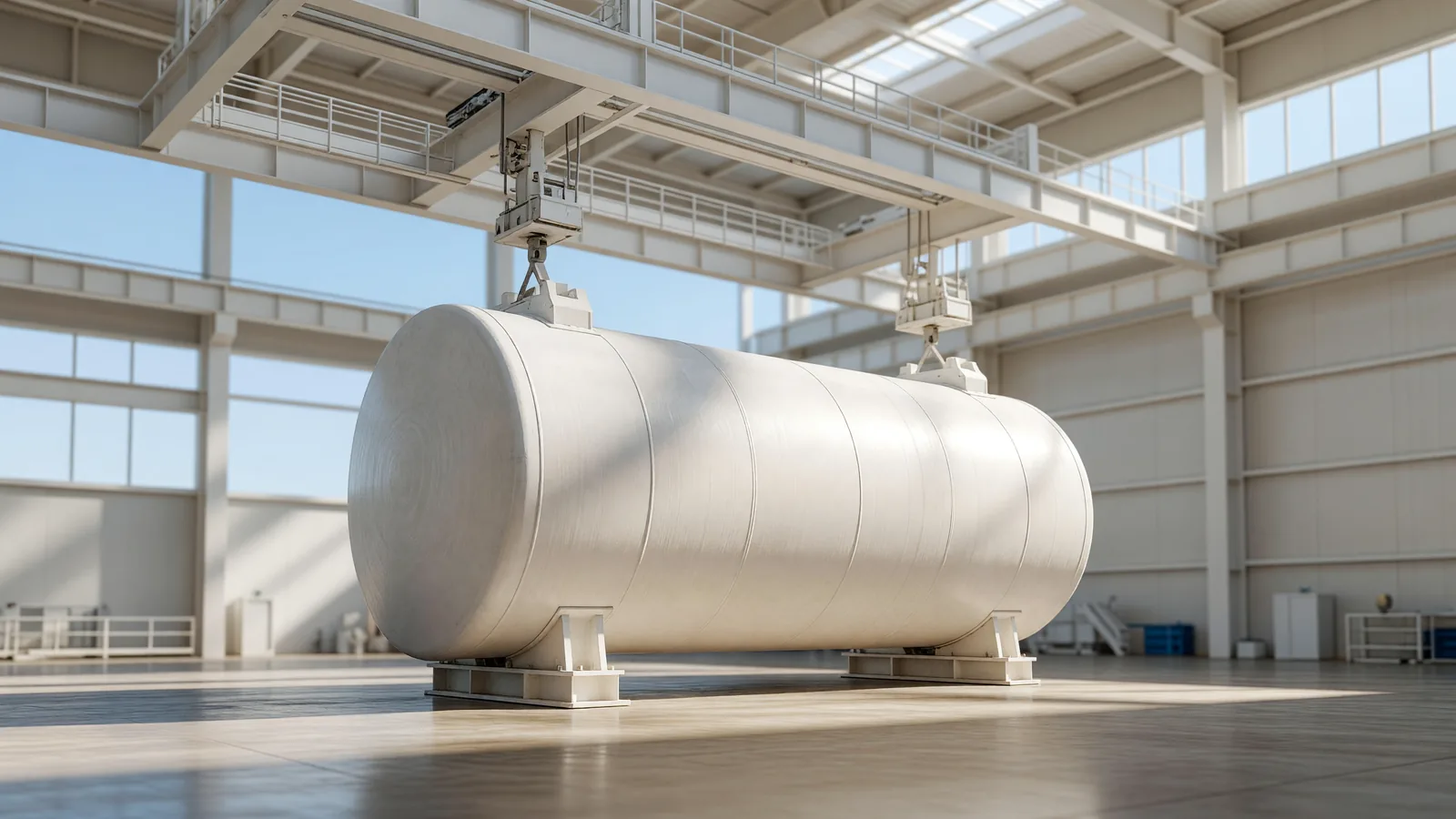
Rosatom has manufactured the second reactor unit for a floating nuclear power plant intended to supply a copper-mining cluster in Russia’s Chukotka region. The PEB-106 project is designed around two 58-megawatt-electric (MWe) RITM units; the milestone moves reactor fabrication forward, but the plant itself is still being built.
Key facts
- Rosatom’s ZiO-Podolsk plant completed the second RITM-200S reactor unit for PEB-106, according to the company’s announcement.
- The unit passed hydraulic tests and control assembly checks, which test pressure integrity and component fit, Rosatom said in its release.
- World Nuclear News reports two 58 MWe reactors, or 116 MWe combined, for the PEB-106 floating unit.
- The first reactor was manufactured in May 2026 and is at the shipyard awaiting installation, according to Rosatom.
- The Baimskaya mining development is expected to need about 300 MWe; WNN says the wider plan calls for three floating plants plus a fourth as a backup during refuelling and maintenance (WNN).
What happened
ZiO-Podolsk, part of Rosatom’s Mechanical Engineering Division, has completed the second RITM-200S reactor unit for the PEB-106 floating power unit. Rosatom says the hardware passed hydraulic tests and a control assembly check. The latter verifies that components fit together against the design drawings; neither test means the reactor has been installed in a vessel or commissioned.
The first reactor was manufactured in May and is already at the shipyard. Rosatom’s release says it will later be installed in the hull. It describes series production of PEB-106 as underway, with the plant aimed at an industrial copper-mining cluster in Chukotka. World Nuclear News uses the designation RITM-200C and gives each unit an electrical output of 58 MWe. Rosatom’s English-language statement calls the units RITM-200S. The naming difference is present in the published material; the project capacity cited by WNN is 116 MWe for the two-reactor unit.
The factory milestone is significant because a floating power project depends on more than reactor design. The reactor vessels and associated equipment must be manufactured, tested, transported, and integrated into the floating platform before the plant can move through commissioning and begin delivery of electricity. Today’s announcement concerns equipment fabrication and testing, not any of those later steps.
Rosatom says ZiO-Podolsk’s production teams made four RITM-family units in less than a year, with five more in production. The statement also says 16 RITM units have been produced, eight operating aboard nuclear icebreakers, while a further 12 are at different manufacturing stages. These totals cover the wider RITM family, not just the two units assigned to PEB-106.
Why it matters
The proposed customer is an industrial site in a remote Arctic region, not a conventional grid-connected city. World Nuclear News links the project to the Baimskaya development, which it says needs around 300 MWe. Its reported concept uses three floating units to provide that capacity and a fourth for backup during refuelling or maintenance. The two reactors whose manufacture is now complete form only one reactor pair within that broader plan.
This is the practical case Rosatom is making for floating nuclear power: locating generation near coastal industrial demand where transmission infrastructure can be difficult to build. The approach could reduce reliance on long transmission links, but it also concentrates a large industrial power supply on a specialised vessel and its supporting port and grid systems. Project execution therefore depends on shipyard integration, local infrastructure and operational planning as much as on reactor performance.
The milestone does not resolve the schedule or cost questions. Rosatom’s announcement does not provide a commissioning date, contract value, or a detailed construction timeline for the complete PEB-106 unit. Nor does completion of reactor fabrication alone establish when the mining complex will need the electricity. Those are separate milestones to watch.
The project also extends a Russian operating model beyond the existing Akademik Lomonosov floating plant. Rosatom says Akademik Lomonosov has operated in Chukotka since 2020 and generated nearly 1.4 billion kilowatt-hours over that period. That experience offers an operational reference point, though PEB-106 uses a different reactor generation and serves a different demand profile: a major industrial development rather than a town and surrounding users.
Background
RITM-200 reactors were developed for Russia’s nuclear icebreaker fleet. The design’s marine origins are central to the floating-power proposition: the reactor package is built for shipboard use, and a floating unit can be assembled at a shipyard before deployment. Rosatom identifies OKBM Afrikantov as chief designer and turnkey supplier, AEM-Spetsstal as the producer of metallurgical forgings, and ZiO-Podolsk as the site where reactor vessels are fabricated and tested.
NNN has covered other stages of Russia’s nuclear build programme, including site licences for the first two Kola units and Rosatom’s EPC agreement for Kazakhstan’s Balkhash plant. The projects are not directly comparable: Kola is a land-based plant moving through licensing, while PEB-106 is a floating power unit progressing through factory production. Both show why a headline about nuclear construction needs to be read against its actual project stage.
For broader technical context, NNN’s small modular reactor explainer outlines how SMR designs differ in size and deployment model. PEB-106’s defining feature is not simply reactor output. It is the combination of marine reactor hardware, a floating platform and a remote industrial customer.
What's next
The next visible step for the first reactor is installation in the PEB-106 hull at the shipyard, which Rosatom says is its planned destination. The company has not said in the release when the second unit will be shipped or when hull integration will be complete. Completion of the full vessel, commissioning and an operating start date remain ahead.
Readers should distinguish three separate markers: reactor manufacture, installation and testing aboard the floating unit, and delivery of electricity to the mining cluster. Rosatom has now reported the second reactor’s manufacture and factory tests. The project’s next meaningful update will need to show progress beyond the factory gate, especially hull integration and a dated construction or commissioning schedule.
Questions
- What has Rosatom completed for the Chukotka floating plant?
- Rosatom's ZiO-Podolsk plant has manufactured the second RITM-200S reactor unit for the PEB-106 floating power unit. The first was manufactured in May 2026.
- How much power will the two reactors produce?
- World Nuclear News reports the plant will have two 58 MWe RITM-200C units, for 116 MWe combined. Rosatom's English release uses the designation RITM-200S.
- Is the floating plant operating yet?
- No. The second reactor has been manufactured; the first is at the shipyard awaiting installation, and PEB-106 remains under construction.
Sources
- Rosatom Mechanical Engineering Division Delivers Key Equipment Set for New Floating Nuclear Power Plant — Rosatom Mechanical Engineering Division
- Second reactor manufactured for floating nuclear plant — World Nuclear News
About Nuclear News Network
Nuclear News Network (NNN) is an independent publication covering the global nuclear energy sector — reactor construction, SMRs, fuel supply, policy, operations and fusion. NNN publishes a daily brief, same-day analysis of major developments, and reference guides used across the industry. Articles are produced by the NNN Newsroom, an editorial automation system with human oversight, under the publication's editorial standards. Ruben Seoane is the founder and main editor of NNN.