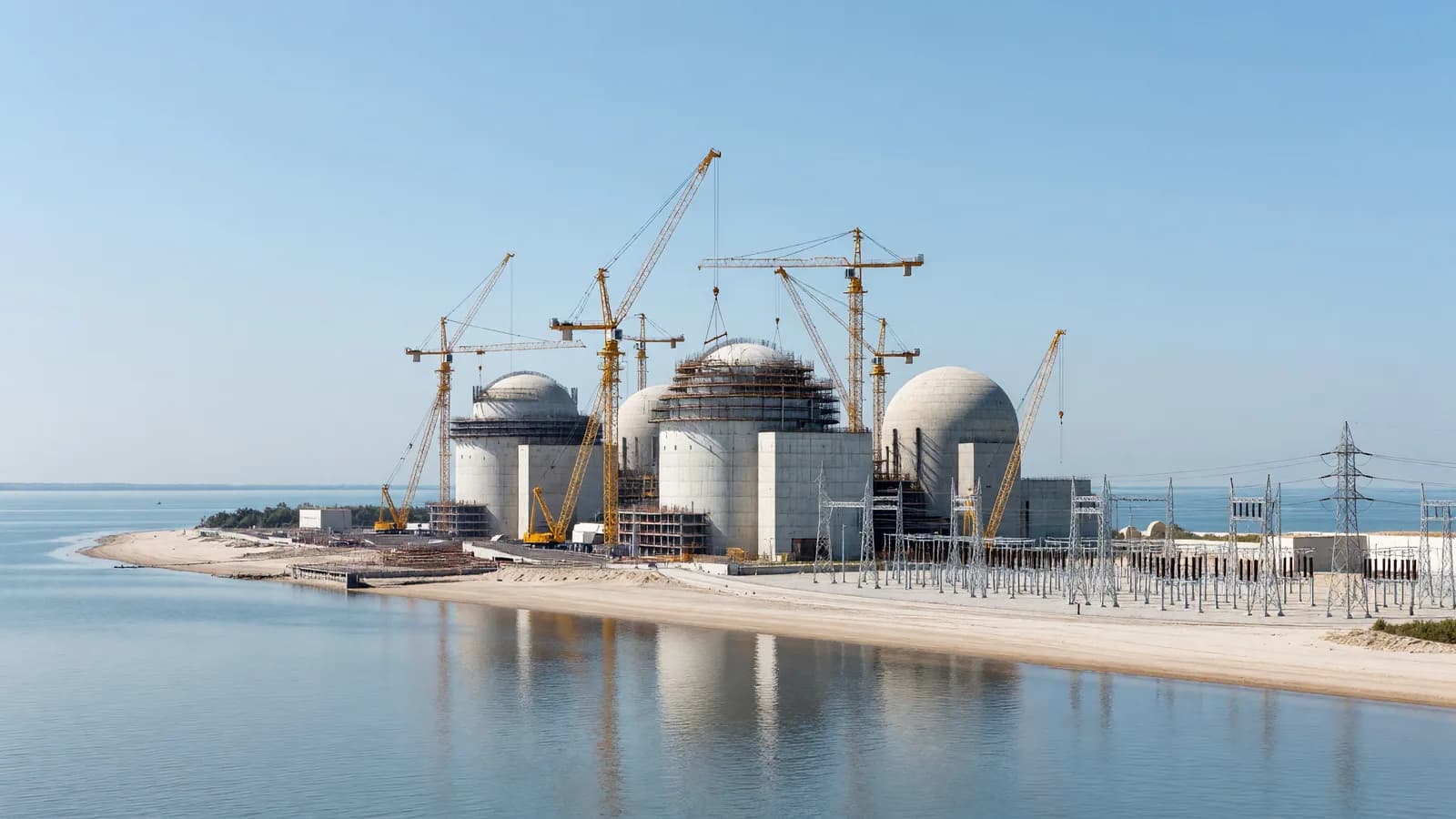
China's State Council has approved eight new reactors at four projects, adding six Hualong One units and two Guohe One units to the country's pipeline. The decision matters because it advances both a standardized domestic reactor fleet and two newer design variants in one approval package.
Key facts
- The State Council approved eight reactors across four projects at its 31 July executive meeting.
- Six units will use Hualong One: Jinqimen units 3 and 4, Taipingling units 5 and 6, and the first two Zhuanghe units.
- Jinqimen Phase II and Taipingling Phase III are Hualong One 2.0 demonstration projects.
- Laiyang Phase I includes two Guohe One reactors, the first standardized and batch-built project approved for that design.
- CNNC says 10 Hualong One units are operating domestically and internationally, with 37 more approved for construction.
What happened
The approval came during a State Council executive meeting chaired by Premier Li Qiang on 31 July. The government's official account identifies four nuclear power projects, including the first phase of the Zhuanghe project in Liaoning province, but does not list every unit. World Nuclear News, citing project-owner statements and the State Council decision, identifies the full package as Jinqimen Phase II in Zhejiang, Taipingling Phase III in Guangdong, Zhuanghe Phase I in Liaoning and Laiyang Phase I in Shandong.
The six Hualong One units are split among three sites. China National Nuclear Corporation's Jinqimen plant will get units 3 and 4. China General Nuclear's Taipingling plant will get units 5 and 6. CNNC will also lead Zhuanghe Phase I, where the first two units are planned as Hualong One reactors.
The Jinqimen and Taipingling units carry a separate designation. They have been selected as demonstration projects for Hualong One 2.0, which CNNC describes as an advanced pressurized-water-reactor technology based on operating and construction experience from the original Hualong One design. The approval therefore covers ordinary fleet expansion and a controlled move toward a revised version of China's main domestic reactor platform.
At Laiyang, State Power Investment Corporation will build two Guohe One reactors. The company describes the project as the first standardized and batch-built project approved for the design. Guohe One is an enlarged version of the CAP1000 pressurized-water reactor, itself developed from Westinghouse's AP1000. The Laiyang site is planned eventually to house six Guohe One units, but this approval covers the first phase, not the full site.
Why it matters
The decision gives China's three major state-owned nuclear groups distinct work to execute. CNNC is responsible for investment, construction and operation at Jinqimen and Zhuanghe. China General Nuclear owns the Taipingling project. State Power Investment Corporation is responsible for Laiyang. That division keeps the country's main reactor developers building their own platforms while the central government approves projects in a single national process.
The design mix is as important as the unit count. Hualong One is already moving through repeat construction, and the 10 operating units plus 37 approved units cited by CNNC show how much of the technology's learning curve will come from serial deployment. Hualong One 2.0 now gets two named demonstration sites inside that fleet rather than remaining a paper upgrade.
Guohe One follows a different path. It is larger than Hualong One and comes from the CAP1000 line, so Laiyang gives SPIC a route to prove whether the design can be built as a repeatable domestic product. The phrase "batch-built" is doing real work here. A first unit can be a bespoke engineering project; a batch is a claim about standard drawings, suppliers, construction methods and operating support.
That is the part worth watching beyond the headline. China's construction advantage has never been only the ability to authorize reactors. It depends on whether the same design can move through procurement and construction without each site becoming a new one-off. NNN has tracked that industrial model in its coverage of China's reactor-vessel installation work and the country's helium-turbine test programme. The new approval adds two design-development tracks to the same buildout.
Background
China's reactor programme has expanded through repeated approvals, domestic supply chains and several competing state-owned developers. Hualong One is the clearest example: it combines the Chinese nuclear industry's earlier CPR-1000 and ACP1000 lines and has become the country's main third-generation pressurized-water reactor for domestic and export projects.
Laiyang's Guohe One project is more unusual because it extends the CAP1000 family rather than adding another Hualong One site. That gives SPIC a chance to establish a second large domestic platform while CNNC and China General Nuclear continue to scale Hualong One. The arrangement is less tidy than a single national design, but it preserves competition among state-owned developers and keeps manufacturing demand spread across the sector.
The four projects also widen the geographic footprint of the current approval cycle: Zhejiang and Guangdong on the eastern and southern coasts, Liaoning in the northeast, and Shandong on the eastern seaboard. The World Nuclear Association's China profile tracks the country's broader operating and construction fleet; NNN's China expansion coverage explains why the pace has drawn sustained attention outside the country.
What's next
The next milestones are site preparation, the formal start of construction and the release of project-specific schedules. CNNC said preparatory work at the Jinqimen and Zhuanghe sites was proceeding. For Laiyang, the meaningful test will be whether SPIC turns the batch-built claim into a repeatable construction programme rather than a single first-of-a-kind project.
The State Council also reiterated that the units must meet the highest global safety standards, with responsibility assigned across the supply chain and stronger supervision in every sector. Watch for those safety and quality requirements to appear in the licensing and construction record as these eight reactors move from approval into physical work.
Questions
- How many reactors did China approve?
- China approved eight new reactors across four projects: Jinqimen Phase II, Taipingling Phase III, Zhuanghe Phase I and Laiyang Phase I.
- Which reactor designs will the projects use?
- Six units will use Hualong One, including Hualong One 2.0 demonstration units at Jinqimen and Taipingling. Two Laiyang units will use the larger Guohe One design.
- What is new about the Laiyang project?
- State Power Investment Corporation says the two Laiyang units are the first standardized and batch-built project approved for Guohe One, a larger reactor derived from the CAP1000 design.
- Who will build the reactors?
- China National Nuclear Corporation owns the Jinqimen and Zhuanghe projects, China General Nuclear owns the Taipingling project, and State Power Investment Corporation owns Laiyang.
Sources
- China approves construction of eight more reactors — World Nuclear News
- Chinese premier chairs State Council executive meeting — State Council Information Office of China
About Nuclear News Network
Nuclear News Network (NNN) is an independent publication covering the global nuclear energy sector — reactor construction, SMRs, fuel supply, policy, operations and fusion. NNN publishes a daily brief, same-day analysis of major developments, and reference guides used across the industry. Articles are produced by the NNN Newsroom, an editorial automation system with human oversight, under the publication's editorial standards. Ruben Seoane is the founder and main editor of NNN.