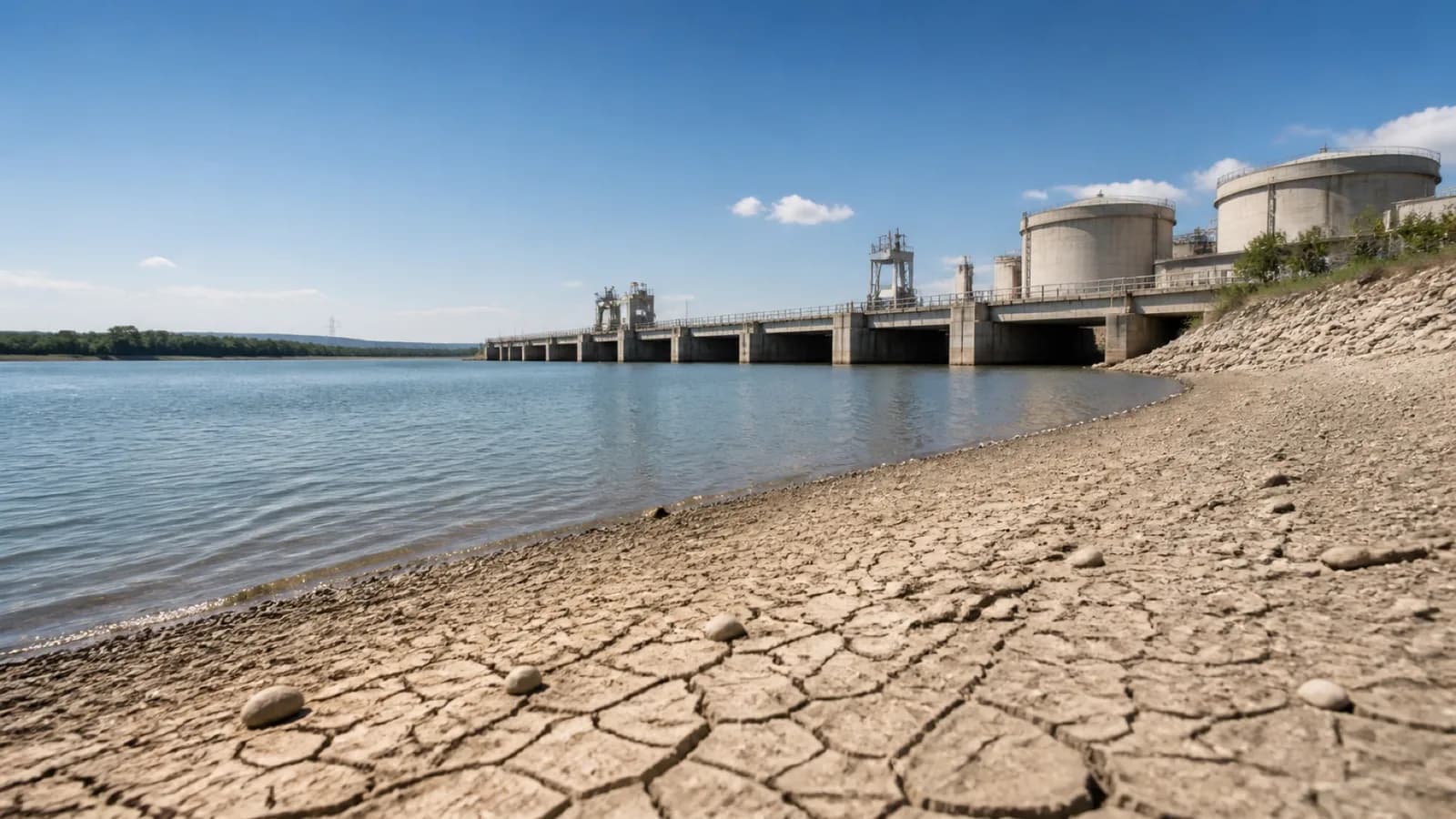
Romania began shutting down the second reactor at the Cernavoda Nuclear Power Plant on 13 August after the Danube fell below the plant's 185-centimetre operating threshold. Both reactors are now in safe shutdown, turning a drought-driven cooling constraint into a national power-supply problem rather than a nuclear accident.
Key facts
- Nuclearelectrica began the controlled shutdown of Unit 2 on the morning of 13 August 2026.
- The Danube had fallen to 182 centimetres on 12 August, below the 185-centimetre operating mark.
- Cernavoda has two CANDU reactors rated at 650 MWe each, producing about one-fifth of Romania's electricity.
- The Ministry of Energy said Unit 2's shutdown and disconnection were completed at 10:53 a.m. on 13 August.
- Hungary's planned Paks water measures are estimated at HUF6 billion, or about USD10 million.
What happened
Societatea Nationala Nuclearelectrica SA, Romania's nuclear operator, said in a 13 August filing to the Bucharest Stock Exchange that it had started the manoeuvres to shut down Cernavoda Unit 2. The company tied the decision to the continuing fall in the Danube and said operators were following procedures for the situation while monitoring safety margins, equipment and hydrology forecasts.
Unit 1 had already been disconnected from Romania's grid on 28 July because of the river's unprecedentedly low level. The operator and the Ministry of Energy tried to buy time by removing a rock obstruction, dredging the riverbed and sinking four barges filled with rock. The work raised water levels near Unit 2 by about 4 centimetres, but the improvement did not last as the drought continued.
Nuclearelectrica said the two units would remain in a safe shutdown state and that the condition had no impact on nuclear safety parameters, personnel, the environment or the public. That is the essential distinction in this story: the reactors were taken offline because the cooling-water margin was shrinking, not because the operator reported damage to the reactor systems or a radiological release.
Romania's Energy Ministry said the national energy system remained stable after the second unit was disconnected. It pointed to domestic generation, imports, hydropower, wind generation and reserve capacity as the sources available to cover the temporary loss of Cernavoda's output.
Why it matters
Cernavoda is Romania's only nuclear power station. Its two CANDU 6 units normally provide roughly one-fifth of the country's electricity, so losing both at the same time is a meaningful grid event even if the shutdown itself is orderly. The near-term question is whether other generators and imports can cover demand during a period when drought is also constraining parts of the wider European power system.
The episode also makes a less comfortable point about nuclear reliability. A reactor can be ready to run, its safety systems can be available, and its fuel can be in the core, yet the plant may still have to stop if the supporting water system loses operating margin. NNN's operations and safety coverage tracks that practical side of plant performance. At Gravelines, jellyfish blocked seawater cooling pumps; at Zaporizhzhia, operators have had to protect cooling systems against repeated off-site power losses. The triggers differ, but the operating lesson is similar: supporting infrastructure can decide whether a reactor produces electricity.
Background
Cernavoda's reactors use the Danube system for cooling. The plant's operating threshold is not a measure of reactor safety by itself. It is an operating condition for reliably drawing and managing the cooling water needed by the station. Once the river fell below that mark, keeping the unit online would have meant accepting less margin while forecasts pointed to further declines.
The Romanian response was unusual in its speed and physicality. Authorities tried to alter local flow conditions rather than wait for the river to recover. The rock obstruction was removed, the channel was dredged and rock-filled barges were sunk. Those measures were temporary. They could raise water locally, but they could not reverse the underlying drought across the Danube basin.
Hungary is facing the same river problem at Paks, its four-unit nuclear plant. World Nuclear News reported that Units 1, 3 and 4 had been shut down during the low-water episode while Unit 2 returned to nominal power after operating at 50% capacity for 11 days. Budapest's response has been to prepare a more durable intervention in the riverbed rather than rely only on day-to-day operating adjustments.
What's next
Nuclearelectrica said specialists would decide when to reconnect the units based on the Danube forecast and the plant's safety margins. The company did not give a restart date. The immediate watchpoints are the river level at the cooling-water intake, the next INHGA hydrology forecasts and whether the temporary measures can keep local water levels above the operating threshold.
At Paks, the Hungarian government said construction of a bottom sill would begin with 35,000 cubic metres of stone, followed by 110,000 cubic metres. Two 80-metre barges were being held as a short-term option that could raise the local water level by up to 20 centimetres. Those interventions will be watched well beyond this week's outage because they test how river-dependent nuclear plants can preserve cooling margin during prolonged drought.
Questions
- Why did Romania shut down both Cernavoda reactors?
- Nuclearelectrica said the Danube's water level continued to fall. The river supplies cooling water, and the plant's operators shut down Unit 2 after Unit 1 had already been taken offline.
- Was the Cernavoda shutdown a nuclear safety accident?
- No. Nuclearelectrica said both units were being kept in a safe shutdown state under procedures for the situation, with no impact on nuclear safety parameters, personnel, the environment or the public.
- What is Hungary doing at Paks?
- Hungary plans a riverbed sill and has placed two 80-metre barges on standby. The government said the measures are intended to keep cooling water available if the Danube falls again.
- How much nuclear capacity is at Cernavoda?
- Cernavoda has two CANDU reactors rated at 650 MWe each, according to World Nuclear News, and normally supplies about one-fifth of Romania's electricity.
Sources
About Nuclear News Network
Nuclear News Network (NNN) is an independent publication covering the global nuclear energy sector — reactor construction, SMRs, fuel supply, policy, operations and fusion. NNN publishes a daily brief, same-day analysis of major developments, and reference guides used across the industry. Articles are produced by the NNN Newsroom, an editorial automation system with human oversight, under the publication's editorial standards. Ruben Seoane is the founder and main editor of NNN.