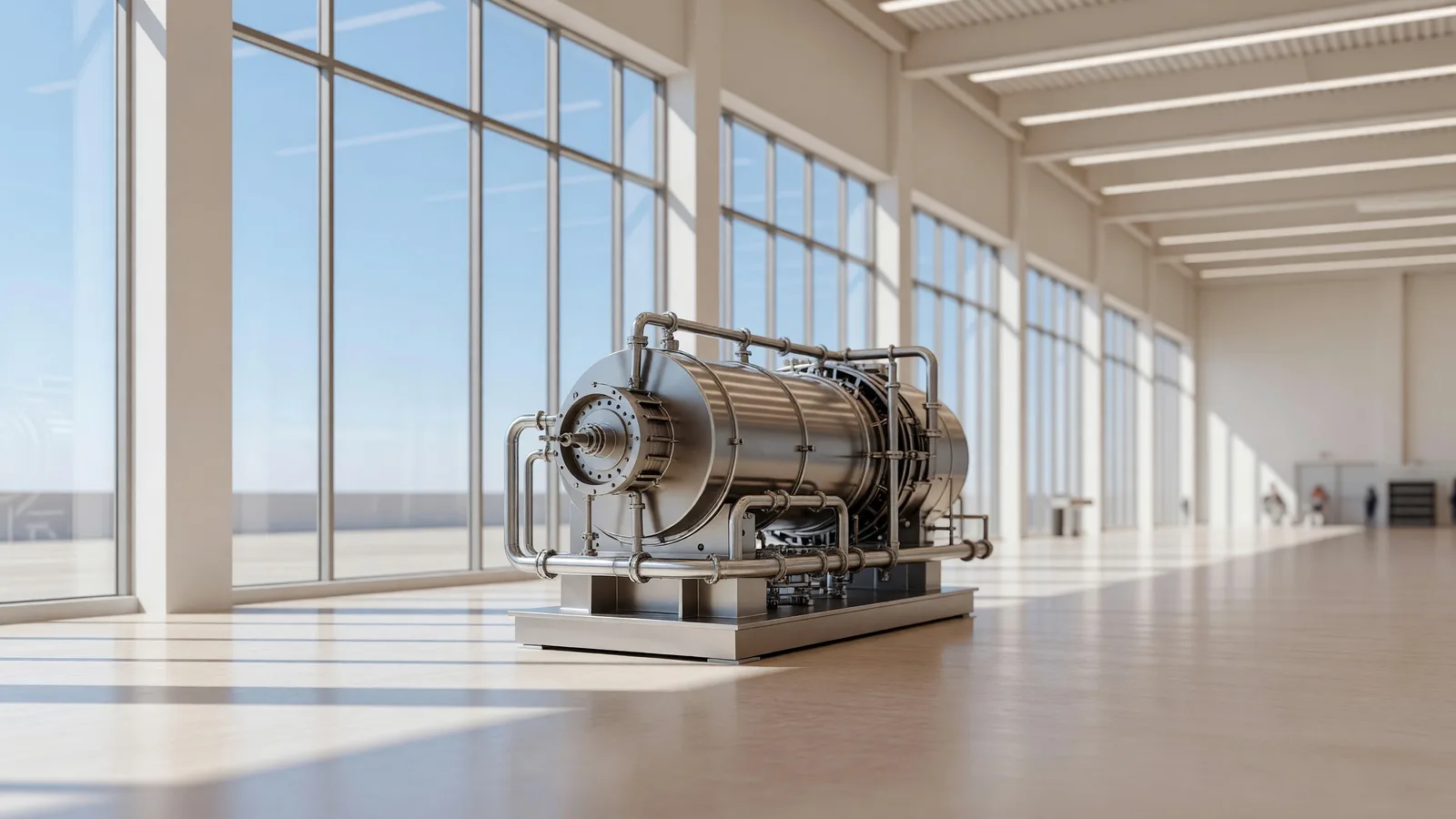
China has completed the first hot power-generation test of a megawatt-class helium turbine, a machine that could give high-temperature gas-cooled reactors a higher-efficiency way to turn heat into electricity. The test bench, built by China National Nuclear Corporation subsidiary CNNC Huaxing, is China's first at this scale.
Key facts
- CNNC Huaxing completed the hot power-generation test of China's first megawatt-class helium turbine facility.
- The rig is a closed-loop Brayton-cycle heat-to-work system using helium as the working medium.
- CNNC called it a step "from theoretical verification to engineering demonstration" for gas-cooled microreactor core power equipment.
- China's HTR-PM demonstration reactor at Shidao Bay entered commercial operation in December 2023.
- HTR-PM uses two pebble-bed reactors driving a single 210 MWe steam turbine.
What happened
According to World Nuclear News, CNNC Huaxing's helium turbine comprehensive performance test bench passed its hot power-generation test — the stage where the rig actually produces electricity under temperature, not just spins cold. The system is a closed-loop Brayton-cycle machine: it compresses helium, adds heat, expands the hot gas through a turbine to extract work, then rejects heat and recirculates the same helium.
CNNC framed the milestone as moving "from theoretical verification to engineering demonstration" in core power equipment for gas-cooled microreactors, crediting the project team with completing installation of the entire test-bench system and carrying it through cold, hot, and power-generation testing.
The distinction that matters is direct versus indirect power conversion. Today's gas-cooled reactors, including China's operating HTR-PM, transfer reactor heat to water and drive a conventional steam turbine. A helium Brayton turbine instead lets the reactor's hot gas do the work directly, cutting a conversion step.
Why it matters
High-temperature gas-cooled reactors are prized because they run hot — hot enough to open efficiency and process-heat options that water-cooled reactors cannot reach. But most HTGR designs, including the pebble-bed line China has commercialised, still bolt on a steam cycle. That leaves efficiency on the table.
A working megawatt-class helium turbine is the piece that would let a gas-cooled reactor use a direct Brayton cycle, which at high turbine-inlet temperatures can convert heat to electricity more efficiently than steam. For the microreactor market NNN tracks in its SMR explainer and DOME microreactor test-bed coverage, compact direct-cycle machines are attractive because they shrink the balance of plant — no large steam generators, condensers, or water circuit.
Efficiency is the whole point. A steam (Rankine) cycle bolted onto a high-temperature reactor typically converts heat to electricity in the low-40% range; a direct helium Brayton cycle running at high turbine-inlet temperature can, in principle, do better while dispensing with the water circuit entirely. That combination — higher efficiency plus a simpler, drier balance of plant — is what makes gas-cooled microreactors attractive for remote sites, industrial heat, and places where water is scarce. It is also why helium turbomachinery has been a decades-long research target in the US, Japan, and Europe, and why a working megawatt-class rig is a genuine milestone rather than a lab curiosity.
It is also a competitive signal. China already has the world's only commercially operating HTGR; pairing that reactor experience with domestic helium-turbine hardware would deepen a lead in a reactor class the US, Japan, and others are also chasing.
Background
China's HTR-PM at Shidao Bay (Shidaowan) reached commercial operation in December 2023, using two small pebble-bed reactors feeding a single 210 MWe steam turbine — the first modular HTGR of its kind to run commercially. That plant proved the reactor side of high-temperature pebble-bed technology at demonstration scale. The power-conversion side has lagged: steam remains the default because helium turbomachinery at reactor-relevant scale is hard, with demanding seals, bearings, and materials in a high-temperature helium environment.
CNNC's test bench is aimed squarely at that gap. A comprehensive performance rig lets engineers characterise the turbine, compressor, recuperator, and controls of a closed helium loop before committing the design to a reactor. Hot power generation is a meaningful checkpoint: it shows the loop can make electricity, not merely circulate gas.
What's next
Watch for CNNC to report performance numbers — efficiency, turbine-inlet temperature, and endurance — that would show how close the helium turbine is to reactor-grade duty. The strategic question is whether a future Chinese HTGR or gas-cooled microreactor is designed around a direct helium Brayton loop rather than a steam cycle. If the test-bench results hold up, direct-cycle gas-cooled power conversion moves from textbook advantage toward a buildable option.
Questions
- What did CNNC test?
- China National Nuclear Corporation subsidiary CNNC Huaxing completed the hot power-generation test of China's first megawatt-class helium turbine — a closed-loop Brayton-cycle heat-to-work system using helium as the working medium.
- Why is a helium turbine significant for reactors?
- High-temperature gas-cooled reactors run hot enough to drive a direct helium (Brayton) turbine, which promises higher thermal efficiency than the steam (Rankine) cycle that today's HTR-PM plant uses.
- What is the Brayton cycle?
- A thermodynamic cycle behind gas-turbine and jet engines: isentropic compression, constant-pressure heat addition, isentropic expansion, and constant-pressure heat rejection. Here helium is the working fluid in a closed loop.
- How does this connect to China's HTGR programme?
- China's HTR-PM demonstration reactor at Shidao Bay entered commercial operation in December 2023, using two pebble-bed reactors driving a single 210 MWe steam turbine. A direct helium turbine is the next-generation power-conversion path.
Sources
- Chinese helium turbine test facility completes hot testing — World Nuclear News
- SMRs explained — Nuclear News Network
About Nuclear News Network
Nuclear News Network (NNN) is an independent publication covering the global nuclear energy sector — reactor construction, SMRs, fuel supply, policy, operations and fusion. NNN publishes a daily brief, same-day analysis of major developments, and reference guides used across the industry. Articles are produced by the NNN Newsroom, an editorial automation system with human oversight, under the publication's editorial standards. Ruben Seoane is the founder and main editor of NNN.