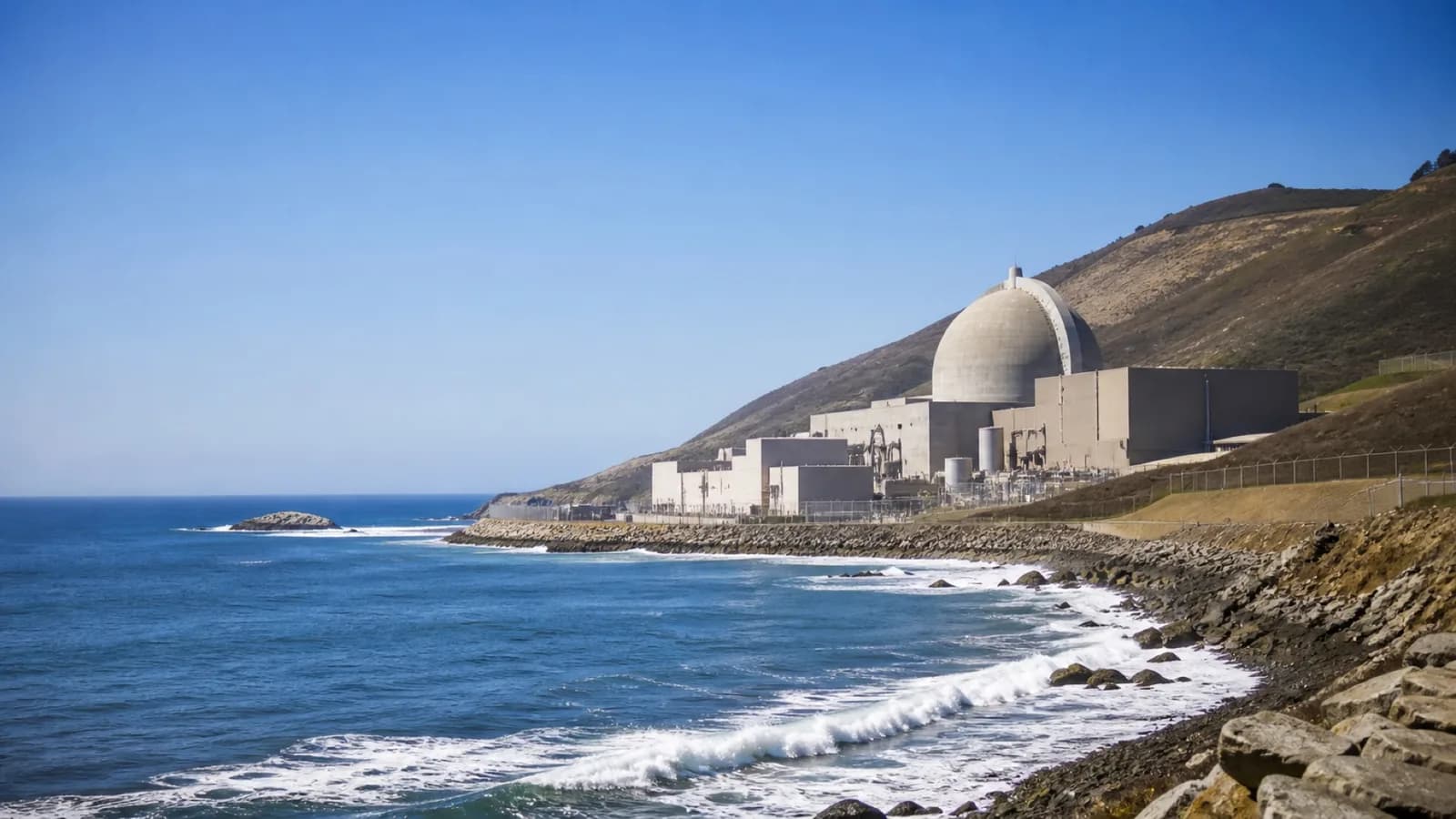
Pacific Gas and Electric has received a $271 million federal payment to support continued operation of Diablo Canyon Unit 1. The Department of Energy’s first Civil Nuclear Credit disbursement is a concrete test of the program’s promise: use federal money to keep an existing reactor producing instead of closing it before its useful life ends.
Key facts
- DOE issued an initial $271 million to PG&E on August 14, 2026.
- The payment supports continued operation of Diablo Canyon Unit 1.
- The broader CNC programme was established as a $6 billion federal investment.
- Diablo Canyon’s two reactors produce a combined 18,000 gigawatt-hours per year, about 9% of California’s annual generation.
- NRC license extensions allow Unit 1 to operate to 2044 and Unit 2 to 2045.
What happened
The payment is the first disbursement under Award Cycle 1 of DOE’s Civil Nuclear Credit (CNC) Program. DOE says the money can support activities including reactor component replacements, equipment upgrades and fuel procurement. In other words, the programme is not a general operating subsidy with no defined purpose; it is intended to help cover the costs of keeping an eligible reactor online.
The initial payment is for Unit 1. DOE says Unit 2 will become eligible for a CNC payment after the completion of the 2025 award-year audit. That distinction is important: the $271 million announced this week is not a $271 million payment to each reactor and is not the full value of PG&E’s potential award.
PG&E is eligible to receive as much as $1.1 billion in DOE funding to support continued Diablo Canyon operations, according to ANS. The disbursement is therefore a partial payment within a wider award structure.
Diablo Canyon’s federal support follows a separate regulatory milestone. In April, the NRC approved 20-year license extensions for the two Westinghouse pressurized-water reactors. ANS reported that Unit 1 can operate until 2044 and Unit 2 until 2045 under those approvals.
Why it matters
The payment makes nuclear retention policy visible in cash terms. Governments often announce that existing reactors are valuable for reliability, emissions reduction and energy security. The CNC programme shows what it costs to translate that view into a financial mechanism: a federal award, an eligible plant, an audit process and a payment tied to continued operations.
Diablo Canyon is particularly significant because it supplies a large block of California’s electricity from one site. The two reactors generate 18,000 GWh a year, about 9% of California’s power. Keeping that generation available does not remove every challenge facing the state’s grid, but closing it would remove a large source of firm output that can run regardless of weather.
NNN’s DOE nuclear funding explainer places the CNC programme alongside loans, advanced-reactor demonstrations and fuel-supply contracts. The policy logic is different here. A loan helps build or restart an asset; a credit helps preserve an operating reactor that might otherwise be uneconomic or politically scheduled for closure.
That difference matters as nuclear policy moves from one-off rescue announcements to a broader portfolio. Existing plants need capital for replacement components, fuel and upgrades. New plants need construction financing and supply-chain contracts. A programme that works for one category cannot automatically solve the other.
Background
Diablo Canyon Units 1 and 2 entered commercial operation in 1985 and 1986. They had been scheduled for decommissioning in 2024 and 2025, but California legislation and regulatory decisions extended the operating path. The state’s 2022 legislation allowed the plant to operate until at least 2029 and 2030, and the California Public Utilities Commission voted in December 2023 to extend the life by another five years, according to ANS.
The NRC’s 20-year license extensions are a separate federal safety and licensing decision from the CNC payment. A license extension says the reactors may continue operating under NRC oversight if the license conditions are met. The credit addresses the financial conditions around that operation. Both are needed for the policy to have practical effect.
The CNC programme was created in 2022 with a stated $6 billion strategic investment to help preserve the existing US reactor fleet. Its relevance has been debated as private investment in existing and new nuclear assets has grown. The Diablo Canyon disbursement provides the clearest real-world example yet of how the programme works.
There is also a state-level clock. ANS reported that continued operation beyond the current California extensions would require additional state legislation. Federal money can support operations, but it cannot by itself rewrite the state’s future shutdown policy.
What’s next
The immediate next step is the audit that will determine Unit 2’s eligibility for a CNC payment. For Unit 1, watch how PG&E applies the funds to equipment, fuel and other extended-operation costs.
The wider question is whether the first payment becomes a model for other operating reactors or remains a one-off. That will depend on plant economics, state policy, federal appropriations and the value policymakers place on firm generation. Diablo Canyon has received the first cheque; the programme’s lasting significance will be measured by what happens after it.
Questions
- How much did Diablo Canyon receive?
- Pacific Gas and Electric received an initial $271 million Department of Energy payment under Award Cycle 1 of the Civil Nuclear Credit program for continued operation of Unit 1.
- What can the Civil Nuclear Credit support?
- DOE says the payment can support reactor component replacements, equipment upgrades, fuel procurement and other costs associated with extended operation.
- Will Diablo Canyon Unit 2 receive a payment?
- DOE said Unit 2 will become eligible for a Civil Nuclear Credit payment after completion of the 2025 award-year audit.
Sources
- Civil Nuclear Credit Award Cycle 1 — US Department of Energy
- Diablo Canyon receives partial Civil Nuclear Credit payment — ANS Nuclear Newswire
- Civil Nuclear Credit Program — US Department of Energy
About Nuclear News Network
Nuclear News Network (NNN) is an independent publication covering the global nuclear energy sector — reactor construction, SMRs, fuel supply, policy, operations and fusion. NNN publishes a daily brief, same-day analysis of major developments, and reference guides used across the industry. Articles are produced by the NNN Newsroom, an editorial automation system with human oversight, under the publication's editorial standards. Ruben Seoane is the founder and main editor of NNN.