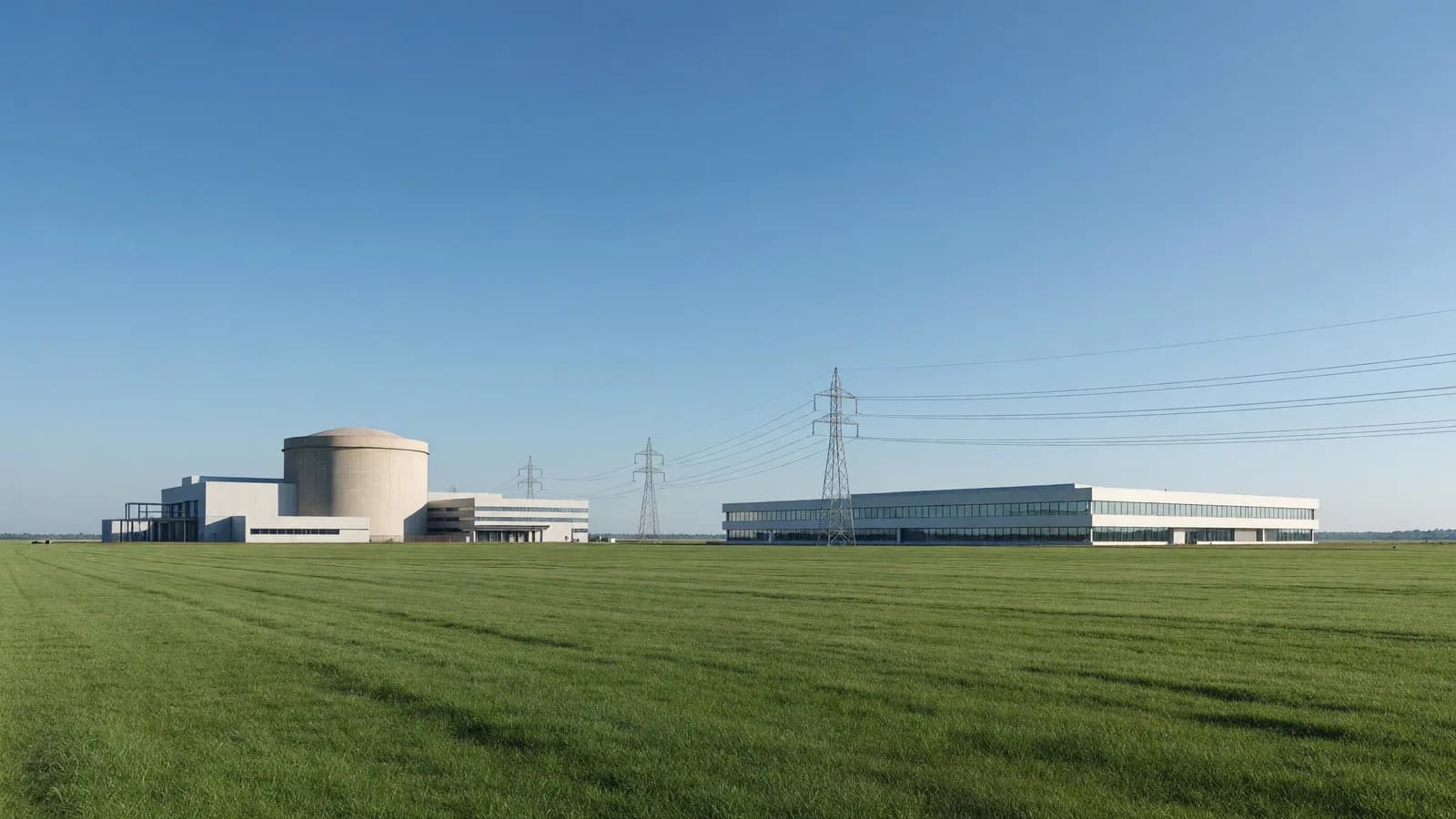
The US Department of Energy has put artificial intelligence at the center of its nuclear build-out strategy, awarding $60 million over three years to Prometheus, an Idaho National Laboratory-led project that will use AI to design, license, manufacture, construct and operate reactors — the largest of the Genesis Mission's first 278 awards.
Key facts
- Prometheus received a $60 million Phase II award over three years, subject to appropriations — the largest single grant in the Genesis Mission's first cohort.
- Industry partners have raised more than $200 million in cost share, over three times the federal award, including a $30 million industry capital commitment.
- The project spans 32 organizations: Idaho National Laboratory with Oak Ridge, Argonne and Sandia national laboratories, Nvidia, Amazon Web Services, and more than 20 industry partners including X-energy, TerraPower, Oklo, Westinghouse and GE Vernova.
- X-energy joined as a Tier 1 partner with a $10 million private capital commitment and is contributing proprietary Xe-100 reactor design and TRISO-X fuel fabrication data.
- The award came as the White House announced more than $5 billion in federal commitments behind the Genesis Mission's first 278 projects, spanning more than 15 agencies.
What happened
The Department of Energy announced the award on July 22 at the Genesis Mission Summit in Washington, D.C., selecting Prometheus as the mission's first Phase II award. The project's scope is unusually broad: applying AI, with human oversight, across the entire reactor lifecycle — design, licensing, manufacturing, construction and operations — plus AI-assisted nuclear fuel fabrication and the machine-reading of decades of legacy licensing and engineering documents.
"America's nuclear future depends on moving with greater urgency and driving down costs," Idaho National Laboratory director John Wagner said in the announcement.
The scale of the award stands out against the program's own funding rules. The Genesis Mission's 2026 solicitation set Phase II awards at $6 million to $15 million per team under a $293 million request for applications; Prometheus, at $60 million, is a flagship-scale exception. Idaho National Laboratory also picked up Phase I funding for GeoFinder, an AI critical-minerals discovery project with Boise State, Mississippi State and Idaho State universities.
On the industry side, X-energy disclosed a board seat and its $10 million commitment, and framed the project around its Xe-100 small modular reactor and TRISO-X fuel line. "We stand at the edge of one of humanity's great technical evolutions, and its infrastructure build-out has already begun," X-energy chief executive J. Clay Sell said. Nvidia and Amazon Web Services are supplying the compute and cloud layer, according to Data Center Dynamics.
The announcement traveled fast on X. Idaho National Laboratory's own post led with the $60 million figure, and nuclear-sector commentators framed Prometheus as the mission's biggest check — with the open question, as one widely shared post put it, being which chokepoint AI breaks first: design, licensing or construction. Investor accounts tied the award to nuclear's role in powering AI data centers, completing a loop the industry has been narrating all year.
Why it matters
The US has a construction problem, not an enthusiasm problem. As NNN's tracker-based census of US new builds shows, the pipeline of announced projects vastly exceeds the number of reactors physically under construction, and the binding constraints are engineering hours, licensing timelines and first-of-a-kind construction risk. Prometheus is the federal government's most direct attempt yet to attack those constraints with software rather than subsidy: the bet is that AI can compress the document-heavy middle of the nuclear lifecycle — safety analysis, licensing submittals, quality documentation — where costs and delays actually accumulate.
The cost-share number is the tell. More than $200 million raised by industry against a $60 million federal award means developers like X-energy, TerraPower and Oklo — all of which NNN tracks in active build or pre-build phases, from Kemmerer's excavation start onward — see commercial value in a shared AI toolchain, not just grant revenue.
Background
The Genesis Mission was created by executive order in November 2025 as a national AI-for-science initiative, with the Department of Energy's national laboratories as its backbone and an "American Science and Security Platform" linking researchers to shared data, compute and models. The July 22 cohort — 278 projects backed by more than $5 billion in federal commitments — is its first concrete funding round, with 87 projects led by DOE and NNSA laboratories and 168 by universities, according to Data Center Dynamics.
Idaho National Laboratory has spent two years positioning itself as the place where advanced reactor hardware gets proven, most visibly with the DOME microreactor test bed, and the deeper explainer context lives in NNN's small modular reactor hub. Prometheus adds the software layer: Oak Ridge, Argonne and Sandia national laboratories each bring modeling, simulation and safeguards capabilities, and the lab directors' stated goal is a unified development pipeline that lowers barriers for every developer rather than one vendor's stack.
What's next
The three-year clock starts now, with funding subject to annual appropriations — the first real test of whether Genesis Mission money survives budget cycles. Watch for three markers: which AI tools Prometheus ships first (licensing-document automation is the most likely early win), whether the US Nuclear Regulatory Commission formally engages with AI-prepared submittals, and whether the $200 million-plus industry cost share converts into named deliverables from X-energy, TerraPower and Oklo. NNN will fold Prometheus milestones into its US new-build tracker coverage as they land.
Questions
- What is Project Prometheus?
- A $60 million, three-year US Department of Energy project led by Idaho National Laboratory that applies artificial intelligence, with human oversight, to designing, licensing, manufacturing, constructing and operating nuclear reactors, plus fuel fabrication and legacy document management.
- What is the Genesis Mission?
- A US national AI-for-science initiative launched by executive order in November 2025. On July 22, 2026 it announced its first cohort: 278 projects backed by more than $5 billion in federal commitments across 15-plus agencies, with shared data and compute infrastructure.
- Who is involved in Prometheus?
- Idaho National Laboratory leads, with Oak Ridge, Argonne and Sandia national laboratories, Nvidia, Amazon Web Services, and more than 20 nuclear companies including X-energy, TerraPower, Oklo, Westinghouse and GE Vernova — 32 organizations in total.
- Will AI actually license a reactor?
- Not on its own. The project's stated model is AI with human oversight: machine tools drafting, checking and managing engineering and licensing work while engineers and regulators keep decision authority. The NRC's review process itself is unchanged by this award.
Sources
- Genesis Mission funds AI innovation to speed up safe, affordable nuclear energy — Idaho National Laboratory
- Trump Administration Announces More Than $5 Billion for the Genesis Mission, a National Mission on AI for Science — The White House
- Energy Department Announces $293 Million in Funding to Support Genesis Mission National Science Challenges — US Department of Energy
- X-energy Joins Project Prometheus for AI-Accelerated Advanced Nuclear Deployment — X-energy
- Idaho National Laboratory, Nvidia, AWS, X-energy launch Prometheus project under Genesis Mission — Data Center Dynamics
About Nuclear News Network
Nuclear News Network (NNN) is an independent publication covering the global nuclear energy sector — reactor construction, SMRs, fuel supply, policy, operations and fusion. NNN publishes a daily brief, same-day analysis of major developments, and reference guides used across the industry. Articles are produced by the NNN Newsroom, an editorial automation system with human oversight, under the publication's editorial standards. Ruben Seoane is the founder and main editor of NNN.