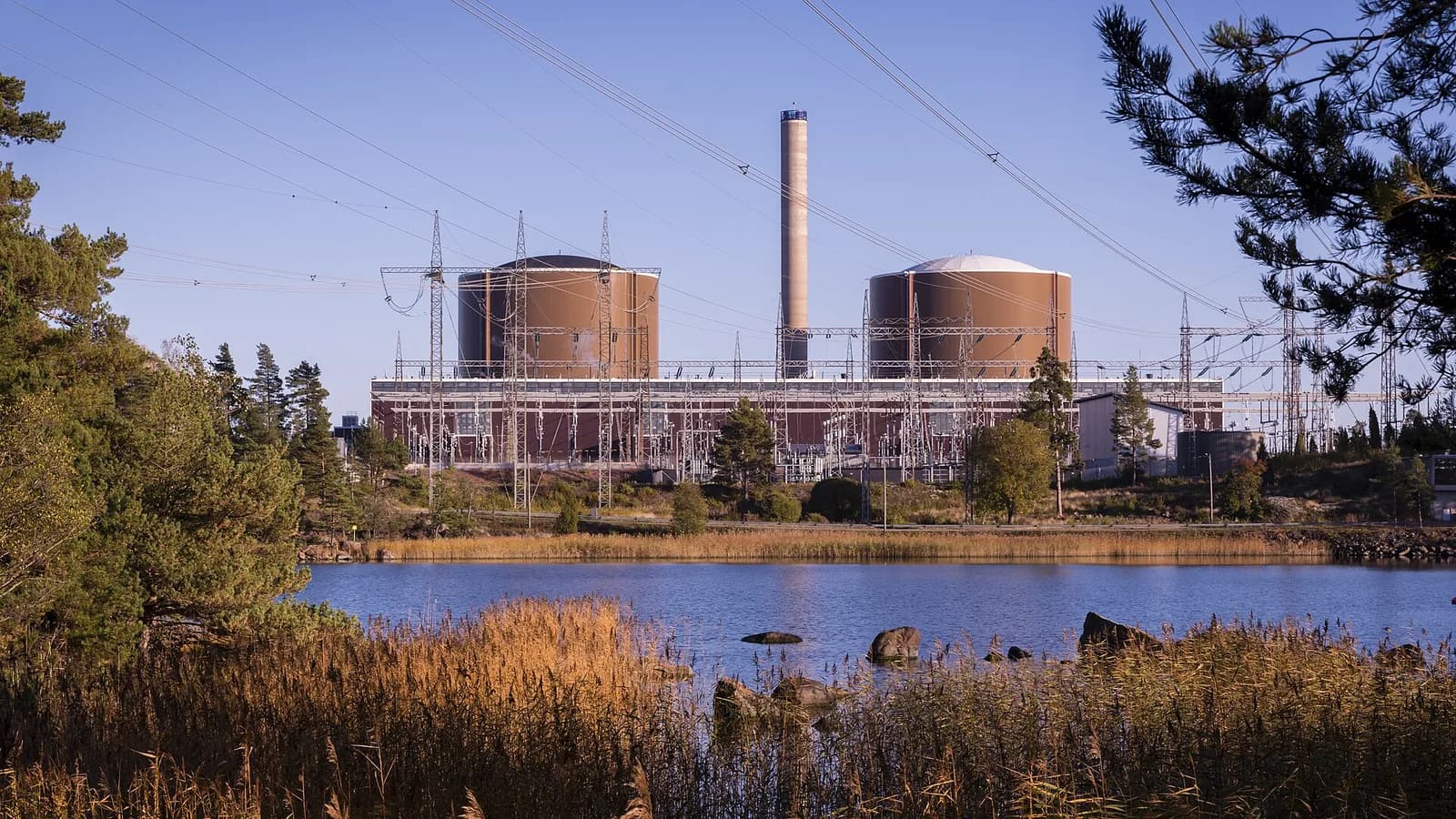
Google and Fortum signed a 22-year power purchase agreement on September 9 covering up to half of Finland's Loviisa nuclear plant through 2050. The deal gives Fortum the revenue certainty to complete a roughly €1 billion life-extension program and marks Google's first PPA tied to extending and uprating an existing reactor fleet.
Key facts
- The Fortum stock exchange release describes a 22-year PPA that starts in 2028 and reaches 50% of Loviisa's capacity between 2030 and 2049, running to the end of the plant's operating licenses in 2050.
- Fortum's life-extension investment program totals approximately €1 billion through 2050; about 80% of the projects, roughly €700 million in capex, were still pending investment decisions before this agreement.
- Without that program, Loviisa could not operate beyond 2030. The plant supplies about 10% of Finland's electricity and employs approximately 580 people.
- The PPA is expected to add a new 10 MW capacity increase on top of a planned 38 MW uprate expected live in 2028, with major turbine modernization work scheduled during outages in 2026 and 2028.
- Once half the plant's output is contracted, Fortum expects the deal to lift Group comparable return on net assets by about 1.4 percentage points, supporting a long-term RONA target of 14%.
- Google simultaneously announced €13 billion of investment in Finland for 2027-2028, covering data centers and supporting infrastructure in Hamina, Muhos, Vaala, and Kajaani.
What happened
The two companies announced the agreement on September 9 in a Fortum stock exchange release and a Google blog post. The PPA begins in 2028 at a smaller volume and scales to half of Loviisa's generation between 2030 and 2049. Google described it as its first-ever agreement for a nuclear plant life extension and uprate.
The structure matters as much as the volume. Fortum says the contract differs economically from its customary financial hedging because it reflects long-term customer value rather than short-term market pricing, and it will sit inside the company's long-term hedge ratio. In plain terms, a hyperscaler is acting as the anchor customer that makes a billion-euro nuclear refurbishment bankable.
"By supporting the lifetime extension of the Loviisa plant, which is located close to our data center in Hamina where we first put down our roots in Finland, we're doing our part to keep a critical energy source on the grid," said Aris Karcanias, Google's director of energy for Europe, the Middle East, and Africa.
Fortum's president and CEO Markus Rauramo framed the deal against volatile Nordic power prices: "Long-term partnerships like the one between Fortum and Google are essential... especially in today's uncertain market environment characterized by low visibility and highly volatile electricity prices," he said in the release.
Alongside the PPA, the companies signed a memorandum of understanding covering new nuclear, renewable capacity, and flexibility. First steps include a 94 MW battery system near Google's data center in Kajaani, which Fortum will optimize, and a commitment to study potential new reactors at Loviisa itself. Google also expanded its Finnish onshore wind contracting to 629 MW with two new projects.
Why it matters
Every signed nuclear PPA converts AI-power demand from narrative into contracted baseload revenue, and this one widens the map. Until now, the best-known hyperscaler nuclear deals were American: restarts like Duane Arnold in Iowa, where Google also holds a PPA, and the wave of data-center reactor deals the IEA tallied at 45 GW. Loviisa shows the same buyers now underwriting Europe's existing fleet.
The deal also settles a question plant owners across the continent have been asking: who pays for life extension when power prices are volatile and financing is expensive? Fortum's answer is a customer with a 22-year horizon. With roughly 80% of the Loviisa life-extension capex still undecided before this contract, the PPA is not a ceremonial add-on; it is the difference between the program happening and not happening.
There is a political dimension too. Google's €13 billion Finnish investment plan, and the €520 million in modeled consumer savings from siting new demand in the Oulu-Kajaani region, give Finnish policymakers a concrete example of data-center growth paired with firm, price-stabilizing generation rather than competing with households for megawatts. That framing is becoming central to the social license of the data-center nuclear build-out, and Loviisa is now its cleanest European case study.
Background
Loviisa sits on Finland's southern coast and runs two Soviet-designed VVER-440 pressurized-water reactors with a combined operating capacity of 1,014 MWe. The plant was connected to the grid in 1977 and 1980, making it Finland's oldest operating nuclear station, and it cooled its reactors with once-through seawater from the Gulf of Finland long before coastal siting was a grid strategy.
Finland's government approved the extension of Loviisa's operating licenses to the end of 2050 in 2023, and Fortum committed to the investment program that followed. The logic mirrors life-extension deals elsewhere in Europe, such as Sizewell B's extension to 2055: keep certified, paid-off reactors online for decades more, at a fraction of new-build cost, while grid demand climbs.
Fortum has also been positioning for new nuclear. Its subsidiary NuCore Energi filed a state aid application in Sweden in late August for a 1,200 to 3,400 MWe project in Oskarshamn Municipality, formed specifically to meet Stockholm's requirement that aid recipients focus solely on new reactor deployment. No investment decision has been made on either side of the Gulf of Bothnia. Track the broader deal flow in industry and business coverage.
What's next
The near-term milestones are mechanical. Turbine modernization work runs during planned outages in 2026 and 2028, and the 38 MW uprate is expected online in 2028, the same year the PPA's volumes begin ramping. The additional 10 MW enabled by the Google contract comes on top of that.
The longer watch item is the MoU. Fortum and Google say they will identify business models for new reactors at Loviisa and assess whether Fortum's powered land sites fit Google's future data-center needs. If that exploration hardens into a project, Loviisa would join the short list of European sites where an operating plant and a brand-new unit sit on the same license area, with the same anchor customer waiting for both.
Questions
- What did Google and Fortum sign?
- A 22-year power purchase agreement announced on 9 September 2026. Starting in 2028, Google will buy power from Fortum's Loviisa nuclear plant, reaching 50% of the plant's capacity between 2030 and 2049, with the contract running to 2050.
- Why does the PPA matter for Loviisa's future?
- Without Fortum's life-extension investment program, the plant could not operate beyond 2030. The PPA provides the long-term revenue certainty needed to complete the roughly €1 billion program that keeps both reactors online through 2050.
- How big is the Loviisa plant?
- Loviisa has two pressurized-water reactors with a combined operating capacity of about 1,014 MWe. It supplies roughly 10% of Finland's electricity and employs approximately 580 people on the country's southern coast.
- Is new nuclear planned at Loviisa?
- Possibly. A separate memorandum of understanding commits Google and Fortum to explore new nuclear capacity at Loviisa, alongside renewables, flexibility assets such as a 94 MW battery at Kajaani, and energy portfolio services. No investment decision has been made.
Sources
About Nuclear News Network
Nuclear News Network (NNN) is an independent publication covering the global nuclear energy sector — reactor construction, SMRs, fuel supply, policy, operations and fusion. NNN publishes a daily brief, same-day analysis of major developments, and reference guides used across the industry. Articles are produced by the NNN Newsroom, an editorial automation system with human oversight, under the publication's editorial standards. Ruben Seoane is the founder and main editor of NNN.