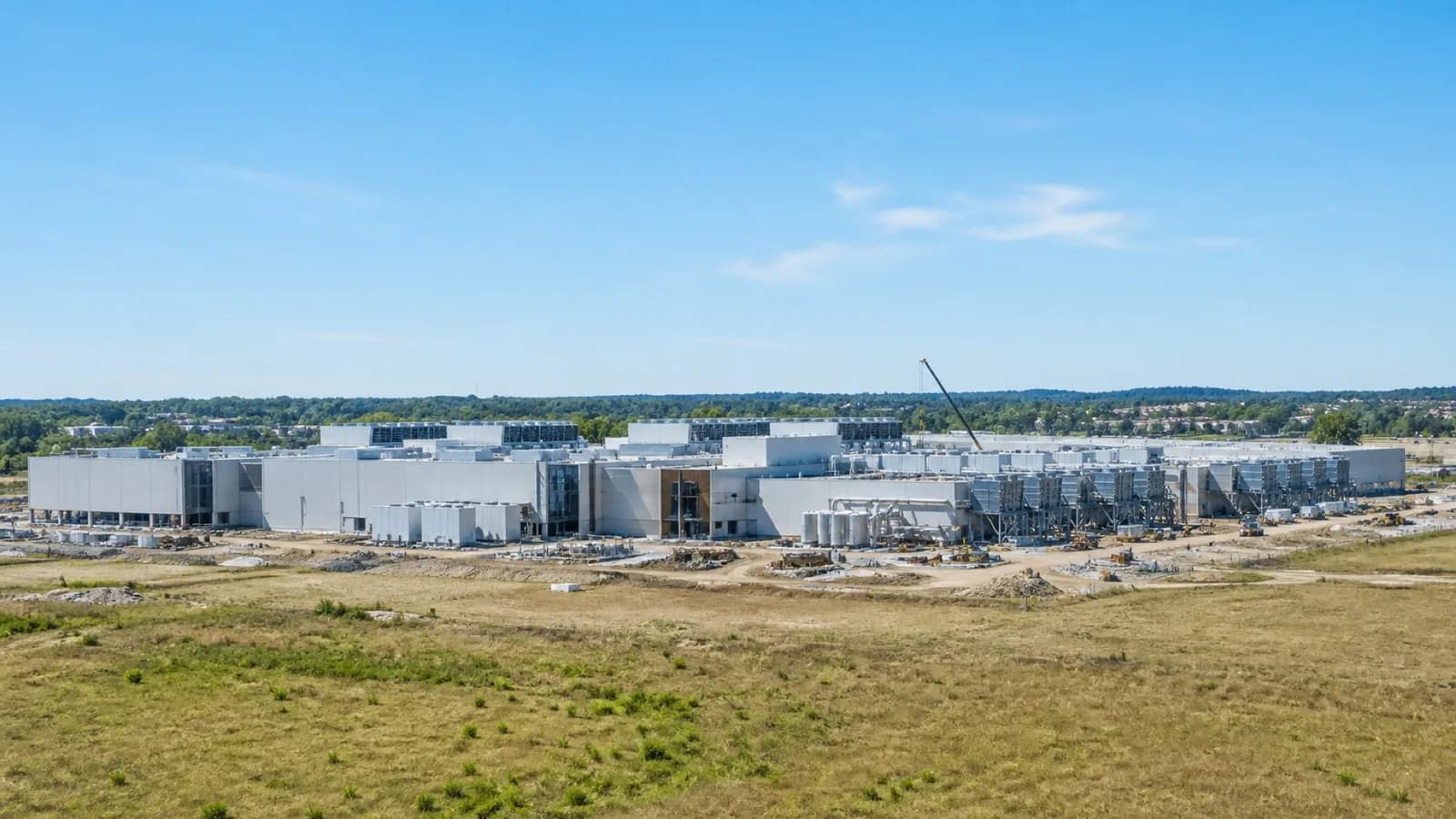
Americans are more resistant to a new artificial-intelligence data center in their community than to a nuclear power plant, according to Gallup. The gap is 71% opposing a local data center versus 53% opposing a local nuclear plant, a finding that could make local politics as important as electricity supply in the AI buildout.
Key facts
- 71% of Americans oppose building an AI data center in their local area, including 48% who are strongly opposed.
- 53% oppose building a nuclear energy plant where they live, compared with 71% for an AI data center.
- 46% say they worry a great deal about the environmental impact of AI data centers, while 24% worry a fair amount.
- Gallup's telephone survey covered 1,000 U.S. adults interviewed from March 2-18, 2026, with a margin of sampling error of plus or minus 4 percentage points.
- Among data-center opponents, 18% specifically mention water use and another 18% mention energy use.
What happened
Gallup asked Americans about local construction of AI data centers for the first time in its March survey. The question was paired with the pollster's existing question about building a nuclear power plant in a respondent's area, allowing a direct comparison of two infrastructure projects that can trigger long permitting fights.
The data-center result was the more negative one. Seven in ten respondents opposed local construction, and nearly half were strongly opposed. Only about a quarter favored a project, including 7% who strongly favored one.
Gallup's question tested broad public sentiment, not the outcome of a specific permit case. Still, the reasons respondents gave are familiar to anyone following recent infrastructure disputes. Data centers occupy large sites, draw substantial electricity and need water for cooling. Those demands can turn an abstract national AI race into a very local argument about land, noise, roads and power bills.
The survey found that supporters usually pointed to economic gains. Two-thirds of people who favored local data-center construction cited economic benefits, while 55% mentioned jobs specifically. Opponents were less focused on one issue. Half mentioned resource use, with water and energy each appearing in 18% of responses. Another 16% cited pollution, including noise pollution and air or water pollution.
Why it matters
The poll lands as technology companies and power developers search for electricity on a compressed schedule. The International Energy Agency recently reported that conditional off-take agreements between data-center operators and small modular reactor projects had risen to 45 GW from 25 GW at the end of 2024. That is a large commercial pipeline, but every project still has to get through a community, a utility process and a regulator.
Gallup's comparison complicates the easy version of the nuclear-for-AI story. Nuclear has spent decades carrying a public image problem, yet local opposition to data centers was 18 percentage points higher in the same survey. A reactor may be politically difficult, but a data center is not automatically the welcome alternative, particularly when residents associate it with water consumption, industrial noise or higher utility costs.
That matters for nuclear developers because many new projects are being sold around AI demand. Blue Energy and GE Vernova Hitachi's Texas plan, for example, pairs gas turbines for an early data-center load with a later buildout of BWRX-300 small modular reactors. The commercial logic is clear: serve a buyer quickly, then add firm nuclear power. The political logic is harder. The host community has to accept the site, the gas equipment and the future reactors.
The results also suggest that "clean power" is not enough as a local sales pitch. People may support more electricity in the abstract and still reject a particular project near their homes. Developers will need to show who pays for new transmission, how cooling water is sourced, what the project does for local tax revenue and whether residents can expect jobs that last beyond construction.
Background
The Gallup survey was conducted by telephone with a random sample of adults in all 50 states and the District of Columbia. The poll's margin of sampling error was plus or minus 4 percentage points at the 95% confidence level. Gallup also used a separate web survey of 2,054 panel members to ask why people supported or opposed data centers; that open-ended work has a plus or minus 3-point margin for the 1,561 opponents.
The partisan split was sharper on intensity than on total opposition. Strong opposition among Democrats was 56%, compared with 39% among Republicans, with independents between those figures. Regional differences were also visible: opposition was 76% in the Midwest and 75% in the South, compared with 63% in the West and 68% in the East.
For nuclear developers, the broader lesson fits the pattern in NNN's SMR coverage. A data-center customer can make a reactor project easier to finance, but it cannot make siting disappear. NNN's baseload comparison explains why nuclear is attractive for round-the-clock loads, while the Texas gas-plus-nuclear plan shows how developers are trying to bridge the schedule gap.
What's next
Watch for local polling, county approvals, utility rate cases and water agreements around proposed AI campuses. Those decisions will show whether the national demand for computing can survive the local costs of building it.
The immediate takeaway is blunt: the public may accept nuclear more readily than data centers, but 53% opposition is still a majority. Developers cannot treat community consent as a communications exercise at the end of the project. It is part of the project economics from the start.
Questions
- Do Americans oppose local AI data centers more than nuclear plants?
- Yes. Gallup found 71% oppose an AI data center in their local area, compared with 53% who oppose a nuclear energy plant.
- Why do people oppose data centers?
- Gallup found that opponents most often cite resource use, including water and energy, followed by pollution, quality-of-life changes and possible effects on utility bills.
- When was the Gallup survey conducted?
- Gallup conducted telephone interviews with 1,000 U.S. adults from March 2-18, 2026. The margin of sampling error was plus or minus 4 percentage points.
- What does the poll mean for nuclear power?
- Nuclear still faces majority opposition in local siting, but the lower figure suggests data-center developers may face an even harder political path when they seek permits and grid connections.
Sources
About Nuclear News Network
Nuclear News Network (NNN) is an independent publication covering the global nuclear energy sector — reactor construction, SMRs, fuel supply, policy, operations and fusion. NNN publishes a daily brief, same-day analysis of major developments, and reference guides used across the industry. Articles are produced by the NNN Newsroom, an editorial automation system with human oversight, under the publication's editorial standards. Ruben Seoane is the founder and main editor of NNN.