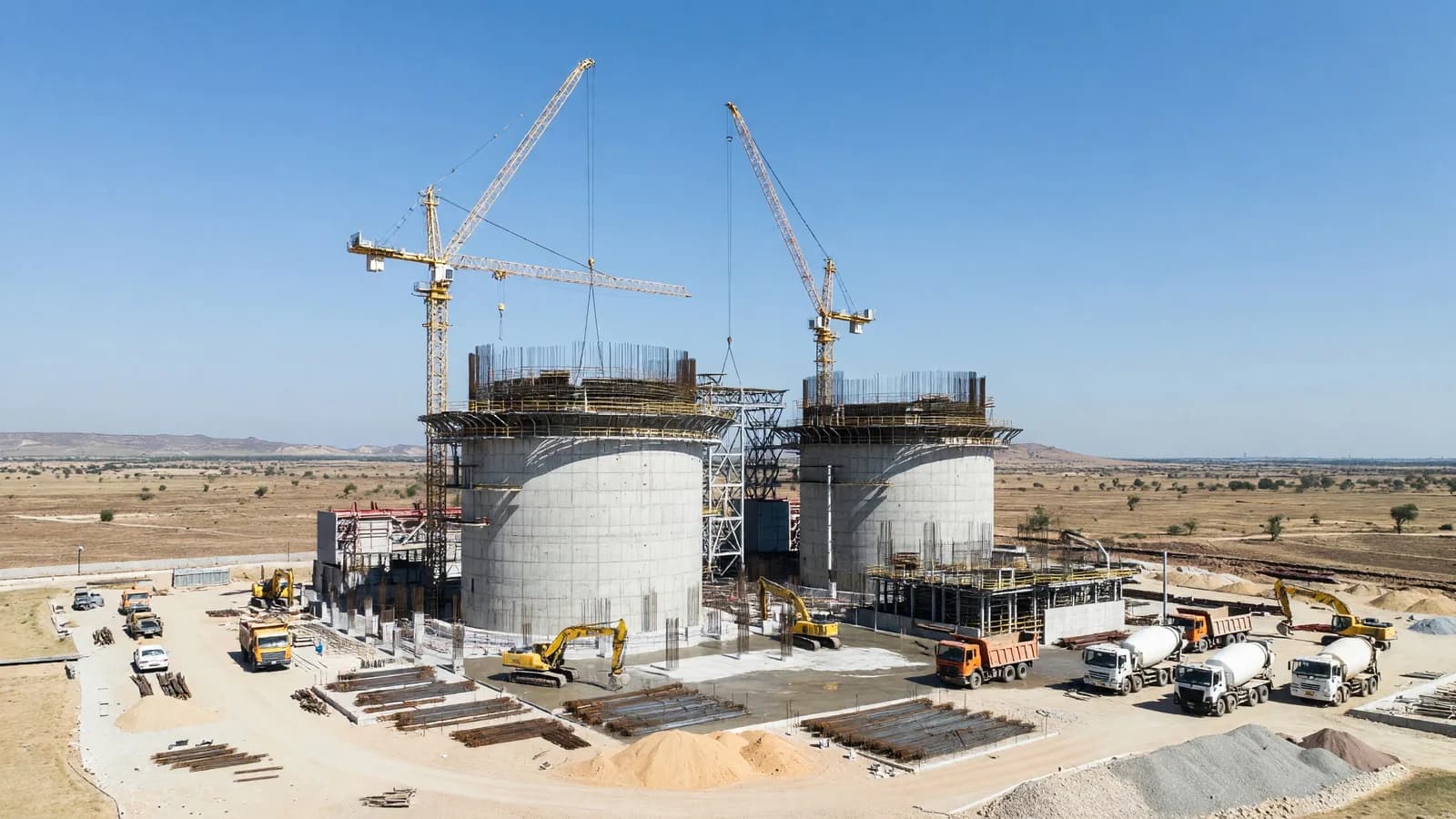
NPCIL's official Mahi Banswara announcement has turned into the day's loudest India nuclear thread on X: ASHVINI is set to release the Nuclear Island Mega EPC package for 4 × 700 MWe PHWRs, a project NPCIL pegs at over ₹28,000 crore. That matters because India cannot get to fleet-scale buildout without a repeatable procurement path.
Key facts
- NPCIL says ASHVINI is preparing the tender for the Nuclear Island Mega EPC package for the Mahi Banswara Rajasthan Atomic Power Project Units 1-4, covering 4 × 700 MWe PHWRs, or 2.8 GW total. NPCIL on X
- The company described the package as over ₹28,000 crore and the largest Nuclear Island EPC package in India's indigenous PHWR programme. NPCIL on X
- World Nuclear News reported that the tender is being launched through ASHVINI, the NPCIL-NTPC joint venture. World Nuclear News
- X discussion quickly amplified the announcement, with @marinebharat and other accounts framing it as a "Made in India" execution milestone. X thread
What's driving the conversation
The conversation started with @NpcilOfficial's announcement that ASHVINI was set to release the tender, then widened as @marinebharat and others turned the procurement into a shareable industrial-story thread. That matters because the social framing is not just hype; it is a clue that India's buildout is starting to register as a national manufacturing story, not only a power-sector one.
The verified fact under the noise is straightforward. ASHVINI — the NPCIL-NTPC joint venture — is preparing a procurement package for four indigenous 700 MWe PHWR units at Mahi Banswara. The package is not a vague policy signal. It is a concrete EPC process with scope that includes engineering, manufacturing, supply, civil construction, installation, testing, and commissioning assistance.
The substance
The scale is the point. A 2.8 GW PHWR order is large enough to shape vendor roadmaps, supply-chain planning, heavy manufacturing schedules, and state-level industrial policy. It also shows why nuclear procurement is so often the real bottleneck: the reactor design matters, but the ecosystem needed to buy, build, and integrate the plant matters just as much.
This is also where the story connects to India's longer-term goals. NPCIL's official post framed the tender as part of the country's path to 100 GW by 2047 and as a push toward Atmanirbhar Bharat manufacturing. Those are ambitions, not guarantees. But the procurement step is what turns an ambition into a project that can be tracked, bid, and delayed for concrete reasons instead of abstract ones.
The wider industry implication is that India is continuing to build an indigenous reactor pipeline around the parts of the business that are hardest to standardize: EPC, heavy components, civil works, and schedule discipline. That is the stage where supply-chain capability starts to matter as much as policy support. If India can keep repeating that process, the national story stops being about one-off reactor announcements and becomes about a reusable delivery model.
NNN has already been tracking the policy and fuel pieces of that bigger picture. Our coverage of India's SHANTI Act consultation showed how the government is trying to align regulation, finance, and manufacturing. Our coverage of the India-Australia uranium deal showed the fuel side of the same expansion. Mahi Banswara is the next layer: the project side.
Why the industry is watching
For EPC vendors, this is a test of who can actually execute at Indian nuclear scale. For policymakers, it is a test of whether the state can keep turning sector goals into procurement files. And for everyone following the global nuclear revival, it is another reminder that the path from statement to steel is built one tender at a time.
If the tender moves on schedule, the project becomes a useful reference point for future PHWR work. If it slips, that will tell the market something too: the procurement stack still needs work. Either way, the story matters because the question is no longer whether India wants more nuclear. The question is how fast it can contract and build it.
Questions
- What did India actually announce?
- NPCIL said ASHVINI was set to release the Nuclear Island Mega EPC package for 4 × 700 MWe PHWR units at Mahi Banswara in Rajasthan.
- Why is the tender important?
- It is the first major procurement step for a 2.8 GW indigenous PHWR project, so it is where the project stops being a policy target and starts being an execution file.
- What is the price tag?
- NPCIL described the package as an estimated over-₹28,000 crore contract, making it the largest Nuclear Island EPC package in India's PHWR programme.
Sources
- NPCIL official announcement on the Mahi Banswara tender — X
- Mahi Banswara tender set to be launched — World Nuclear News
About Nuclear News Network
Nuclear News Network (NNN) is an independent publication covering the global nuclear energy sector — reactor construction, SMRs, fuel supply, policy, operations and fusion. NNN publishes a daily brief, same-day analysis of major developments, and reference guides used across the industry. Articles are produced by the NNN Newsroom, an editorial automation system with human oversight, under the publication's editorial standards. Ruben Seoane is the founder and main editor of NNN.