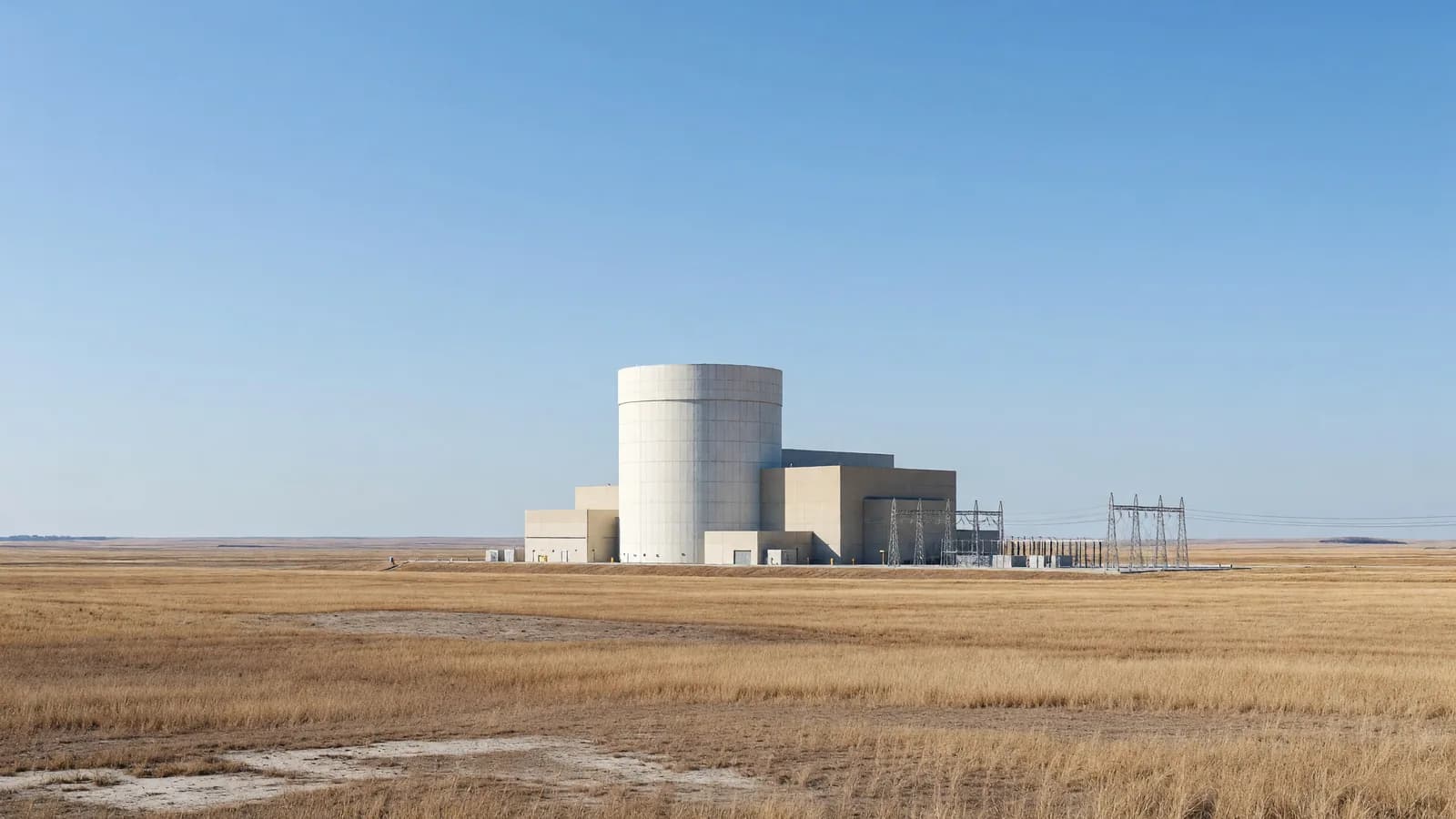
The State of Indiana, Hoosier Energy Rural Electric Cooperative and AtkinsRéalis have agreed to evaluate a potential CANDU reactor campus of up to eight units and 6 GW. The memorandum of understanding opens discussions about deployment, not construction; no site or project schedule has been announced.
Key facts
- The three parties signed an MOU on October 19, 2026 to explore possible deployment scenarios for CANDU technology in Indiana.
- The concept is for up to eight reactors with up to 6.0 GW of capacity, according to AtkinsRéalis.
- The announcement names no site, investment decision or schedule; any timeline depends on site selection, financing, licensing, environmental review and other approvals.
- The partners will also assess gas generation ahead of nuclear and potential gas-to-nuclear conversions at retired or retiring power sites.
What happened
AtkinsRéalis, the State of Indiana and Hoosier Energy said they had signed an MOU to examine whether CANDU reactors could be deployed in the state. The company's announcement describes a possible campus with up to eight reactors producing up to 6 GW. The wording matters: this is an evaluation arrangement, not an order for reactors, a utility construction approval or a final investment decision.
The statement outlines a broad assessment rather than a defined project. The partners will consider how a multi-unit program might use standardized designs and repeat construction, and whether existing generation sites could be converted from gas to nuclear. They will also examine smaller gas-turbine plants that might supply power before any nuclear units are ready. The announcement says deployment scenarios could involve several sites and communities.
There is no named location, customer contract, ownership arrangement, cost estimate or target operating date in the public announcement. World Nuclear News reports that any schedule would depend on site selection, financing, power offtake, regulatory and licensing work, environmental review, transmission planning and stakeholder engagement. Those are substantial decisions, not administrative details: a 6 GW program would require arrangements for several major generating units and the grid connections to move their output.
The Indiana proposal arrives alongside a separate nuclear evaluation in the state. American Electric Power, Amazon and X-energy have announced a study of a 960 MW, 12-unit Xe-100 plant in Sullivan County. The projects are distinct, use different reactor technologies and have separate participants. Neither announcement means Indiana has approved construction.
Why it matters
At 6 GW, the CANDU concept would be unusually large as a single state-level nuclear program. The capacity figure gives Indiana a measure of what the partners are exploring, but it should not be read as expected generation or a firm addition to the grid. Capacity is only delivered if a project clears financing, site, licensing, supply-chain and construction hurdles.
The proposed approach also raises a practical question for utilities: can new nuclear use sites and infrastructure left by retiring fossil plants? Existing transmission connections and industrial land may be useful, though they do not settle questions about cooling water, local impacts, interconnection capacity or whether a particular site is suitable for a reactor. The gas-first option in the announcement appears intended to address the gap between near-term power needs and the longer development cycle for nuclear; the parties have not disclosed how that sequence would work commercially.
For Hoosier Energy, the MOU is an opportunity to take part in an early assessment. The cooperative serves member-customers in central and southern Indiana and southeastern Illinois, according to the American Nuclear Society's report. That role does not establish that its members will buy power from a future project or bear its costs. The eventual ownership and offtake structure remain unannounced.
AtkinsRéalis is promoting its Canadian-designed technology for a US market dominated by light-water reactors. A decision to study the design is an early commercial foothold, but the path to a US project still involves licensing and a site-specific review. The company's US licensing effort has begun with a notice of intent to the Nuclear Regulatory Commission; that is not a construction license for an Indiana plant.
Background
CANDU means Canada Deuterium Uranium. The design uses heavy water, or deuterium oxide, as moderator and coolant, and can use natural uranium fuel rather than requiring enrichment. Its online refuelling system allows fuel bundles to be replaced while a unit operates. These features differ from the pressurized-water and boiling-water reactors that make up most of the US commercial fleet. The World Nuclear Association's CANDU overview describes the reactor family and its fuel cycle.
AtkinsRéalis holds the commercial rights to CANDU technology on behalf of Atomic Energy of Canada Limited, a Canadian federal Crown corporation. World Nuclear News reports that 34 CANDU units have been built worldwide, including 17 currently operating in Canada. The company's Enhanced CANDU 6 design is a 700-plus-MWe class reactor, so eight such units could approach the announced upper capacity, though the MOU does not specify a design or say all units would be identical.
This proposal is the second major nuclear study announced in Indiana in a short period. NNN reported on AEP, Amazon and X-energy's separate Indiana SMR evaluation, which is framed around a retired coal site and a defined 960 MW design. The wider SMR explainer and guide to state nuclear procurement provide context on how early interest must progress through planning, commercial agreements and licensing before a project becomes a build.
What's next
The next evidence of progress would be a site-selection process, a public description of the feasibility work, or an agreement identifying the intended power buyer and project owner. Community engagement, transmission planning and the licensing path will also need to move from general considerations to specific proposals.
Until those details appear, 6 GW describes the outer scope under study. The MOU creates a process for evaluating CANDU deployment in Indiana; it does not commit the state, the cooperative or AtkinsRéalis to build any reactor.
Questions
- Has Indiana approved a 6 GW CANDU power plant?
- No. Indiana, Hoosier Energy and AtkinsRéalis signed an MOU to evaluate possible deployment scenarios. The partners have not announced a selected site, investment decision, license application or construction schedule.
- How many reactors could the Indiana CANDU project include?
- The MOU covers evaluation of a potential campus of up to eight CANDU reactors with up to 6 GW of combined capacity.
- What is a CANDU reactor?
- CANDU is a Canadian pressurized heavy-water reactor design. It uses heavy water as moderator and coolant, can refuel while operating, and is designed to use natural uranium fuel.
Sources
- AtkinsRéalis, the State of Indiana and Hoosier Energy Partner to Advance U.S. Energy Goals with Evaluation of CANDU Nuclear Technology Deployment — AtkinsRéalis
- In latest Indiana power plant proposal, parties to explore CANDU reactors — American Nuclear Society
- Indiana considering 6 GW Candu nuclear project — World Nuclear News
About Nuclear News Network
Nuclear News Network (NNN) is an independent publication covering the global nuclear energy sector — reactor construction, SMRs, fuel supply, policy, operations and fusion. NNN publishes a daily brief, same-day analysis of major developments, and reference guides used across the industry. Articles are produced by the NNN Newsroom, an editorial automation system with human oversight, under the publication's editorial standards. Ruben Seoane is the founder and main editor of NNN.