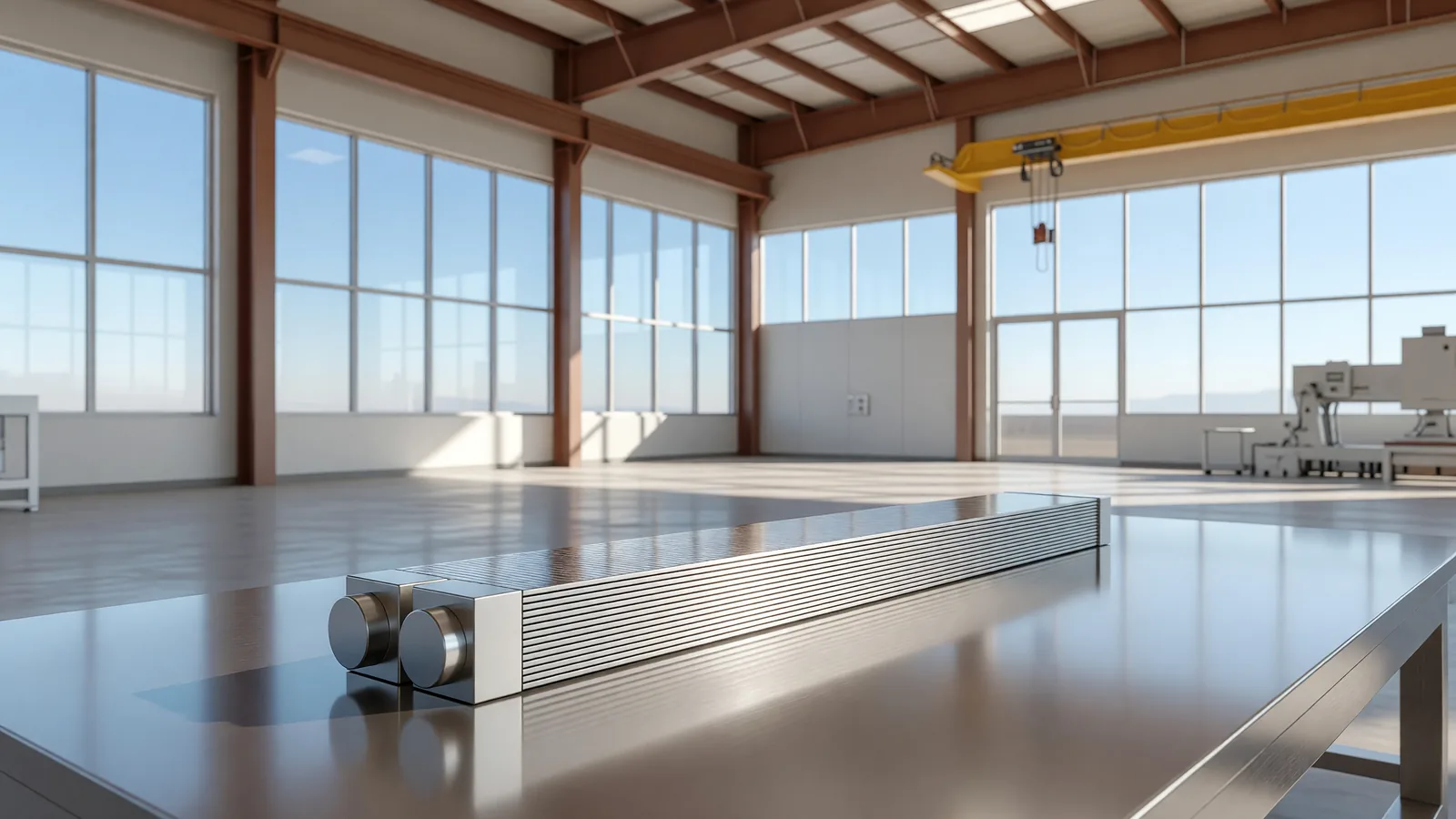
Pacific Northwest National Laboratory (PNNL), acting for the National Nuclear Security Administration (NNSA), is asking industry who could commercially make monolithic uranium-10% molybdenum (U-10Mo) fuel, the HALEU fuel meant to move five U.S. research reactors off highly enriched uranium. The RFI preliminarily sizes the market at roughly $100–175 million a year; letters of interest are due December 21, 2026.
Key facts
- The RFI puts the overall market at about 10,000 fuel plates and 200 fuel elements a year, consuming 3,000 to 3,500 kg of HALEU metal annually.
- It preliminarily estimates the annual market for U-10Mo fuel for ATR, HFIR, NBSR, MURR and MITR at approximately $100–175 million, with uranium metal alone roughly $60 million a year.
- Demand is expected to exceed existing fabrication capacity in the mid-2030s, with NNSA supplier development beginning in the late 2020s.
- Today's process runs at hundreds of plates a year; an equilibrium plant is estimated at 45 full-time staff.
- Letters of interest under SAM.gov notice 0000966967 are due December 21, 2026, at 4 p.m. Pacific.
What happened
PNNL, which Battelle operates for the Department of Energy, first posted "RFI U-10Mo Fuel Fabrication" on SAM.gov on September 17, 2026. On October 9 it updated the notice with Battelle's answers to 35 first-round technical questions from prospective respondents. The notice lists Richland, Washington, as the place of performance and carries no small-business set-aside.
The 16-page RFI document states that PNNL distributed it as a contractor to NNSA's Office of Reactor Conversion and Uranium Supply (ORCUS), and that ORCUS and DOE/NNSA federally funded research and development center contractors will review all responses. Respondents can express interest in one of three scopes: supplying the U-10Mo alloy only; fabricating fuel plates and assemblies only; or doing both in the same facility, which NNSA prefers.
The government is offering substantial help. HALEU metal would be government-furnished material, and NNSA says it can provide major fabrication equipment and technical support for a "turnkey capability." In its answers, PNNL said NNSA's lead time for that equipment is 12 months for standard items and up to 36 months for specialised custom equipment, running in parallel with any procurement.
The physical requirements are specific. PNNL estimates roughly 25,000 square feet of manufacturing floor space, some high-bay space with about 30-foot ceilings, and either an NRC Category II special nuclear material facility or a DOE Hazard Category III facility. Teams of companies are acceptable, US businesses are preferred, and foreign-owned respondents must submit a plan to address foreign ownership, control or influence. Letters should run under 20 pages and include rough cost and schedule estimates to first equipment receipt and an initial product demonstration.
Why it matters
These reactors are the last holdouts in a long nonproliferation effort. PNNL describes the U.S. high-performance research reactors as the final civilian reactors in the US to transition from HEU to HALEU, because no existing fuel meets their performance needs. They are not niche assets: the RFI notes that MURR is the only domestic research reactor used for routine radioisotope and radiopharmaceutical production, and that HFIR is an 85 MW thermal flux-trap reactor aimed at isotope production.
A qualified fuel is only half the job. The RFI says a commercial fuel supply is needed as the new fuel is implemented, and frames this as a capacity problem arriving within a decade. That mirrors NNSA's broader habit of market-sounding before it buys, seen in its uranium acquisition RFI seeking about 4 million pounds a year.
The answers also show what remains unproven. PNNL said the largest full-size plates required for ATR have not yet been demonstrated, with plate-forming optimisation planned over the next year. It expects about 30% process scrap, which would go to recovery rather than disposal until cost-effective commercial HALEU metal exists. And it noted that hot rolling of U-10Mo, while considered mature by the programme, is not a commercially available process.
For HALEU demand, the order of magnitude matters too. Three to 3.5 tonnes of HALEU metal a year is a meaningful, steady customer for a market still at demonstration scale, as NNN's HALEU explainer sets out. An NRC Category II facility is also the security category FANCO plans for its own HALEU fuel facility.
Background
The U-10Mo route has three stages: alloying, plate fabrication and assembly. Uranium and low-carbon molybdenum are vacuum-induction melted and cast, then hot-rolled with a zirconium interlayer into a foil. Aluminum cladding is bonded to the foil by hot isostatic pressing at about 560°C and 103 MPa for 90 minutes, and finished plates are swaged into aluminum side plates and welded to end fittings.
Production has so far run through two partners. In a May 2025 summary, PNNL said the programme's fuel fabrication pillar has worked with the Y-12 National Security Complex and BWXT Nuclear Operations Group: Y-12 had begun processing alloy feedstock for conversion elements, and BWXT had started final fabrication of experimental elements before moving to conversion elements. In 2020 NNSA awarded BWXT an initial $3.6 million contract for engineering work to decommission and refurbish part of its Lynchburg, Virginia, facility for U-Mo HALEU production. BWXT, through a separate subsidiary, is also building NNSA's DUECE defense enrichment pilot plant in Tennessee. The RFI itself does not name incumbent suppliers or say whether they may respond.
Abroad, NNSA has used U-Mo before. Its December 2025 account of converting Japan's Kyoto University Critical Assembly, counted as the 111th HEU reactor converted or verified shut down since 1978, credits France's Framatome CERCA with fabricating that U-Mo fuel from powder made in South Korea. For how research-reactor fuel fits the wider chain from mine to fabricator, see NNN's U.S. nuclear fuel supply chain explainer and, for a contrasting HALEU fuel form, TRISO fuel, explained.
What's next
Second-round questions are due to Battelle by November 12, 2026, with answers promised by November 19. Letters of interest close December 21. PNNL has cautioned that technical requirements may change before any future action, so the next signal to watch is whether NNSA follows this market survey with the supplier development it says it anticipates beginning in the late 2020s.
Questions
- What is U-10Mo fuel?
- U-10Mo is a uranium alloy with 10% molybdenum, rolled into thin foils and clad in aluminum. NNSA's reactor conversion office has led its development as a high-density HALEU fuel so high-performance research reactors can stop using highly enriched uranium.
- Which reactors would use the fuel?
- The RFI names five: the Advanced Test Reactor, the High Flux Isotope Reactor, the NIST reactor (NBSR), the Missouri University Research Reactor and the MIT Reactor.
- Is this a contract award?
- No. It is a non-binding request for information. PNNL is gathering industry interest and facility options for NNSA; it says technical requirements may change before any future action.
- When are responses due?
- Letters of interest are due December 21, 2026, at 4 p.m. Pacific time. A second round of questions closes November 12, with answers promised by November 19.
Sources
- RFI U-10Mo Fuel Fabrication (notice 0000966967) — SAM.gov / Pacific Northwest National Laboratory
- Request for Information RFI 966967: U-10Mo Monolithic Fuel Fabrication, Revision 0 — Pacific Northwest National Laboratory (Battelle) for NNSA
- Round 1 Questions to RFI-966967: U-10Mo Monolithic Fuel Fabrication — Pacific Northwest National Laboratory (Battelle) for NNSA
- Commercialization of High-Density High Assay Low Enriched Uranium Fuel Systems — Pacific Northwest National Laboratory
- 111th reactor conversion advances nuclear nonproliferation and innovation in partnership with Japan — National Nuclear Security Administration
- Department of Energy Selects BWXT to Support Nonproliferation Fuel Program — BWX Technologies
About Nuclear News Network
Nuclear News Network (NNN) is an independent publication covering the global nuclear energy sector — reactor construction, SMRs, fuel supply, policy, operations and fusion. NNN publishes a daily brief, same-day analysis of major developments, and reference guides used across the industry. Articles are produced by the NNN Newsroom, an editorial automation system with human oversight, under the publication's editorial standards. Ruben Seoane is the founder and main editor of NNN.