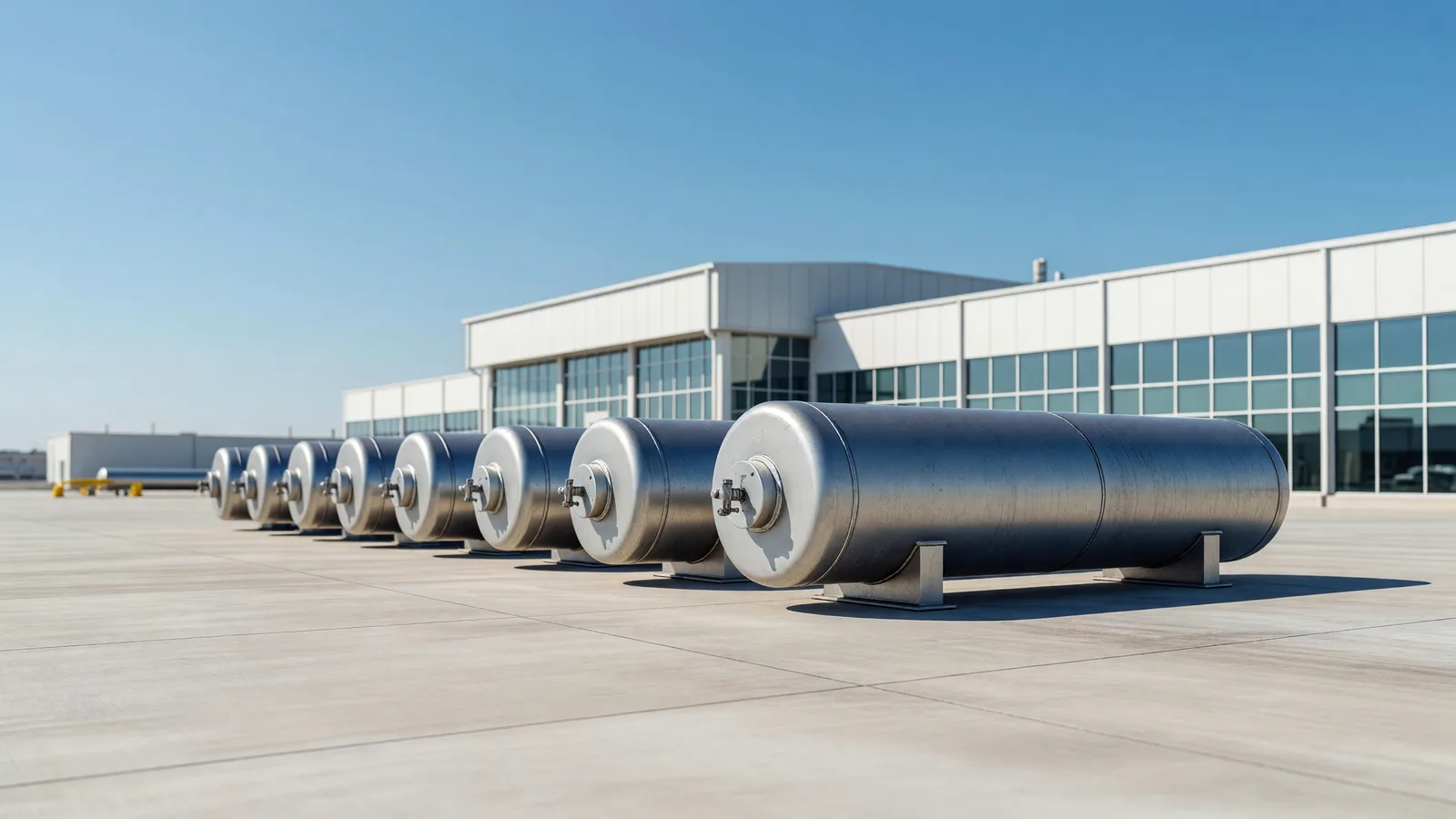
HALEU is high-assay low-enriched uranium: uranium enriched to more than 5% and less than 20% uranium-235. Most advanced reactors are specified around that band. Today's light-water fleet is not. Centrus has produced more than 1,900 kilograms at Piketon, Ohio. Commercial U.S. plants that would make it at scale are still being built.
Key facts
- DOE and the Energy Act of 2020 define HALEU as uranium with an assay greater than 5.0 weight percent and less than 20.0 weight percent U-235.
- Centrus's Piketon cascade finished a DOE demonstration contract in June 2026 at more than 1,900 kilograms of HALEU UF6. That is licensed production, not a commercial market.
- In January 2026 DOE issued about $2.7 billion in enrichment task orders: $900 million each to Centrus and General Matter for HALEU, $900 million to Orano for LEU, and $28 million to Global Laser Enrichment.
- Centrus says first new commercial capacity is 12 metric tons a year by 2029. DOE's allocated stockpile is measured in tens of tons through 2028.
- Facilities holding 10 kilograms or more of U-235 in uranium enriched to 10% or more but less than 20% are NRC Category II.
- Actinide said on August 26, 2026 that an independent lab assayed research-scale material at 15.38% U-235, produced under the NRC's laboratory-scale exclusion.
How it works
Natural uranium is about 0.7% U-235. Conventional reactor fuel raises that to a few percent. HALEU keeps going, often toward 19.75%, just under the line that would make it highly enriched.
The industrial chain is today's fuel chain, pushed into a higher assay:
- Conversion. Yellowcake becomes uranium hexafluoride (UF6), the gas centrifuges enrich.
- Enrichment. Centrifuge cascades raise the U-235 assay. Electromagnetic separators (calutrons) are a different route: they sort atoms by mass and do not use a UF6 cascade.
- Deconversion. Enriched UF6 has to become oxide or metal before it can be made into fuel. The United States still lacks commercial HALEU deconversion at scale.
- Fabrication. The solid is pressed into pellets, coated as TRISO particles, or formed as metal fuel.
A kilogram of HALEU UF6 is not a fuel assembly. Deconversion plants, Category II security, transportation packages and licensed fabrication lines all have to exist before a reactor can load a core. Material below 10% enrichment stays in the lighter Category III regime used for conventional fuel, which is why Framatome's Richland amendment to less than 10% U-235 is a different plant from a Category II HALEU fabricator.
Why advanced reactors need it
Higher assay packs more fissile atoms into a smaller volume. A compact core can run longer between refuellings, reach higher temperatures, or fit inside a transportable package. TRISO fuel is the clearest case: coated particles need HALEU kernels for the power density those reactors are sold on. X-energy says its TRISO-X fuel is enriched to about 15.5% U-235.
Fast-spectrum reactors need it for a different reason. TerraPower's Natrium is a sodium-cooled fast reactor. Its fuel cycle is a named watch item, with four parallel HALEU tracks. The Natrium timeline records the 2022 slip from a 2028 completion target to 2030 as a fuel problem after the Russian supply route closed.
Not every small reactor is in this market. Light-water SMRs such as the BWRX-300 use conventional low-enriched uranium. The HALEU constraint belongs to high-temperature gas reactors, microreactors, sodium and lead fast reactors and some molten-salt designs, not to "SMRs" as a class. NNN's SMR hub maps the reactors. This page maps the fuel some of them cannot start without.
The numbers
| Band | U-235 assay | Typical use | Security (qualifying quantities) |
|---|---|---|---|
| Natural uranium | ~0.7% | Feedstock | Outside this table |
| Conventional LEU | about 3–5% | Today's light-water fleet, BWRX-300 | Category III |
| HALEU | >5% to <20% | Advanced reactors, TRISO, fast reactors | Category II at ≥10% |
| Highly enriched uranium | ≥20% | Naval and some research uses | Category I |
DOE's HALEU environmental analysis has used figures on the order of 40 metric tons cumulative by 2030. Industry surveys publish much higher paths. The useful fact in 2026 is narrower: demonstration cores need material this decade, commercial fleets need plants that do not yet operate, and DOE's allocated stockpile is tens of tons through 2028, not hundreds.
Who is building the chain
Mixing the layers is how HALEU announcements get over-read.
Enrichment
Centrus Energy is the only U.S. company with licensed demonstration HALEU production. Its American Centrifuge Plant in Piketon, Ohio, finished the DOE demonstration contract in June 2026 at more than 1,900 kilograms of HALEU UF6 and then signed the $900 million task order, worth up to $1.07 billion if options are exercised. The company intends to run the existing cascade commercially while it builds toward 12 metric tons a year by 2029.
General Matter holds the matching $900 million HALEU task order and plans a commercial plant at the former Paducah Gaseous Diffusion Plant in Kentucky. That is a licensed plant to be built, not a producing cascade.
Global Laser Enrichment received $28 million to advance SILEX laser enrichment. That is a technology programme, not a HALEU factory.
Actinide is a Dallas company founded in September 2025. On August 26, 2026 it said it had enriched natural uranium to HALEU on Endurance, a first-generation electromagnetic isotope separator (a modern calutron) it designed and built in Texas. The company says an independent ISO/IEC 17025-accredited laboratory assayed the material at 15.38% U-235, in research quantities, under the laboratory-scale exclusion in 10 CFR 70.4, which carves experimental enrichment out of the definition of a uranium enrichment facility. Endurance's paying product is ytterbium-176 for medical isotopes. Actinide says the machine outputs solid material rather than UF6, which would skip the deconversion step centrifuge HALEU still needs. It is now building Fortitude, a second-generation separator that the company estimates could match roughly half of existing U.S. government electromagnetic-separation capacity. That is a laboratory-scale company demonstration. It is not a licensed plant, a DOE task order or a fuel delivery.
Orano's Project Ike in Oak Ridge is a proposed $5 billion centrifuge plant licensed to a maximum of 8% U-235, backed by a $900 million DOE LEU task order. Urenco USA is expanding conventional enrichment in New Mexico by 2.1 million SWU. Both matter for the existing fleet after the Russian import cutoff. Neither is a HALEU plant.
Newer concepts sit in DOE's Nuclear Energy Launch Pad: Hexium (laser isotope separation, lithium first), Nusano (an isotope company with a stated HALEU process), and conversion projects such as Raven-Flint and Sublime. Launch Pad authorization lets a developer prove a process. Commercial sales of enriched product are not permitted under DOE authorization. An NRC licence is still required to sell fuel.
Deconversion and fabrication
Centrifuge enrichment output is UF6. Reactors do not burn UF6.
TRISO-X, X-energy's fuel subsidiary, is building commercial TRISO capacity in Oak Ridge and already has a named path from Centrus enrichment under the companies' August 2026 supply agreement. Standard Nuclear–Framatome is attaching TRISO manufacturing to Framatome's Richland, Washington, plant, now licensed to under 10% U-235, with a starting target of about 2 tonnes of TRISO a year.
FANCO has told the NRC it intends to build a Category II HALEU deconversion and fuel fabrication plant, with a 10 CFR Part 70 application targeted for late 2027. That is preapplication engagement, not a licence. Oklo's Launch Pad selection covers fuel and recycling work that still has to cross into NRC space.
Who needs the material
| Programme | Why it needs HALEU | What NNN has on file |
|---|---|---|
| TerraPower Natrium | Sodium fast reactor; metal-fuel path | Natrium, explained, timeline |
| X-energy Xe-100 | TRISO at about 15.5% U-235 | Centrus offtake |
| Radiant Kaleidos | TRISO microreactor; DOE allocation | Idaho shipment |
| FANCO EAGL-1 | Fast reactor; plans own Category II fab | NRC notice |
DOE allocations are conditional draws on a government stockpile. They decide who can load a first core this decade. They are not a substitute for a commercial plant.
How DOE is buying the chain into existence
The HALEU Availability Program, created by the Energy Act of 2020, now has three levers, mapped in the DOE nuclear funding explainer:
- Buy enrichment capacity. The January 2026 task orders pay companies against future output. Centrus and General Matter are the HALEU awards. Orano's matching cheque is LEU.
- Allocate stockpile. Three rounds since April 2025 have reached TRISO-X, Kairos, Radiant, Westinghouse, TerraPower, Antares, Standard Nuclear, Natura and, in July 2026, NASA.
- Pay for the rest of the chain. UF6 is not fuel. Deconversion contracts and fabrication licences still have to catch the enrichment plants.
The policy backdrop is the Prohibiting Russian Uranium Imports Act. Russia was the only commercial-scale HALEU supplier to Western customers. U.S. waivers end on 1 January 2028. After that date the domestic and allied chain has to exist, or advanced-reactor schedules wait.
Common misconceptions
"HALEU is highly enriched uranium." It is not. The legal line is 20% U-235. HALEU is defined to stay below it. Category II physical protection still applies at 10% and above. That is a real industrial cost, not evidence that the material is weapons-grade.
"Enrichment is the whole problem." Centrus producing UF6 does not fuel a reactor. Deconversion, fabrication, licensed transport and the right fuel form have to move in parallel. That is why Richland, TRISO-X and FANCO belong on the same page as Piketon.
"Orano's $900 million DOE award is a HALEU plant." The January 2026 package was $2.7 billion for American enrichment, not $2.7 billion of HALEU. Orano's task order is LEU.
"A laboratory enrichment run is a HALEU plant." Actinide says it assayed 15.38% U-235 in research quantities under a 10 CFR 70.4 exclusion. Centrus's 1,900 kilograms at Piketon is the licensed demonstration cascade. Those are not the same milestone. A Launch Pad selection, a stockpile allocation and an MoU are not commercial supply either.
"Any HALEU is interchangeable." Assay, chemical form and fuel geometry are design-specific. Xe-100 TRISO at 15.5%, a Natrium metal fuel path and a microreactor compact are not drop-in substitutes.
Current state (August 2026)
The United States has demonstration HALEU production, not a commercial HALEU market. Centrus's Piketon cascade is the producing licensed asset. The 2029 expansion and General Matter's Paducah plant are the scale-up bets. DOE allocations are the bridge for first cores. Fabrication is moving at TRISO-X and Richland. Actinide's August claim is a laboratory-scale assay on a Texas-built calutron, not a second producing plant.
Watch the dated items: kilograms leaving Piketon under commercial contracts, a General Matter construction start and NRC docket, Richland TRISO powder in 2027, and whether DOE's remaining stockpile covers the demonstration reactors still in the queue. Until those land, every advanced-reactor schedule that assumes HALEU is a fuel-chain schedule.
Related reading
Read this alongside the TRISO fuel explainer, the DOE nuclear funding explainer, the Centrus task-order story, the X-energy–Centrus offtake, FANCO's NRC notice, the Natrium explainer and timeline, and the Launch Pad second-round list. The SMR hub maps the reactors that do and do not sit in this market.
Questions
- What is HALEU?
- High-assay low-enriched uranium is uranium enriched to more than 5% and less than 20% uranium-235. That is above conventional reactor fuel, typically under 5%, and below highly enriched uranium, which starts at 20%.
- Why do advanced reactors need HALEU fuel?
- Higher enrichment lets designers use smaller cores, longer cycles and compact fuels such as TRISO. Fast reactors like TerraPower's Natrium and high-temperature gas reactors like X-energy's Xe-100 are specified around it. Light-water SMRs such as the BWRX-300 are not.
- Who is developing HALEU?
- Centrus Energy has produced demonstration HALEU at Piketon, Ohio. General Matter holds a DOE HALEU task order for a Paducah plant. Actinide says it produced research-scale HALEU on a Dallas calutron. Fabricators include TRISO-X, Standard Nuclear–Framatome and FANCO.
- Is HALEU the same as highly enriched uranium?
- No. Highly enriched uranium is 20% U-235 or above. HALEU is defined as remaining below 20%. That line drives security rules and export controls. HALEU is not weapons-grade material.
- When will commercial U.S. HALEU be available?
- Centrus says first new commercial capacity is expected by 2029, initially about 12 metric tons a year. Until then DOE is allocating limited stockpile material so demonstration reactors can load fuel.
Sources
- What is High-Assay Low-Enriched Uranium (HALEU)? — US Department of Energy
- HALEU Availability Program — US Department of Energy
- HALEU Frequently Asked Questions — US Department of Energy
- 42 U.S.C. § 16281 — Advanced nuclear fuel availability — United States Code
- High-Assay Low-Enriched Uranium (HALEU) — US Nuclear Regulatory Commission
- HALEU Security and Safeguards — US Nuclear Regulatory Commission
- 10 CFR 70.4 — Definitions — eCFR
- U.S. Department of Energy Awards $2.7 Billion to Restore American Uranium Enrichment — US Department of Energy
- Centrus Signs Contract with Department of Energy for $900 Million Award — Centrus Energy Corp
- US Department of Energy to Distribute First Amounts of HALEU to US Advanced Reactor Developers — US Department of Energy
- Energy Department to Distribute Third Round of HALEU to NASA and Radiant — US Department of Energy
- Nuclear Fuel Availability for Advanced Reactors (GAO-26-107385) — US Government Accountability Office
- Prohibiting Russian Uranium Imports Act, Public Law 118-62 — Congress.gov
- X-energy, Centrus Sign HALEU Supply Agreement for Xe-100 — X-energy
- Final Environmental Impact Statement for DOE's HALEU Availability Program, Volume 1 — US Department of Energy
- Actinide becomes first startup to ever enrich uranium, producing HALEU — Actinide
- Actinide — Actinide
About Nuclear News Network
Nuclear News Network (NNN) is an independent publication covering the global nuclear energy sector — reactor construction, SMRs, fuel supply, policy, operations and fusion. NNN publishes a daily brief, same-day analysis of major developments, and reference guides used across the industry. Articles are produced by the NNN Newsroom, an editorial automation system with human oversight, under the publication's editorial standards. Ruben Seoane is the founder and main editor of NNN.