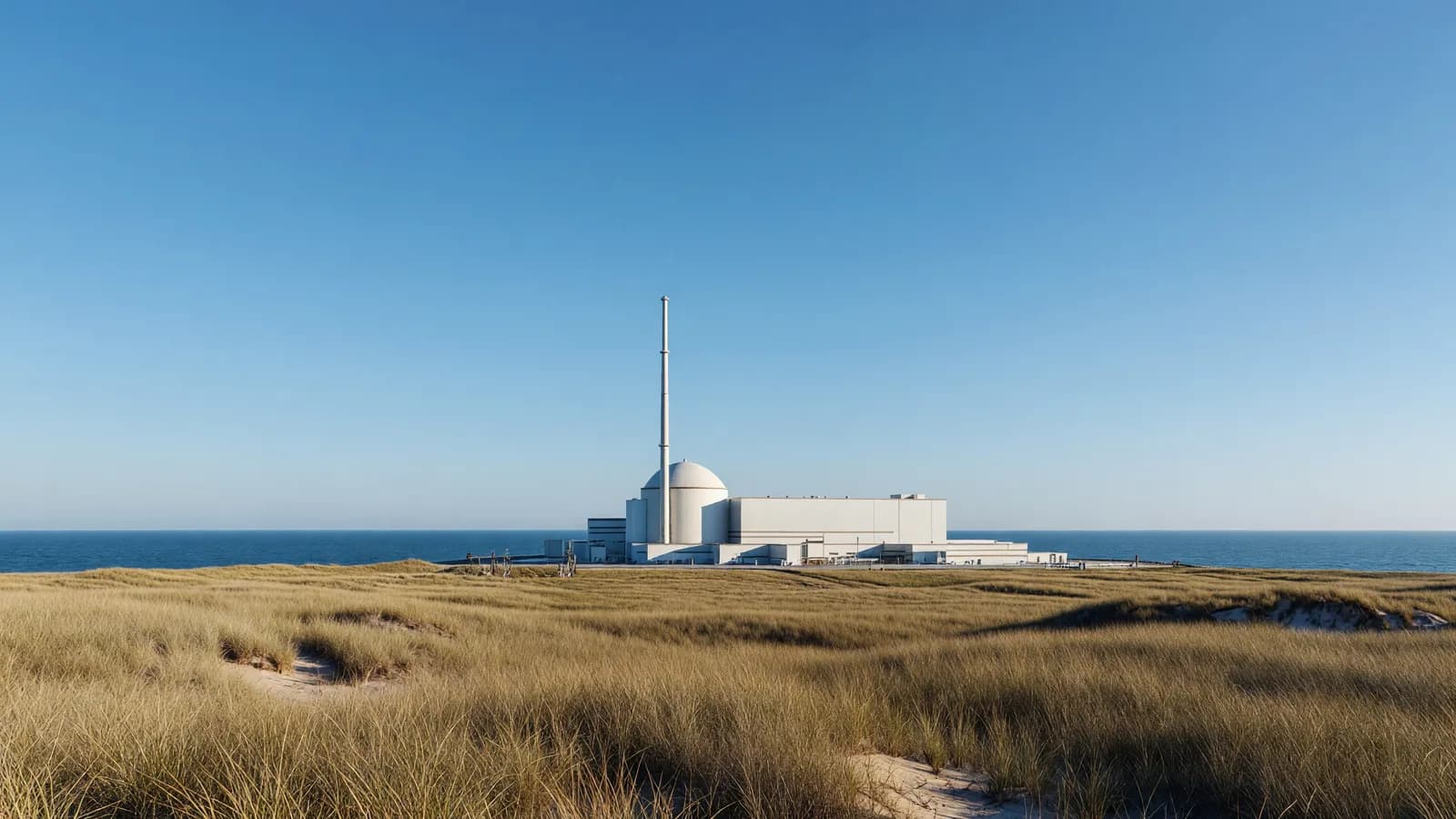
The Nuclear Regulatory Commission has cited Holtec International's Palisades plant for two radiation-safety violations, both classified Green, the agency's lowest significance level, after airborne radioactivity in a reactor-building work pit reached 469 times the regulatory concentration limit during restart maintenance. No worker exceeded dose limits — but the findings surfaced the same week fuel loading began at the 777-MWe Michigan reactor.
Key facts
- The NRC issued two violations, both rated Green and treated as non-cited violations with no fine, in an inspection report dated Aug. 31, 2026.
- Airborne radioactivity inside the reactor building's "tilt pit" hit 173 times the derived air concentration on Feb. 11 and 469 times on Feb. 13 during fuel-handling equipment work.
- 29 personal air samples exceeded the plant's 10-millirem internal-dose evaluation threshold without the required follow-up; preliminary estimates ranged up to 690 millirem.
- A separate shutdown-cooling heat-exchanger job recorded airborne radioactivity of 890 DAC inside the work enclosure, against a 40-DAC stop-work threshold.
- Fuel loading at Palisades began Aug. 31, 2026, placing the plant in Mode 6 with 204 fuel assemblies to move into the vessel.
- The violations cover work between December 2025 and March 2026, before fuel loading started.
What happened
The NRC's inspection report, number 05000255/2026090, documents two findings from a special inspection of radiological work at Palisades during the restart campaign. The first centers on the "tilt pit," an area of the reactor building where maintenance crews worked on fuel-handling equipment in February. Workers in the pit wore respirators and personal air samplers, but airborne radioactivity there reached 173 times the NRC's derived air concentration on Feb. 11 and 469 times on Feb. 13 — mostly alpha-emitting dust, which cannot penetrate skin but delivers intense dose if inhaled.
A floor survey found alpha contamination above the plant's stop-work criteria. Yet the required response never came: the area was not evacuated or posted, workers were not informed, and no condition reports were generated. A continuous air monitor near the work did not detect alpha radiation at all, and follow-up air samples were not collected until about eight hours after the Feb. 11 reading and 16 hours after the Feb. 13 reading, per the MLive account of the report. Workers on the floor above the pit, where readings reached 2.21 and 3.82 DAC, wore no respirators — though Palisades procedures required action at 0.3 DAC.
The second finding involves a January shutdown-cooling heat-exchanger inspection, where airborne radioactivity inside the controlled work enclosure hit 890 DAC — more than 22 times the 40-DAC stop-work threshold — with no condition report documenting the plant's response. Separately, inspectors found that 29 personal air samples exceeding the 10-millirem investigation threshold had never received required dose evaluations, even though several carried preliminary estimates above 100 millirem, including readings of 150, 223, 257, 311 and 690 millirem. Plant personnel argued some samples were cross-contaminated, but inspectors found no documented evaluations supporting that conclusion.
Both findings were classified Green and closed as non-cited violations. The NRC nonetheless called the failures preventable and "more than minor." Holtec Palisades spokesperson Nick Culp acknowledged the deficiencies in a statement to MLive: "The performance did not meet our standards, and we take this issue very seriously. Some workers received greater-than-expected dose associated with these work activities. At no time did any worker approach federal occupational radiation dose limits." The plant has begun reviewing personal air samples back to November 2025, completed pending dose evaluations, and launched a root-cause review, with added controls that Culp said have prevented any recurrence.
Why it matters
The timing is the story. Fuel loading began on Aug. 31 — the same date the inspection report was issued — moving Palisades into Mode 6 under its technical specifications, as NNN covered in Palisades begins fuel loading ahead of planned restart. A Green-rated enforcement action during fuel load is not a restart-stopper: no dose limit was exceeded, no fine was assessed, and Holtec's corrective actions predate the public disclosure. But Palisades is the first U.S. commercial nuclear plant attempting to return to service after entering decommissioning, and every regulatory data point gets magnified under that spotlight.
The findings also sketch the real texture of a restart campaign. Palisades is not a new build with a clean radiological baseline; it is a 1970s pressurized-water reactor that shut in May 2022 and sat in a decommissioning posture while Holtec reversed course. Restart maintenance means opening systems that have been idle for years, in a building where contamination control discipline has to be rebuilt alongside the hardware. Inspectors attributed one violation to shortcomings in identifying and correcting problems, the other to human performance and failure to follow procedures — exactly the categories that matter most for a workforce reassembling an operating culture.
For the broader restart cluster — Duane Arnold, Crane and the others mapped in NNN's nuclear decommissioning market analysis — the Palisades inspection is a live case study in how the NRC grades imperfect execution during a restart: findings public, classification conservative, no tolerance for unevaluated worker doses even when totals stay far below limits.
Background
Palisades is a single-unit pressurized-water reactor on the Lake Michigan shoreline near Covert, Michigan, rated at 777 MWe in operating configuration (Holtec cites 805 MWe for the uprated design). Entergy shut the plant 11 days early in May 2022 and transferred it to Holtec for decommissioning. Holtec instead pursued a restart, backed by a federal loan of up to $1.52 billion and $300 million from Michigan taxpayers.
The NRC's significance spectrum runs Green, White, Yellow and Red. Green findings carry the lowest safety significance and are often resolved without citations, though they still enter the plant's formal corrective-action program and inspection history. A derived air concentration, the unit behind the 173 and 469 figures, is a regulatory yardstick for airborne radioactivity, not a dose multiplier — exposure depends on time in the area and protective equipment, which is why the unevaluated personal air samples, not the pit readings themselves, drove the second violation.
The restart campaign has moved through more than two years of steam-generator tube reinforcement, control-rod-drive nozzle replacement, primary-system decontamination and reactor-vessel inspections. Holtec is also pursuing a separate plan to site two SMR-300 reactors at the Palisades site, which entered the NRC's environmental review in June, as covered in NRC opens environmental review of Holtec's Palisades new-build.
What's next
Fuel loading of the 204-assembly core continues, followed by the testing, inspections and startup activities Holtec has said remain before power operation. The company has not announced a firm commercial-operation date, though Holtec founder and CEO Kris Singh has said he expects Palisades to restart this year, ahead of a contractual power-supply deadline in March 2027.
Near-term watch items: completion of the personal-air-sample review back to November 2025 and its dose conclusions; the root-cause review's findings on why stop-work criteria went unheeded in the tilt pit; and whether the NRC schedules any follow-up inspection of radiological controls during the startup sequence. None of these threatens the restart schedule on its own — but the first-of-a-kind restart is being judged gate by gate, and the next gate is criticality.
Questions
- What did the NRC find at Palisades?
- Two Green findings: the plant failed to control airborne alpha contamination during maintenance and failed to evaluate personal air samples for potential internal worker doses. Both are non-cited violations, meaning no fine was issued.
- Did any worker exceed radiation dose limits?
- No. The NRC found no exposure records showing any worker exceeded or approached federal occupational limits. However, 29 personal air samples exceeded the 10-millirem evaluation threshold and had not been evaluated.
- What does a Green finding mean?
- Green is the lowest of the NRC's four finding significance levels (Green, White, Yellow, Red). It indicates very low safety significance, though inspectors still deemed the Palisades failures preventable and more than minor.
- Will this delay the Palisades restart?
- No delay has been announced. Fuel loading began Aug. 31, 2026, and Holtec says corrective actions — strengthened controls, procedures, oversight and staffing — are in place with no recurrence.
- What is a derived air concentration (DAC)?
- A DAC is the NRC's regulatory measure of airborne radioactive material concentration. Pit readings of 173 and 469 DAC do not mean workers received 173 or 469 times an allowable dose; actual dose depends on respirator use and time in the area.
Sources
- NRC Inspection Report 05000255/2026090 (ML26245A104) — Nuclear Regulatory Commission
- NRC finds radiation safety lapses during Palisades restart work — MLive
- Fuel loading process begins at Palisades — American Nuclear Society
About Nuclear News Network
Nuclear News Network (NNN) is an independent publication covering the global nuclear energy sector — reactor construction, SMRs, fuel supply, policy, operations and fusion. NNN publishes a daily brief, same-day analysis of major developments, and reference guides used across the industry. Articles are produced by the NNN Newsroom, an editorial automation system with human oversight, under the publication's editorial standards. Ruben Seoane is the founder and main editor of NNN.