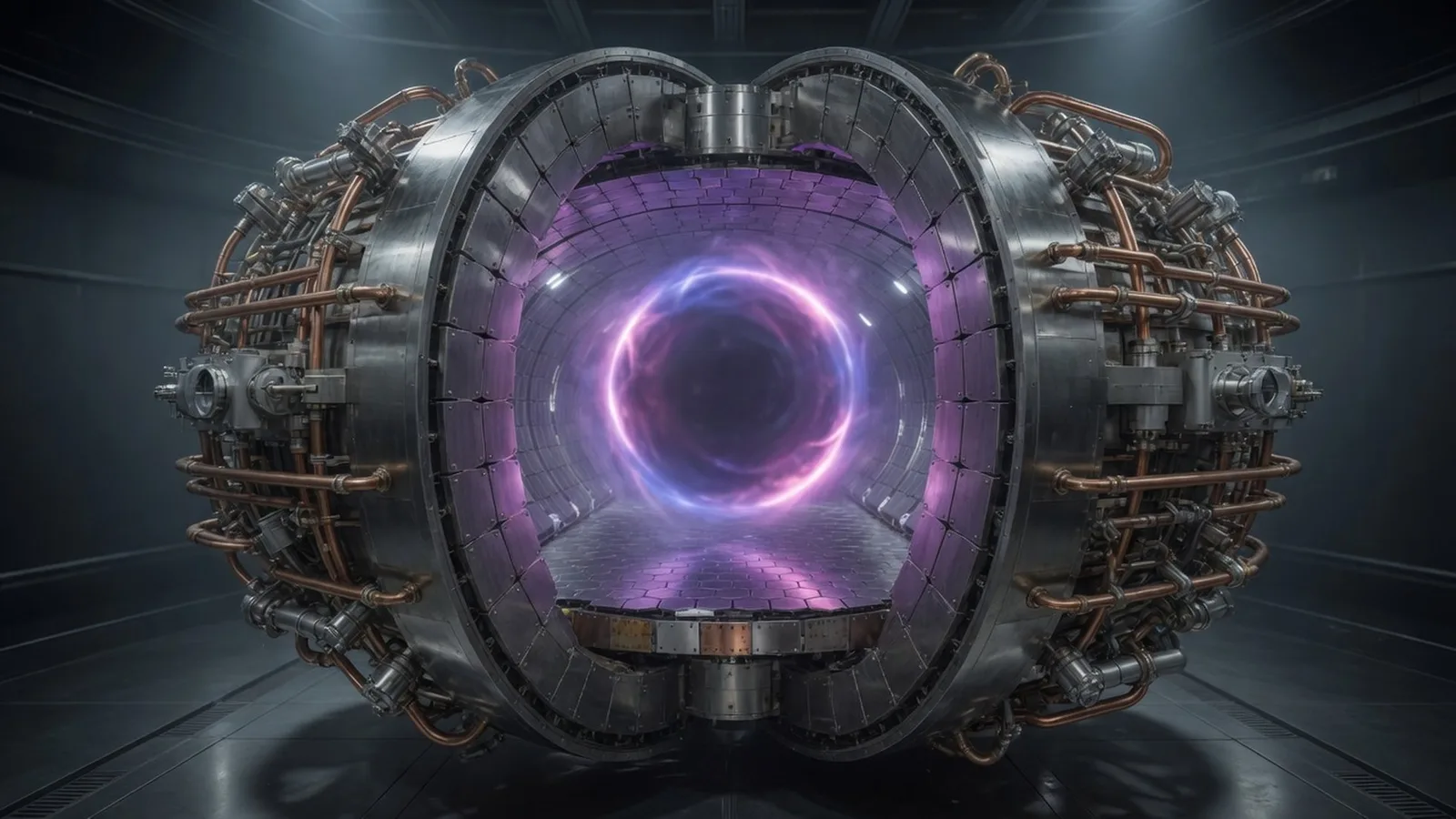
Nuclear fusion is the reaction that combines light atomic nuclei into heavier ones, releasing about four times more energy per kilogram of fuel than nuclear fission — the same process that powers the sun and every other star. It matters because the fuel is effectively inexhaustible, the reaction cannot run away, and it leaves no long-lived high-level waste. The physics has been understood for a century; the unsolved problem is engineering a machine that holds a star's conditions long enough, and cheaply enough, to sell the electricity.
Key facts
- Fusion combines light atoms into heavier ones, releasing roughly 4x more energy per kilogram than fission and nearly 4 million times more than burning coal
- The fuel — usually the hydrogen isotopes deuterium and tritium — must be heated above 100 million degrees Celsius and confined long enough to sustain the reaction
- Three machine families compete: tokamaks, stellarators and laser-driven inertial confinement
- Laser fusion holds the gain record: 8.6 MJ from a 2.08 MJ shot — target gain above 4 — at the National Ignition Facility in 2025
- Private fusion companies have raised $14.24 billion cumulatively, including a record $4.48 billion in the year to mid-2026
- No fusion machine has yet delivered sustained net electricity to a grid
How it works
Two light nuclei carry positive charges, so they repel each other. Fusion happens only when they collide hard enough to overcome that repulsion — which means heating the fuel into a plasma at over 100 million degrees Celsius, roughly ten times hotter than the core of the sun. Stars cheat: their gravity squeezes fuel at pressures no machine can match, so they burn at lower temperatures. On Earth, the whole game is confinement — holding a plasma hotter than anything in the solar system away from every material surface, long enough for fusion output to exceed the power spent heating it.
Three families of machines solve that puzzle in very different ways.
Tokamaks confine the plasma in a donut-shaped magnetic cage, driving a strong current through the plasma itself to complete the confining field. They are the most studied approach and hold most of the field's performance records for sustained fusion power — ITER, the largest science experiment on Earth, is a tokamak, and so is Commonwealth Fusion Systems' SPARC, the leading private machine.
Stellarators twist the chamber and the external magnetic coils themselves so the plasma stays confined without a driven current. That trades enormous engineering complexity at construction time for calmer, more stable plasma at run time — no current means no sudden disruptions. Germany's Wendelstein 7-X, the flagship stellarator, set a world-record triple product over a 43-second plasma in 2025, the key metric on the road to a self-sustaining burn. The approach also holds a regulatory first: in August 2026, Tennessee issued Type One Energy the first state fusion-specific license in the U.S. for its stellarator-based Project Infinity at TVA's Bull Run site.
Inertial confinement abandons sustained confinement entirely: laser pulses compress a peppercorn-sized fuel pellet to fusion conditions for a fraction of a second. A power plant would repeat the shot several times per second. This is the approach that achieved ignition first, at the National Ignition Facility in December 2022.
The numbers
| Metric | Value | Context |
|---|---|---|
| Fusion temperature required | >100 million °C | ~10x hotter than the sun's core |
| Energy density vs fission | ~4x per kg of fuel | ~4 million times chemical combustion |
| First ignition (NIF, Dec 2022) | 3.15 MJ out / 2.05 MJ in | first controlled fusion reaction to exceed its driver energy |
| Record laser shot (NIF, 2025) | 8.6 MJ, target gain >4 | facility still draws ~300 MJ from the grid per shot |
| Stellarator record (W7-X, 2025) | 43-second high-performance plasma | world-record triple product for long pulses |
| First U.S. fusion plant license (Aug 2026) | ~400 MWe Infinity Two | Tennessee byproduct-material license to Type One Energy, Bull Run site |
| ITER research operations | 2034; D-T fusion 2039 | rebaselined in 2024 from the earlier 2025 first-plasma plan |
| Private investment to date | $14.24 billion | record $4.48B raised in the year to mid-2026 |
Common misconceptions
"Fusion produced net energy, so power plants are close." NIF's ignition shots measure fusion output against laser energy delivered to the target — not against the roughly 300 MJ the facility pulls from the grid to fire those lasers. A power plant needs engineering gain, wall-plug to wire, plus materials, tritium breeding and a shot rate no laser system has demonstrated.
"Fusion is just another kind of nuclear power." Today's reactors split heavy atoms in a chain reaction that must be actively controlled. Fusion is the opposite trade: no chain reaction, no meltdown mechanism, no long-lived high-level waste — but a reaction so hard to sustain that any fault simply extinguishes it. Fusion's safety case is easier; its physics case is far harder.
"The tokamak has already won." Tokamaks lead on performance records and capital raised, but laser fusion is the only approach to demonstrate gain above 1, and stellarators may prove the better power-plant topology precisely because they avoid the tokamak's disruption problem. The $14.24 billion private field is still spread across all three families — and several more exotic ones.
Who is building fusion
The private fusion industry counted 56 companies employing more than 16,000 people in the Fusion Industry Association's 2026 survey, up from 23 companies in 2021, and 71% of them expect the first fusion plant to deliver grid electricity in the 2030s. Capital is concentrated at the top: Commonwealth Fusion Systems alone has raised $4 billion, Helion reached a $15.5 billion valuation with its $465 million Series G, and Europe's largest round to date is Proxima Fusion's $518 million. The leading developers by approach:
| Company | Approach | HQ | Flagship machine / next step |
|---|---|---|---|
| Commonwealth Fusion Systems | High-field tokamak (HTS magnets) | US | SPARC (~80% assembled) → ARC, ~400 MWe on PJM grid, early 2030s |
| Helion Energy | Pulsed magneto-inertial (FRC) | US | Polaris → Orion plant under construction in Washington; Microsoft PPA targets 2028 |
| TAE Technologies | Field-reversed configuration | US | Copernicus, on the road to hydrogen-boron fuel |
| Pacific Fusion | Pulsed-power inertial | US | Demonstration System targeting net facility gain ~2030 |
| Type One Energy | Stellarator | US | Infinity One prototype 2029 → ~400 MWe Infinity Two at TVA's Bull Run site, first state fusion license holder |
| Tokamak Energy | Spherical tokamak (HTS) | UK | ST80-HTS → ST-E1 pilot plant |
| Zap Energy | Sheared-flow Z-pinch | US | FuZE-Q → Century repetitive-pulse platform |
| General Fusion | Magnetized target (liquid-metal compression) | Canada | LM26 compression demonstration |
| Proxima Fusion | Quasi-isodynamic stellarator | Germany | Stellaris demonstration plant design |
| Thea Energy | Planar-coil stellarator | US | Eos neutron-production system |
| Marvel Fusion | Laser inertial (nanostructured targets) | Germany | Laser facility with Colorado State University |
| Focused Energy | Laser inertial | Germany/US | Direct-drive laser facility and targets |
| Xcimer Energy | Laser inertial (excimer amplifiers) | US | Phoenix laser system |
| First Light Fusion | Inertial (amplifier technology) | UK | Pivoted to supplying pressure-amplifier targets to other developers |
| Energy Singularity | High-field tokamak (HTS) | China | HH70 (first all-HTS tokamak, operated 2024) → HH170 |
| ENN | Field-reversed configuration | China | Xuanlong series, hydrogen-boron ambition |
| Kyoto Fusioneering | Plant systems and fuel-cycle supply chain | Japan | UNITY test facilities for blankets and tritium handling |
| SHINE Technologies | Fusion neutron applications | US | Stepwise path: isotopes and inspection today, power later |
The list runs longer — the FIA counts stellarator, mirror, levitated-dipole and electrostatic ventures from New Zealand to Sweden — but the table above holds most of the $14.24 billion invested to date.
Current state (September 2026)
The field's center of gravity is shifting from laboratories to companies. Commonwealth Fusion Systems raised another $1 billion in July 2026, bringing its total to $4 billion, with CEO Bob Mumgaard putting SPARC assembly at roughly 80% complete and holding to grid power from the follow-on ARC plant in the early 2030s. Industry-wide, the Fusion Industry Association counted a record $4.48 billion raised in a single year. Regulators are moving too: on August 31, 2026, Tennessee issued Type One Energy the first fusion-specific license granted by any U.S. state — a byproduct-material license, the pathway the NRC settled on for fusion in 2023 — for its stellarator-based Project Infinity at TVA's retired Bull Run coal site in Clinton, Tennessee. The company initiated licensing in January 2026 and targets its Infinity One prototype in 2029 and a roughly 400 MWe Infinity Two plant in the early-to-mid 2030s. On the public side, ITER's rebaselined schedule targets research operations in 2034, while NIF keeps raising the gain ceiling and Wendelstein 7-X extends the stellarator's long-pulse records. The scoreboard that matters — sustained net electricity on a grid — still reads zero for every approach.
Related reading
For the money and hardware behind the leading private tokamak, see NNN's coverage of Commonwealth Fusion Systems' $1 billion raise. Fusion is also one thread in the U.S. government's AI-for-science push tracked in DOE's Genesis Mission project portfolio, and the test-bed model for advanced machines has a fission cousin in the DOME microreactor test bed.
Questions
- What is nuclear fusion?
- Nuclear fusion is the reaction that combines light atomic nuclei — typically the hydrogen isotopes deuterium and tritium — into heavier ones, releasing about four times more energy per kilogram of fuel than nuclear fission. It is the process that powers the sun and other stars.
- What is the difference between a tokamak and a stellarator?
- Both confine plasma magnetically in a torus. A tokamak uses a symmetric donut-shaped chamber and drives a current through the plasma to complete the confining field; a stellarator twists the chamber and external coils themselves, so the plasma stays confined without a driven current — harder to build, calmer to run.
- Has fusion produced net energy?
- At the target, yes. The National Ignition Facility achieved ignition in December 2022 (3.15 MJ out from 2.05 MJ of laser energy) and reached 8.6 MJ — a target gain above 4 — in 2025. But the facility's lasers draw far more electricity from the grid than the target releases, and no approach has yet delivered sustained net electricity to a grid.
- Is fusion the same as the nuclear power we have today?
- No. Today's nuclear plants use fission — splitting heavy uranium atoms in a chain reaction. Fusion joins light atoms, cannot sustain a runaway chain reaction, and produces no long-lived high-level waste, but it is far harder to sustain: the fuel must be held above 100 million degrees Celsius.
- When will fusion electricity reach the grid?
- No fusion machine has yet generated grid electricity. The most aggressive private roadmaps — such as Commonwealth Fusion Systems' ARC plant — target the early 2030s; the international ITER project now plans to begin research operations in 2034 and full deuterium-tritium fusion in 2039. Stellarator developer Type One Energy, holder of the first U.S. state fusion plant license, targets a ~400 MWe plant at TVA's Bull Run site in the early-to-mid 2030s.
Sources
- What is nuclear fusion? — IAEA
- Achieving Fusion Ignition — Lawrence Livermore National Laboratory
- Target Breakthrough Enabled Fusion Record at NIF — Lawrence Livermore National Laboratory
- New performance records on Wendelstein 7-X — Max Planck Institute for Plasma Physics
- ITER Project new baseline — ITER Organization
- Fusion Industry Attracts Record Annual Funding of $4.48bn, Raising Total to $14.24bn — Fusion Industry Association
- A Regulatory Breakthrough for Fusion: The Bull Run Energy Complex — Type One Energy
- Type One Energy initiates licensing of fusion power plant — World Nuclear News
- Commonwealth Fusion Systems Raises Another $1 Billion as Work on Commercial Power Plant Continues — POWER Magazine
About Nuclear News Network
Nuclear News Network (NNN) is an independent publication covering the global nuclear energy sector — reactor construction, SMRs, fuel supply, policy, operations and fusion. NNN publishes a daily brief, same-day analysis of major developments, and reference guides used across the industry. Articles are produced by the NNN Newsroom, an editorial automation system with human oversight, under the publication's editorial standards. Ruben Seoane is the founder and main editor of NNN.