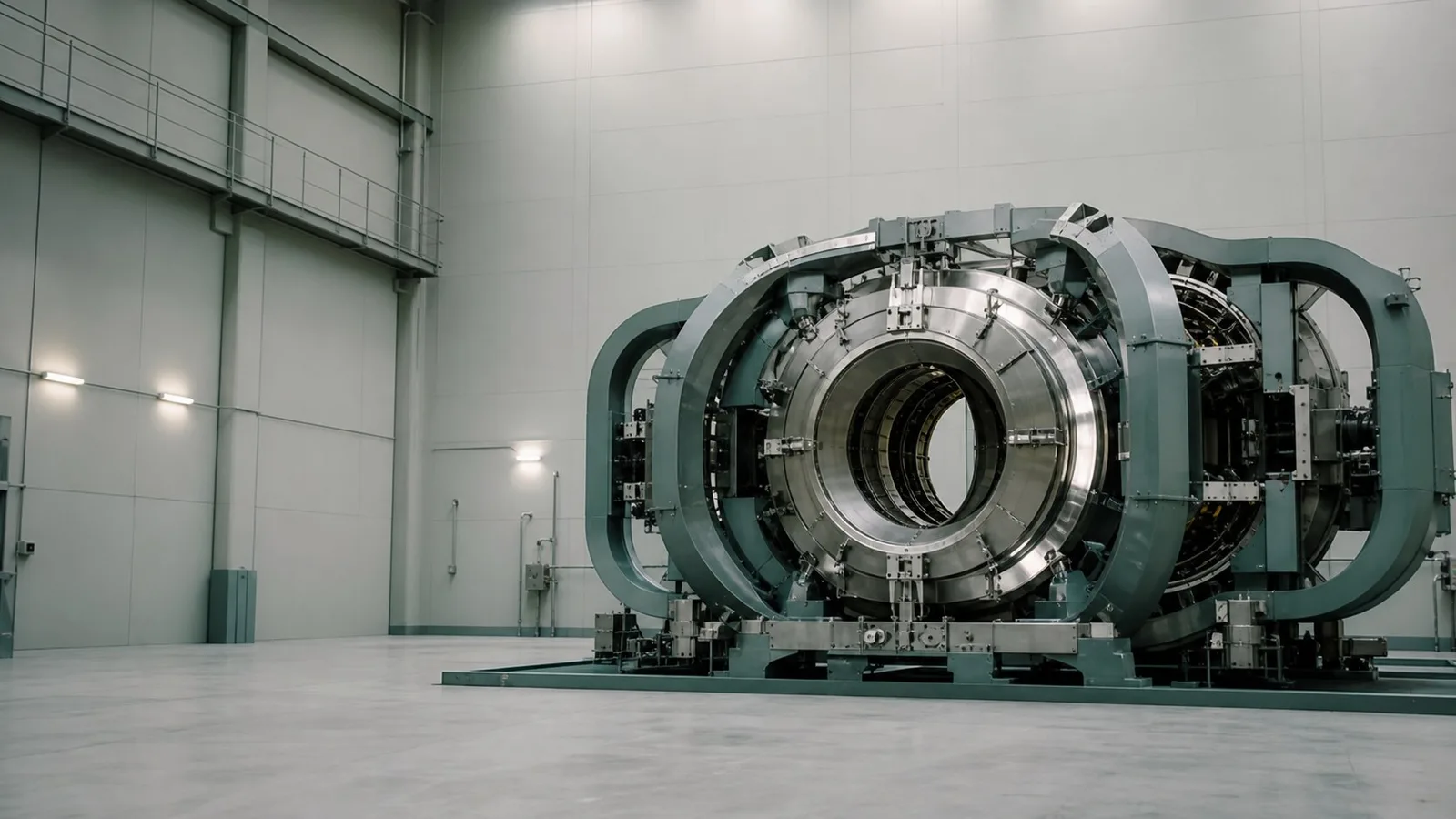
Commonwealth Fusion Systems has raised another $1 billion in equity, bringing total capital in the Massachusetts fusion company to $4 billion. Announced July 30, the round is the largest single fusion-company funding package since CFS's own $1.8 billion raise in 2021.
Key facts
- CFS closed a $1 billion equity round announced July 30, 2026.
- Total capital invested in CFS is now $4 billion, including $863 million raised in 2025.
- CFS says the round is the largest single fusion raise since its 2021 $1.8 billion financing.
- CEO Bob Mumgaard said SPARC is about 80% complete and deep into tokamak assembly.
- CFS has applied to connect its planned ARC plant to PJM and still targets grid power in the early 2030s.
What happened
According to POWER Magazine, a broad investor group — including pension funds, sovereign wealth funds and infrastructure/industrial corporates — put another $1 billion into CFS. The company did not disclose valuation. Management framed the money as acceleration capital: finish SPARC, then move quickly into ARC, the planned commercial pilot plant meant to sell power rather than only demonstrate physics.
Mumgaard told a briefing call SPARC construction is roughly 80% done. That is not a new first-plasma date, and CFS declined to update the public schedule. It is, however, a more industrial status report than fusion companies usually give at fundraising time: magnets and support systems at Devens, Massachusetts, with assembly of the tokamak itself under way.
CFS also used the moment to spotlight new CFO Lorence Kim, formerly of Moderna and Goldman Sachs biotech banking, as part of a shift toward investors who underwrite infrastructure and operating companies, not only deep-tech venture bets. Kim told the briefing that continued multi-sector investment is recognition of CFS's position in the private fusion field and that the company intends to lead when commercial fusion arrives.
Why it matters
Fusion financing is no longer a novelty metric; it is a sorting mechanism. A $1 billion check does not prove net energy. It does prove that large, slow capital is still willing to underwrite a U.S. private tokamak path while Chinese public and directed fusion investment is estimated in the multi-billion to low-tens-of-billions range by industry researchers cited in POWER's account.
CFS says its $4 billion haul is about 30% of all fusion capital raised globally to date. Even allowing for definitional disputes, that concentration matters. If SPARC works, ARC is already being positioned inside a real market structure through the PJM interconnection application and offtake-minded partners such as Google and Eni. Dominion Energy is also in the partnership set around the grid path. For context on the machine classes in play, see NNN's fusion explainer.
Background
CFS is commercializing a high-field tokamak approach using high-temperature superconducting magnets. SPARC is the compact demonstration device under assembly in Devens. ARC is the follow-on plant intended to put electricity on the grid in the early 2030s. That two-step roadmap is the company's answer to the sector's credibility problem: show a fast experimental machine, then a power plant with customers and a queue position, not an endless science project.
The company manufactures circular poloidal-field magnets on the Devens campus and has been inviting investors to see hardware rather than only pitch decks. That factory-tour posture is part of why infrastructure and sovereign capital is now showing up beside classic tech money. It is also why the SPARC completion percentage matters more than another vague "progressing toward first plasma" line.
The latest round lands in a wider energy-capital story NNN tracks across fission and AI load growth. Fusion is competing with SMRs and gas for the same long-duration offtake conversations. A balance sheet that can fund hardware through SPARC turn-on is a prerequisite for being in those conversations at all. Related NNN coverage on federal AI-science infrastructure, including the Genesis Mission nuclear portfolio, is the policy backdrop against which private fusion capital is being judged.
What's next
The only milestones that will reprice this raise are technical and regulatory. Watch for a firmer SPARC completion and first-plasma window, evidence that the 80% assembly claim converts into an operating campaign, and real progress on ARC's PJM queue and site development with utility partners. Fundraising bought CFS more runway. SPARC still has to earn the next chapter.
If the machine slips while the balance sheet swells, CFS becomes another cautionary capitalization story. If SPARC turns on and ARC keeps its early-2030s grid claim credible, this $1 billion round will look like the bridge from physics company to power developer.
Questions
- How much did Commonwealth Fusion Systems raise?
- CFS announced a $1 billion equity round on July 30, 2026. POWER Magazine reports it is the largest single fusion-company funding round since CFS's own $1.8 billion raise in 2021.
- How much capital has CFS raised in total?
- The new round brings total capital invested in CFS to $4 billion, including $863 million raised in 2025, according to the company via POWER.
- What will the money fund?
- CFS says the capital supports continued work toward a commercial fusion power plant, accelerating the path from SPARC demonstration to the planned ARC grid-connected plant.
- How complete is SPARC?
- CEO Bob Mumgaard said SPARC completion is about 80% and the company is deep into tokamak assembly, without giving a new public completion date.
- When does CFS expect grid power?
- CFS says it is on track to put power on the grid in the early 2030s, and earlier this year applied to connect ARC to PJM Interconnection.
Sources
- Commonwealth Fusion Systems Raises Another $1 Billion as Work on Commercial Power Plant Continues — POWER Magazine
- Nuclear fusion, explained: three ways to bottle a star — Nuclear News Network
About Nuclear News Network
Nuclear News Network (NNN) is an independent publication covering the global nuclear energy sector — reactor construction, SMRs, fuel supply, policy, operations and fusion. NNN publishes a daily brief, same-day analysis of major developments, and reference guides used across the industry. Articles are produced by the NNN Newsroom, an editorial automation system with human oversight, under the publication's editorial standards. Ruben Seoane is the founder and main editor of NNN.