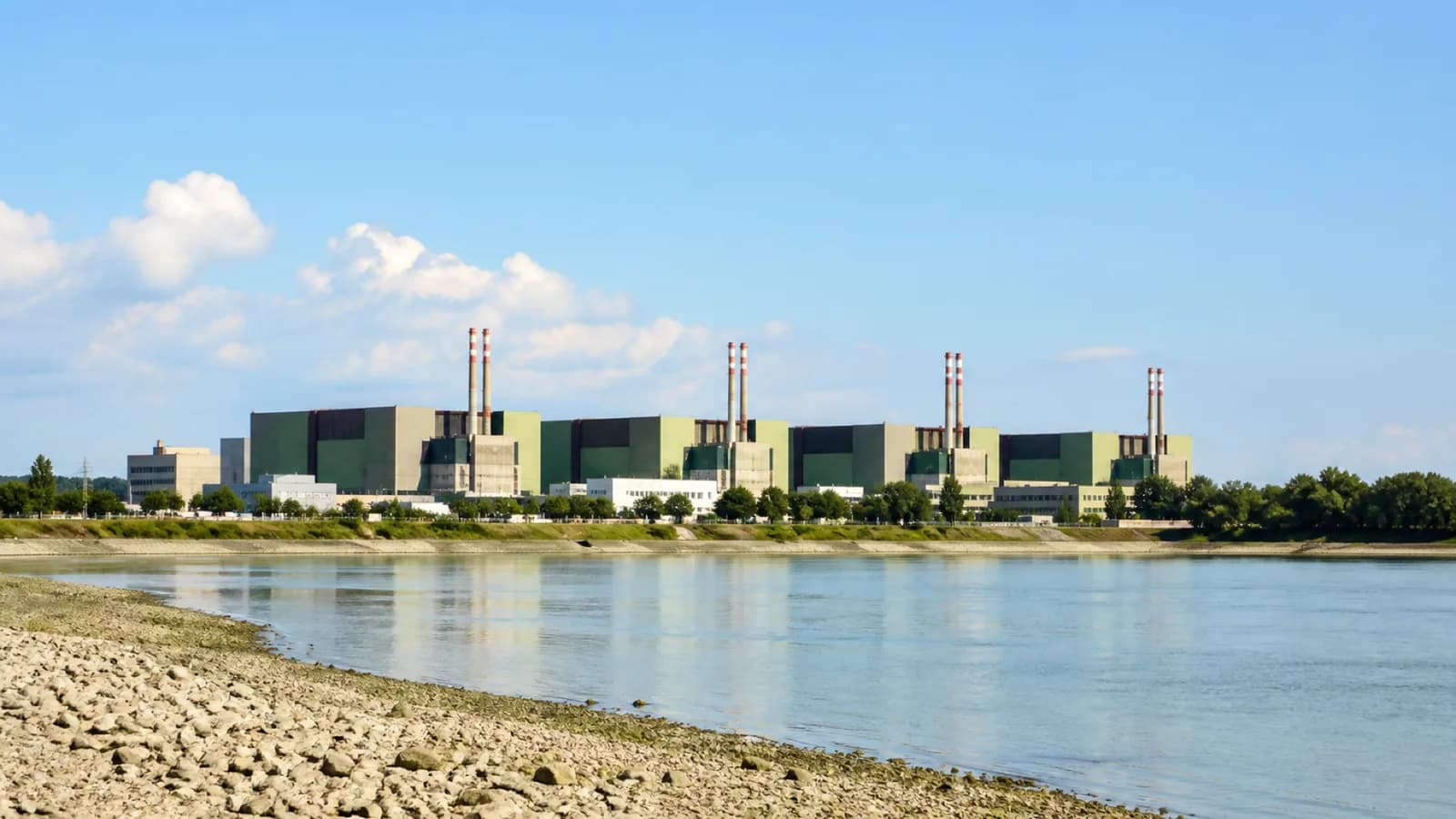
Hungary's Paks nuclear power station has returned Units 1 and 3 to nominal power as the Danube rises and a submerged riverbed sill restores cooling-water conditions. The recovery puts two of the four reactors back at full rated output after drought-related restrictions exposed a direct link between river levels and nuclear availability.
Key facts
- Unit 1 returned to nominal power at 19:39 local time on August 23, 2026.
- Unit 3 returned to nominal power at 07:01 on August 24, according to Hungary's nuclear regulator.
- Paks has four VVER-440/V-213 reactors rated at 479 MW each.
- Unit 2 returned to nominal operation on August 10 after 11 days at 50% capacity.
- The recovery followed rising Danube levels and construction of a submerged sill in the riverbed.
What happened
MVM Paksi Atomerőmű, the operator of Hungary's only commercial nuclear power station, said Unit 1 was back at nominal power on the evening of August 23. The announcement linked the restart to the rising Danube and to construction of a bottom sill, a low submerged structure intended to preserve water depth near the plant's cooling-water intake.
The Hungarian Atomic Energy Authority then reported that Unit 3 reached nominal power at 07:01 on August 24. The regulator said the higher river level and the sill had allowed the station to increase the units' output gradually. It also said further increases would be carried out under safety requirements and with continued monitoring of plant conditions.
That leaves the plant in a partial recovery rather than a clean return to normal. Unit 2 had already reached nominal power on August 10 after spending 11 days at half output. The latest MVM and regulator notices do not identify Unit 4 as having returned to nominal power, so the immediate operating picture is two units at nominal output, with the wider recovery still under way.
The original problem was not damage to the reactors. Low water in the Danube made it harder to maintain the cooling-water supply conditions needed for continued operation. Operators reduced output and shut down units in stages as the river fell. The response was operational and precautionary: protect cooling margin first, then restore output as conditions allow.
Why it matters
Paks is a large piece of Hungary's electricity system. Its four reactors are each rated at 479 MW, and the plant normally supplies about half of the country's electricity production, according to the operator's figures cited by NucNet. When river conditions forced the station to operate with only one unit at very reduced power, the effect was visible far beyond the plant fence.
The episode also shows why reactor nameplate capacity can be a poor guide to short-term availability. The core, turbine and generator can all be ready to run while the plant still has to reduce power because the water system is losing margin. That is the same distinction NNN examined when Romania shut both Cernavoda reactors after the Danube fell below its cooling threshold. At Cernavoda, the river fell below a defined operating level. At Paks, Hungary used river engineering and staged load changes to keep the plant operating and bring units back.
The two cases are close enough to be compared, but not collapsed into one story. Romania's Cernavoda units went into safe shutdown. Paks is recovering. Both show that a nuclear plant's dependable output depends on supporting infrastructure, hydrology and the operating rules applied when conditions move outside the design envelope.
NNN's operations and safety coverage follows that practical side of nuclear performance. The question is often not whether a reactor can generate electricity in principle. It is whether the systems that supply cooling water, electrical power and other services can keep doing their jobs on the day the grid needs the plant most.
Background
Paks has four Soviet-designed VVER-440/V-213 pressurized-water reactors. The station is on the Danube in southern Hungary, and the river provides the cooling water used to remove heat from the plant. During the latest low-water episode, Units 1, 3 and 4 were shut down while Unit 2 continued at reduced output before returning to nominal power on August 10.
Hungarian authorities announced a two-part response in August. The longer-term measure was the riverbed sill. The government also prepared two barges that could be sunk temporarily to raise water levels near the plant if the river fell again. World Nuclear News reported that the sill work would begin with 35,000 cubic metres of stone followed by 110,000 cubic metres. Those quantities describe the physical scale of the intervention, not a guarantee that the plant will be insulated from future drought.
This matters for the wider European fleet because many nuclear plants use rivers, lakes or coastal water for heat rejection. Drought and heat can affect the amount, temperature and accessibility of that water. NNN's Gravelines coverage documented a different cooling-water constraint, when marine organisms clogged seawater pumps and forced EDF to reduce output. The hardware and trigger were different; the availability lesson was not.
What's next
The next marker is Unit 4. The operator and regulator will need to show whether the riverbed works and rising water levels provide enough stable margin for the remaining unit to return to service. The plant's load changes will remain subject to the Hungarian Atomic Energy Authority's oversight and to the river conditions at the intake.
The forecast matters as much as the latest measurement. A short rise can restore operating conditions without ending the underlying drought. If the Danube falls again, MVM has already shown that it can reduce output in stages. The clean reading of the August recovery is narrower: Paks has brought two more reactors back to nominal power, but river-dependent nuclear availability remains a live operating issue.
Questions
- Why were Paks reactors reduced or shut down?
- Low Danube water levels affected cooling-water availability at the plant. MVM Paks reduced output and shut down units while operators and authorities worked to restore stable conditions for safe operation.
- How many Paks reactors are back at nominal power?
- Units 1 and 3 returned to nominal power on August 23 and 24, 2026. Unit 2 had already returned to nominal operation on August 10; Unit 4 was not identified as nominal in the latest operator report.
- How large is the Paks plant?
- Paks has four Russia-designed VVER-440/V-213 pressurized-water reactors rated at 479 MW each, according to NucNet's report of the operator's update.
- Does the restart mean the Danube risk is over?
- No. The Hungarian regulator said further load increases would continue under safety requirements and continuous monitoring of the plant's technical condition and river conditions.
Sources
- Üzemi esemény: Újra névleges teljesítményen üzemel az 1. blokk — MVM Paksi Atomerőmű
- Újra névleges teljesítményen üzemel a Paksi Atomerőmű 3. blokkja — Hungarian Atomic Energy Authority
- Two Paks Reactor Units Return To Nominal Power As Danube Waters Rise — NucNet
- Romanian plant taken offline as Hungary moves to keep Paks operating — World Nuclear News
About Nuclear News Network
Nuclear News Network (NNN) is an independent publication covering the global nuclear energy sector — reactor construction, SMRs, fuel supply, policy, operations and fusion. NNN publishes a daily brief, same-day analysis of major developments, and reference guides used across the industry. Articles are produced by the NNN Newsroom, an editorial automation system with human oversight, under the publication's editorial standards. Ruben Seoane is the founder and main editor of NNN.