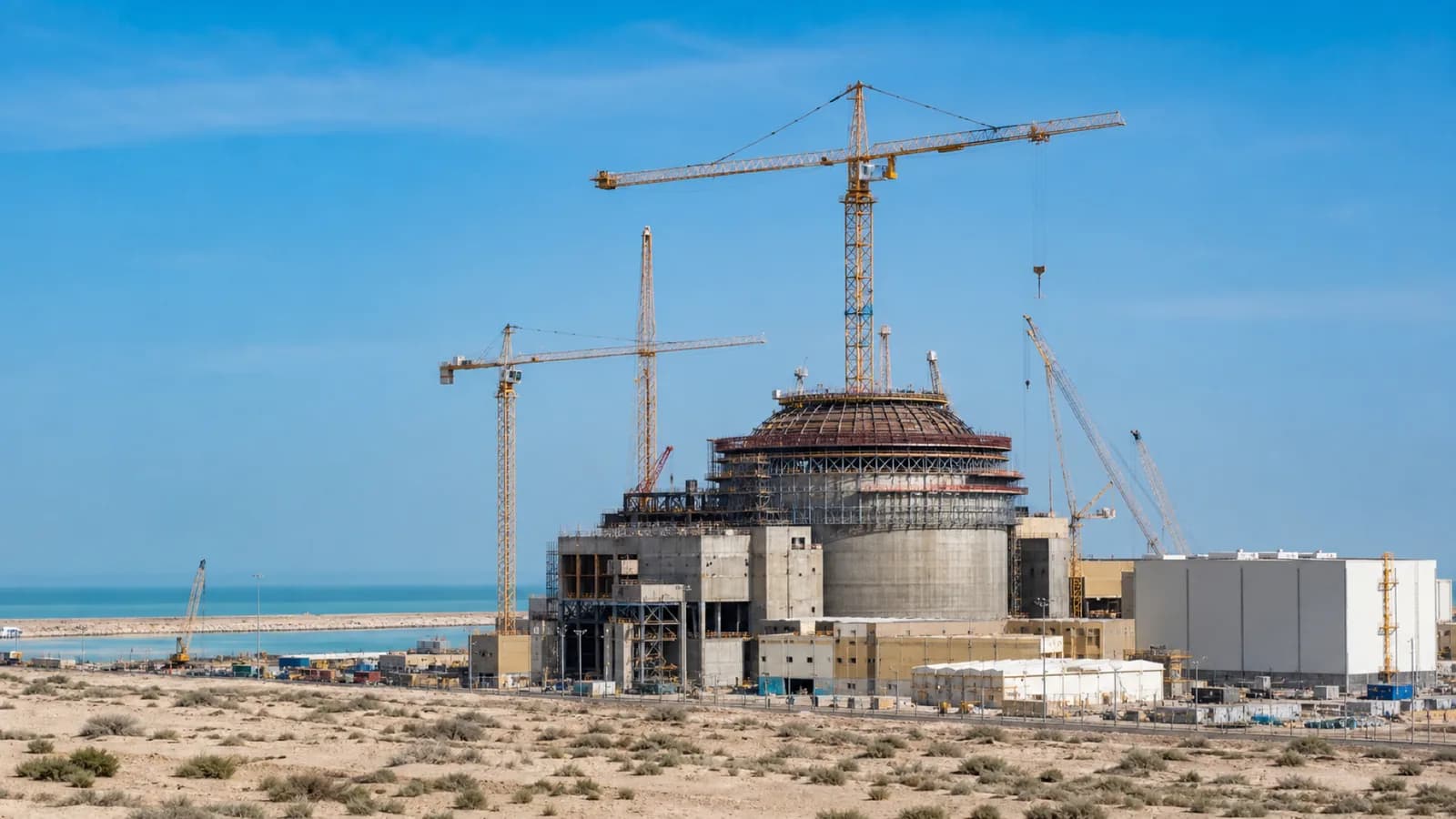
Rosatom has begun returning Russian engineering specialists to Iran's Bushehr Nuclear Power Plant, with five workers back on site and 25 Russian specialists now present. The move allows construction work to continue on two additional reactors, but a full staffing return still depends on the security situation and a lasting agreement to end hostilities, according to Rosatom Director General Alexei Likhachev.
Key facts
- Five Russian engineering specialists have returned to the Bushehr site.
- The returning group brings the Russian project team to 25 people.
- Rosatom plans to raise the project staff to 100 by autumn, if there is no further escalation.
- Bushehr 1 is a 915 MWe Russian-designed VVER unit that was connected to the grid in 2011.
- Units 2 and 3 are VVER-1000 reactors under construction.
What happened
Likhachev said Rosatom has started bringing personnel back to the Bushehr construction site after staff were evacuated during the conflict. The first five engineering and technical workers have arrived. TASS reported that the total Russian presence has reached 25, while the next group could include several dozen employees within two weeks if the security situation holds.
Likhachev's condition matters. He said Rosatom wants to return all specialists who were evacuated, but a return to pre-war staffing levels would require final agreements between the United States and Iran on a cessation of hostilities. The company is therefore rebuilding its site team in stages rather than treating the first arrivals as a full restart.
The immediate work is on Bushehr Units 2 and 3. World Nuclear News reported that construction of their main and auxiliary buildings is continuing, together with preparatory work on hydraulic structures. Those activities are distinct from operating a reactor: the staffing announcement does not mean either new unit has been fuelled, started up or connected to the grid.
Why it matters
Bushehr is already an operating nuclear site, but the news concerns its expansion. Bushehr 1, a Russian-designed VVER unit, entered grid service in 2011. Units 2 and 3 are larger VVER-1000 projects intended to add capacity while extending Russia's role in Iran's nuclear power programme.
The return of personnel is a narrow operational signal. It says Rosatom believes enough access and security exist to resume more normal project activity. It does not settle the harder questions around schedule, equipment delivery, financing or the conditions under which a long-term construction workforce can remain at the site.
That distinction is important at a plant operating in a conflict-affected environment. Staffing supports engineering coordination, construction supervision, quality control and the interface between Russian suppliers and Iranian contractors. It cannot by itself remove the risks created by renewed military action or uncertain transport and procurement conditions.
NNN's operations and safety coverage follows the same practical question at other sites: which systems and people remain available when a plant's normal operating assumptions are disrupted? At Zaporizhzhia, for example, the issue has been the resilience of cooling and off-site power during repeated outages. Bushehr is a different situation, but the common thread is operational margin under security pressure.
Background
Bushehr 1 is a VVER-1000 design adapted and completed with Russian involvement, and its rated capacity is 915 MWe. The two newer units use VVER-1000 technology. Unit 2 received first concrete in 2019, and World Nuclear News reported that the core catcher was installed in 2024. In January, the third tier of the inner containment building was installed.
Likhachev said in May that Bushehr 2 was more than 60% complete, while its steam generators were 50% complete. He also said key equipment shipments were planned for the following year. These figures came before the latest staffing announcement and do not constitute a new project completion estimate.
Iran had suggested an operating target of 2029 for Unit 2 at an International Atomic Energy Agency General Conference event in 2024. Whether that target remains credible will depend on the pace of construction, equipment supply and the ability to maintain a stable workforce. For readers new to the project pipeline, NNN's reactor licensing process explainer sets out why construction progress and permission to operate are separate gates.
The wider programme also reaches beyond the two large units. Rosatom and the Atomic Energy Organization of Iran signed a memorandum of understanding on small modular reactor cooperation in 2025. That agreement is a policy and commercial signal, not evidence that an Iranian SMR project has entered construction.
What's next
The next watchpoint is whether Rosatom sends the additional group of specialists it described as possible within two weeks. The more consequential test will be whether the Russian workforce can grow toward the stated target of 100 by autumn without another security interruption.
NNN will also be watching for a revised schedule, evidence of major equipment shipments and new construction milestones at Bushehr 2 and 3. Until those appear, the clearest reading is limited but concrete: five specialists have returned, work is continuing, and the project remains exposed to the conflict conditions that forced the earlier evacuation.
Questions
- How many Rosatom specialists have returned to Bushehr?
- Rosatom says five Russian engineering specialists have returned, bringing the total Russian staff at the Bushehr site to 25.
- Is Bushehr 2 operating?
- No. Bushehr 2 is under construction. The operating unit is Bushehr 1, while Bushehr 2 and 3 are being built as VVER-1000 reactors.
- What could slow the staff return?
- Rosatom Director General Alexei Likhachev said a full return depends on the security situation and final agreements between the United States and Iran to end hostilities.
- What work is continuing at Bushehr?
- World Nuclear News reports that work continues on the main and auxiliary buildings for Units 2 and 3, along with preparatory work on hydraulic structures.
Sources
- Rosatom staff begin returning to Iran's Bushehr nuclear plant — World Nuclear News
- Rosatom begins returning specialists to Bushehr NPP — TASS
About Nuclear News Network
Nuclear News Network (NNN) is an independent publication covering the global nuclear energy sector — reactor construction, SMRs, fuel supply, policy, operations and fusion. NNN publishes a daily brief, same-day analysis of major developments, and reference guides used across the industry. Articles are produced by the NNN Newsroom, an editorial automation system with human oversight, under the publication's editorial standards. Ruben Seoane is the founder and main editor of NNN.