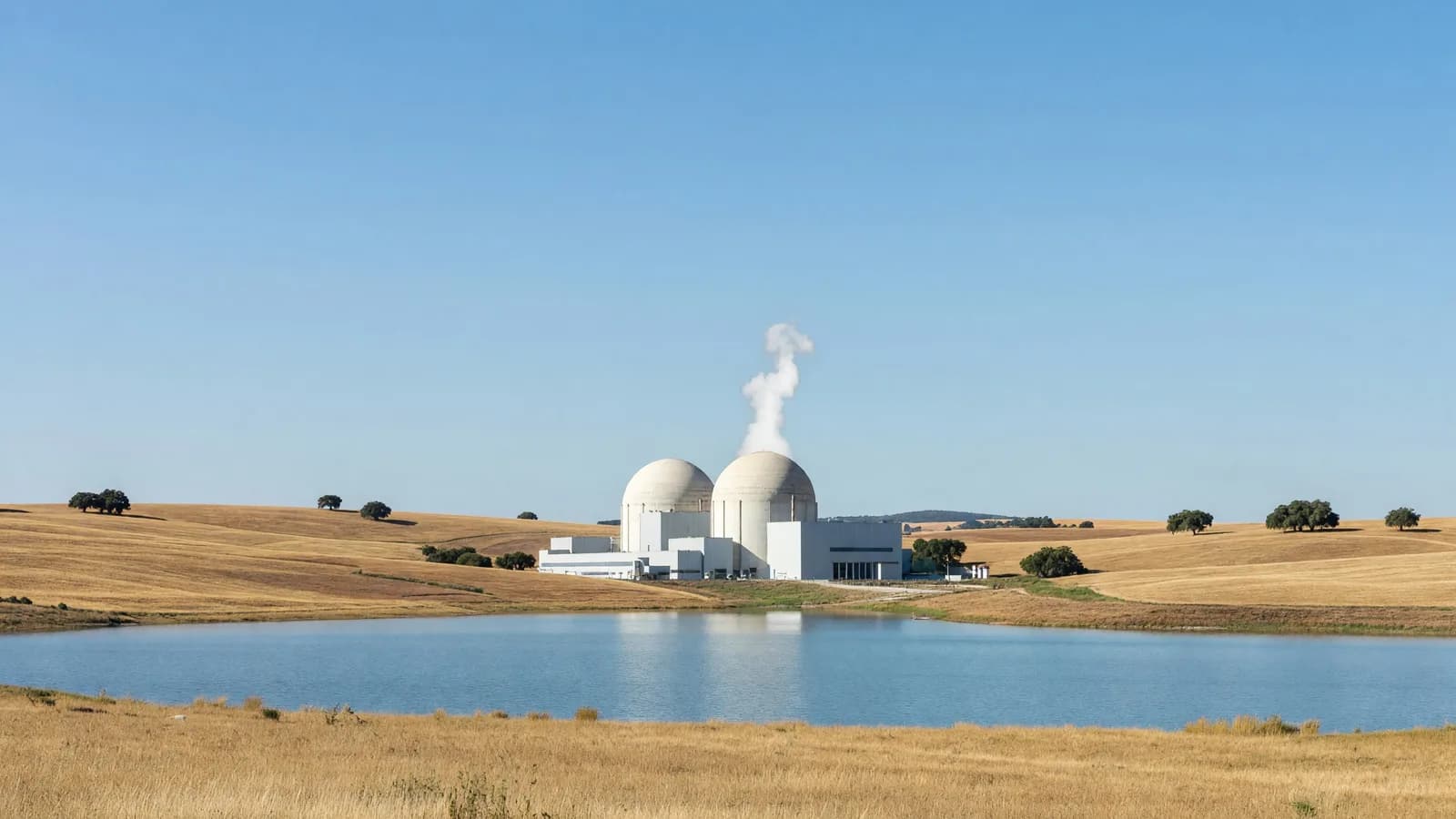
Spain has officially renewed the operating licence of the two-unit Almaraz nuclear power plant until June 2030, overriding phase-out shutdown dates of October 2027 and October 2028. It is the first concrete retreat from the closure calendar Spain agreed in 2019 — even as the government insists the 2035 end date for the whole fleet still stands.
Key facts
- A ministerial order from MITECO was published in the Official State Gazette on August 14, 2026, granting the licence renewal to June 2030.
- Under the 2019 phase-out schedule, Unit 1 was to close in October 2027 and Unit 2 in October 2028.
- Spain's Nuclear Safety Council (CSN) issued a favourable report last month, concluding the plant can operate safely until June 2030.
- Almaraz supplies more than 7% of Spain's electricity — about 4 million homes — and employs roughly 4,000 people.
- The ministry says the extension does not alter the 2035 closing date for Spain's entire nuclear park.
What happened
The Ministry for Ecological Transition and the Demographic Challenge (MITECO) published the renewal order after a process that began on October 30, 2025, when the board of operator Centrales Nucleares Almaraz-Trillo (CNAT) — acting for owners Iberdrola, Endesa and Naturgy — formally requested the extension. MITECO asked the Nuclear Safety Council for its mandatory report in November; the CSN's favourable conclusion arrived in July, finding the plant meets the conditions to operate safely until June 2030.
The government's stated rationale is explicitly economic and geopolitical. The ministry cited "uncertainty in international energy markets" caused by the armed conflict in the Middle East and the continuing war in Ukraine, and said the "limited and temporary extension may help to moderate the exposure of Spanish consumers to previously unforeseen price spikes" while renewables and storage continue to deploy as the structural answer.
The technical groundwork was already in place: when the CSN renewed Almaraz's licence in June 2020, it approved operation until June 2030 — standard ten-year terms — and the earlier 2027/2028 dates were a political overlay from the phase-out agreement, not a safety boundary.
Why it matters
Spain's seven reactors generate about 20% of its electricity. The 2019 phase-out plan front-loaded the pain: four reactors, including both Almaraz units, were to close by the end of 2030. Moving Almaraz's dates is therefore not a rounding error — it defers the single largest early tranche of retirements in the schedule.
It also lands in a European context where firm capacity is being repriced in real time. This week NNN covered Cernavoda shutting both reactors over Danube cooling constraints while Hungary spends to keep Paks running — governments are discovering how expensive it is to lose dispatchable baseload at the wrong moment. Madrid's own framing — consumer price exposure, imported-fuel dependence — reads as an admission that the phase-out calendar was written for a different energy market.
Industry is treating the door as open, not ajar. Foro Nuclear president Marta Ugalde called for a review of "the regulatory, economic, and tax conditions" for continued nuclear operation, and World Nuclear Association Director General Sama Bilbao y León said she hopes this is "the first step" toward extending Almaraz and the rest of the fleet to 60 years of operation.
Background
Almaraz Units 1 and 2 are pressurized water reactors of 1,011 MWe and 1,006 MWe net, in commercial operation since 1983 and 1984. The 2019 closure protocol — agreed between the government and the utilities — set a staggered national exit: Almaraz first, then Ascó, Cofrentes, Trillo and Vandellós II, with the last unit off the grid by 2035. The utilities' October 2025 extension request was the first formal crack in that protocol, and the CSN's July report removed the safety argument against it.
What's next
Three markers will show whether June 2030 is a ceiling or a floor. First, whether CNAT's owners file for operation beyond 2030 — the CSN's ten-year licence logic and the industry's 60-year ambitions point that way. Second, whether Ascó, whose closure dates come next in the calendar, follows the Almaraz playbook. Third, whether the government's "2035 stands" line survives the next price spike: the same energy-security reasoning it used for this order applies to every reactor in the fleet. The phase-out is still official policy — but as of August 14, its dates are negotiable.
Questions
- What did the Spanish government approve for Almaraz?
- A MITECO order published in the Official State Gazette on August 14, 2026 renews the operating licence for both Almaraz units until June 2030, replacing the previously agreed shutdown dates of October 2027 for Unit 1 and October 2028 for Unit 2.
- Does this end Spain's nuclear phase-out?
- No. The ministry explicitly stated the extension does not alter the 2035 closing date for the entire Spanish nuclear fleet. It framed the move as limited and temporary, driven by energy-market uncertainty.
- How important is Almaraz to Spain's grid?
- The two pressurized water reactors supply more than 7% of Spain's electricity — equivalent to about 4 million homes — and the plant employs around 4,000 people.
- Who owns Almaraz?
- The plant is owned by Iberdrola (53%), Endesa (36%) and Naturgy (11%), and operated by Centrales Nucleares Almaraz-Trillo (CNAT).
Sources
- Order granting the renewal of the Almaraz operating licence (Official State Gazette) — BOE / MITECO
- Government approves extended operation of Almaraz plant — World Nuclear News
About Nuclear News Network
Nuclear News Network (NNN) is an independent publication covering the global nuclear energy sector — reactor construction, SMRs, fuel supply, policy, operations and fusion. NNN publishes a daily brief, same-day analysis of major developments, and reference guides used across the industry. Articles are produced by the NNN Newsroom, an editorial automation system with human oversight, under the publication's editorial standards. Ruben Seoane is the founder and main editor of NNN.