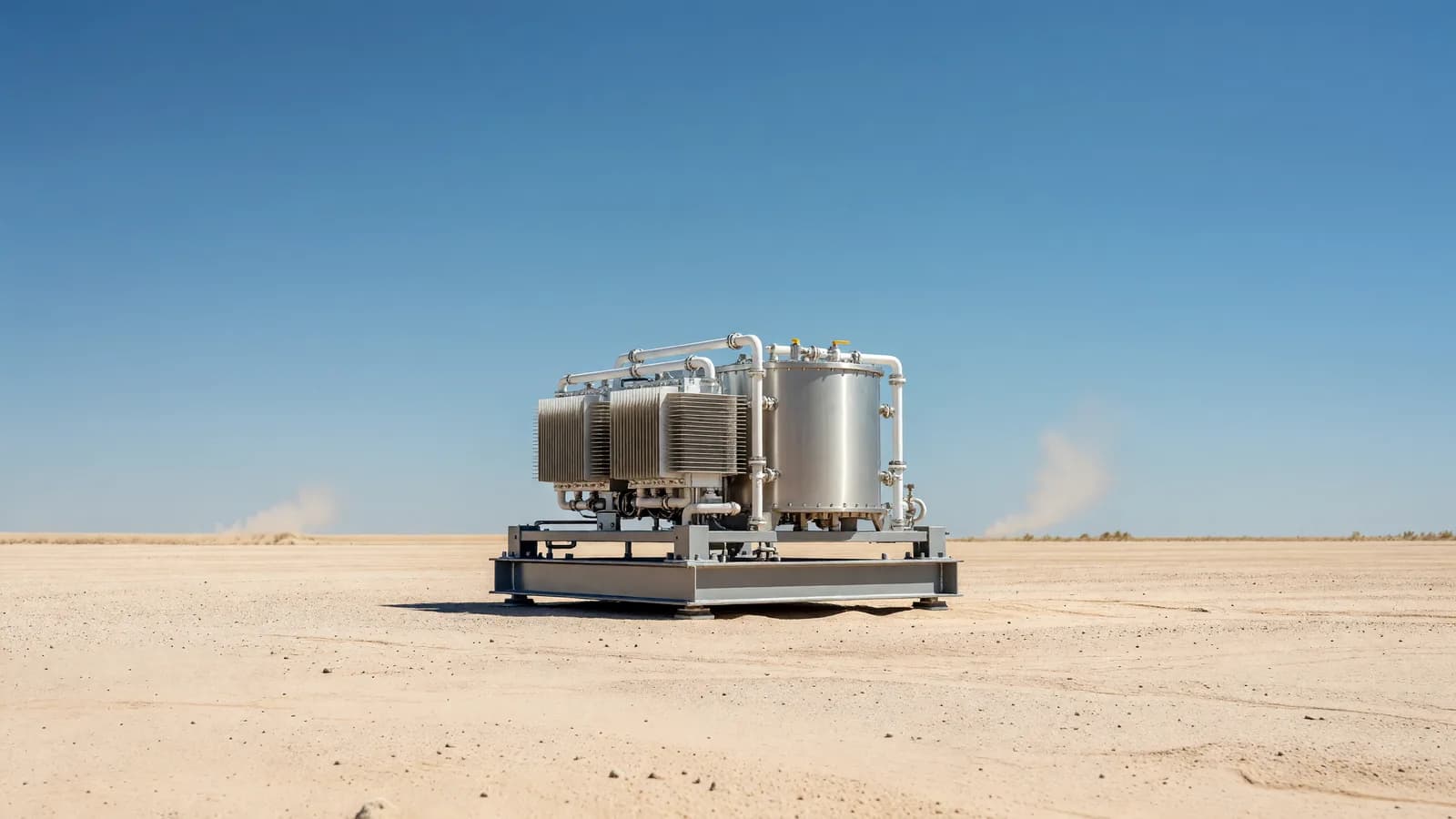
A thread on Deployable Energy's Unity microreactor went viral on X this week, amplified by Australian nuclear advocates who framed the pickup-bed-sized reactor as "banned in Australia." The discourse is the story. Underneath it sits a verified milestone: Unity reached zero-power criticality at Idaho National Laboratory on 30 June 2026, roughly 150 days from project kickoff.
Key facts
- Unity is a 1-MWe water-moderated, gas-cooled microreactor — a "nuclear battery" sized to fit in a pickup bed.
- The reactor achieved zero-power fueled criticality at INL's National Reactor Innovation Center on 30 June 2026, about 150 days after kickoff.
- Unity was the third DOE-authorized reactor to reach criticality by the 4 July 2026 deadline set under the May 2025 presidential nuclear executive order, and the first selection under DOE's Nuclear Energy Launch Pad.
- The driving thread drew roughly 4,000 likes and about 98,000 views within hours, with Australian advocacy accounts including @nuclearforaus carrying the ban framing.
- Australia's prohibition is real: section 140A of the EPBC Act 1999 prevents federal approval of nuclear power plants.
What's driving the conversation
The thread that started it — from @ListenToLewko — showcases Unity's compact form factor and its mass-manufacturing pitch: commodity-scale nuclear built for data centers, remote sites and defense missions rather than bespoke gigawatt projects. Australian accounts rapidly adopted the framing that a reactor of this class could not even be proposed at home, with @nuclearforaus, @OwenGregorian and @Traceychapo pushing it to their audiences. That is a political argument about Australian law, not a claim about Unity's licensing status — the reactor is American, demonstrated on a federal test pad in Idaho.
The substance
The verified facts are straightforward. Unity is a 1-MWe, water-moderated, helium-cooled design running on 4.95% enriched uranium dioxide fuel and commercially available materials — deliberately avoiding high-assay low-enriched uranium, graphite and heat pipes. It went from project kickoff to a controlled, self-sustaining chain reaction in about 150 days under the Nuclear Energy Launch Pad, the DOE initiative that certifies and constructs first-of-a-kind advanced reactors on DOE authorization rather than the full NRC licensing route. Zero-power criticality is a physics demonstration: the core sustains a chain reaction without producing meaningful heat or electricity. Commercial deployment is a separate, longer road.
Why the industry is watching
The viral pairing matters because it compresses the industry's central tension into one image: reactors getting smaller, cheaper and faster to build in the United States, while advanced-nuclear demand compounds in data centers — in a country where nuclear power remains statutorily prohibited. Deployable Energy is already targeting that demand commercially, including a data-center pipeline partnership announced earlier this summer. Unity was also one of the four advanced reactors to hit criticality under DOE authorization in 2026, alongside Aalo Atomics, which is pushing the same mass-production thesis. Whether Australia's prohibition debate moves is a legislative question; whether microreactors can be manufactured like appliances is the engineering question the discourse keeps circling.
Questions
- What actually happened?
- Deployable Energy's Unity microreactor achieved zero-power criticality at Idaho National Laboratory on 30 June 2026. An X thread about the reactor later went viral among Australian nuclear advocates.
- Why is Australia part of the story?
- Section 140A of Australia's Environment Protection and Biodiversity Conservation Act 1999 bars federal approval of nuclear power plants. Advocates used the viral thread to press the case for repeal.
- What is Unity?
- A 1-MWe water-moderated, helium-cooled microreactor running on 4.95% enriched uranium dioxide, designed for mass manufacture and behind-the-meter uses including data centers.
Sources
- Viral thread on Deployable Energy's Unity microreactor and Australia's nuclear ban — X
- Nuclear for Australia amplifies Unity thread — X
- Criticality for third US reactor ahead of 4 July deadline — World Nuclear News
- Deployable Energy achieves criticality at INL — ANS Nuclear Newswire
- Nuclear Energy Launch Pad — US Department of Energy
- Current prohibitions on nuclear activities in Australia: a quick guide — Parliament of Australia
About Nuclear News Network
Nuclear News Network (NNN) is an independent publication covering the global nuclear energy sector — reactor construction, SMRs, fuel supply, policy, operations and fusion. NNN publishes a daily brief, same-day analysis of major developments, and reference guides used across the industry. Articles are produced by the NNN Newsroom, an editorial automation system with human oversight, under the publication's editorial standards. Ruben Seoane is the founder and main editor of NNN.