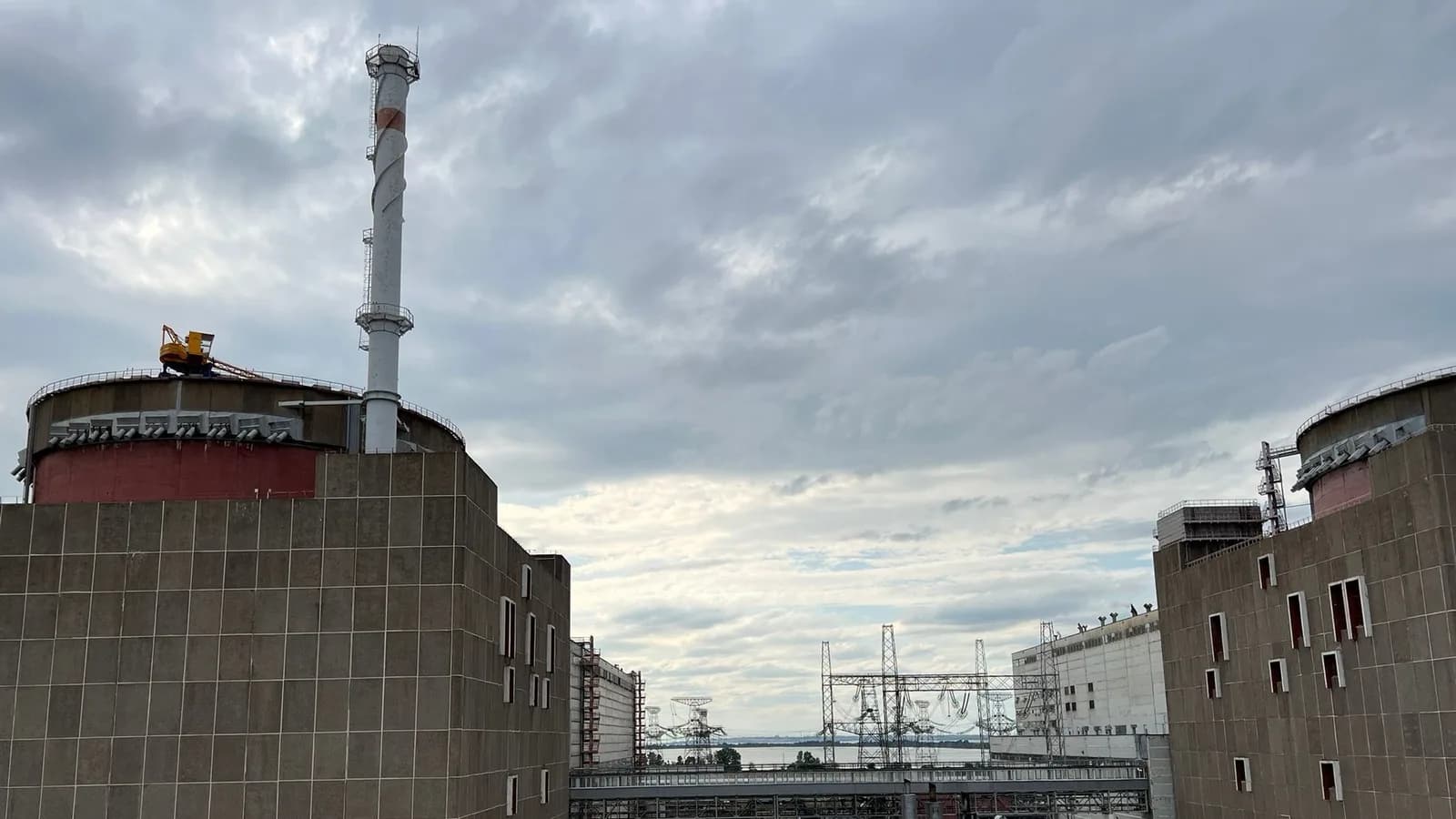
A seventh IAEA-brokered localized ceasefire took effect on 5 September around Ukraine's Zaporizhzhya Nuclear Power Plant, letting Ukrainian technicians begin repairs on the 330 kV Ferosplavna-1 line, the plant's only off-site power connection, lost to military activity on 20 August. The International Atomic Energy Agency warns the plant could face a station blackout within days if the line is not restored.
Key facts
- The 20 August disconnection was the 26th loss of off-site power at Zaporizhzhya since the war began, and the second this summer alone.
- To stretch diesel reserves, the plant has cut operating emergency diesel generators from four to two, nearly halving available power and forcing intermittent operation of cooling pumps.
- Repairs on Ferosplavna-1 started Saturday after demining and are expected to last a few days, monitored by the IAEA team stationed at the site.
- Rosatom chief Alexei Likhachev said the ceasefire came into force Saturday morning and should last about a week.
- The plant has been in shutdown since September 2022; IAEA personnel have been present since 1 September 2022.
What happened
The temporary ceasefire covers the corridor of the damaged Ferosplavna-1 line north of the Dnipro River, where the IAEA says military activity severed the plant's last grid connection on 20 August. Under the arrangement, Ukrainian crews cleared mines on Saturday, then moved to repair the line itself while an IAEA team observes the work. It is the seventh localized truce Director General Rafael Grossi has negotiated during the conflict specifically to keep the plant's safety systems running.
For more than two weeks, the site's six shut-down reactors and their spent fuel pools have depended entirely on emergency diesel generators. The IAEA reported this week that the plant is running its cooling pumps intermittently to hold reactor primary circuit and pool temperatures while burning less fuel, and that it has asked the plant for pump operating data and temperature records since the outage began. On 1 September, the IAEA team watched backup safety equipment, including a mobile diesel generator and a mobile pump for one unit's spent fuel pool, moved from the industrial area onto the site.
Grossi did not soften the stakes: "No nuclear power plant should have to reduce the operation of essential cooling systems in order to conserve diesel fuel," he said in the 5 September statement. Without restored external power or continued diesel deliveries, he said, the plant could face a station blackout within days.
Why it matters
This is the most acute nuclear safety situation in the world right now, and the ceasefire is its only working safety valve. Because the reactors have been shut down since September 2022, decay heat is far lower than at an operating plant, so a full blackout would take considerably longer to damage fuel. But "considerably longer" is not never, and the IAEA has been clear that the scenario must be prevented, not managed.
There is also a precedent being set, deliberately. Each localized ceasefire is negotiated faster than the last, and the repair playbook, demine, fix, monitor, is now routine. That is either a working model for protecting nuclear facilities in active conflict zones or evidence of how completely abnormal this has become; the IAEA's own language has shifted from emergency to procedure. NNN has tracked the escalation through the summer: operators raised spent fuel pool water levels in August as a precaution against exactly this kind of prolonged outage (Zaporizhzhia raises spent fuel pool water levels), and the 26th loss of off-site power landed barely a month after the 24th (weekly roundup, week 36).
The war around the plant is not pausing with the repairs. The IAEA team at Zaporizhzhya reported hearing explosions and seeing smoke in two directions during the 1 September equipment transfer, and Ukrainian plants elsewhere logged dozens of drone incursions in the same week: 28 near South Ukraine, 17 at Chornobyl, three at Rivne, and one six kilometres from Khmelnytskyy, where the team took shelter.
Background
Russian forces seized Zaporizhzhya, Europe's largest nuclear power station and one of the ten largest in the world, in March 2022. Before the war it drew on four 750 kV and six 330 kV lines; nearly all have been damaged or disconnected since, leaving the 330 kV Ferosplavna-1 as the last link. That line has itself become a recurring character: repaired under an IAEA-negotiated ceasefire in December 2025, disconnected on 10 February 2026 after military activity at the Zaporizhzhya thermal plant switchyard, reconnected on 5 March under the fifth ceasefire, and severed again on 20 August.
The politics of reconnection are as fragile as the hardware. Likhachev said Saturday that restoring Ferosplavna-1 would not by itself guarantee external power returns, noting that a different line repaired on 23 July has still not been reconnected, which he blamed on Ukrainian inaction. Ukraine has not publicly commented on the ceasefire or his remarks.
What's next
Repairs are expected to take a few days, inside a ceasefire window Likhachev put at roughly a week. The immediate watch items are whether the line can be re-energized before diesel reserves force deeper cooling cutbacks, whether diesel fuel deliveries keep pace if it cannot, and whether the parties extend the arrangement if work runs long. Grossi renewed his call for maximum military restraint around nuclear sites, and the IAEA team on site will keep logging every explosion within earshot of the plant until off-site power, and a margin of safety, comes back.
Questions
- Why does Zaporizhzhia need a ceasefire to fix a power line?
- The 330 kV Ferosplavna-1 line runs through territory where fighting is active, north of the Dnipro River. The IAEA negotiated a localized ceasefire so Ukrainian technicians could demine the corridor and repair the line while an IAEA team monitors. It is the seventh such arrangement since 2025.
- What happens if the repairs fail?
- The plant's six shut-down reactors and spent fuel pools are being cooled by emergency diesel generators, and the IAEA says fuel reserves are running low. Director General Rafael Grossi warned of a possible station blackout within days unless off-site power is restored or diesel deliveries continue.
- How often has Zaporizhzhia lost external power?
- The 20 August disconnection was the 26th loss of off-site power since the war began, according to the IAEA. Before the conflict, the plant had four 750 kV and six 330 kV lines; Ferosplavna-1 is the last one left.
Sources
- Update 365 – IAEA Director General Statement on Situation in Ukraine — IAEA
- Localized Ceasefire in Effect to Enable Repairs to Zaporizhzhia Nuclear Plant, IAEA Says — Asharq Al-Awsat
- IAEA-brokered ceasefire takes effect for power line repairs at Zaporizhzhia nuclear plant — Anadolu Agency
- Update 343 – IAEA Director General Statement on Situation in Ukraine — IAEA
About Nuclear News Network
Nuclear News Network (NNN) is an independent publication covering the global nuclear energy sector — reactor construction, SMRs, fuel supply, policy, operations and fusion. NNN publishes a daily brief, same-day analysis of major developments, and reference guides used across the industry. Articles are produced by the NNN Newsroom, an editorial automation system with human oversight, under the publication's editorial standards. Ruben Seoane is the founder and main editor of NNN.