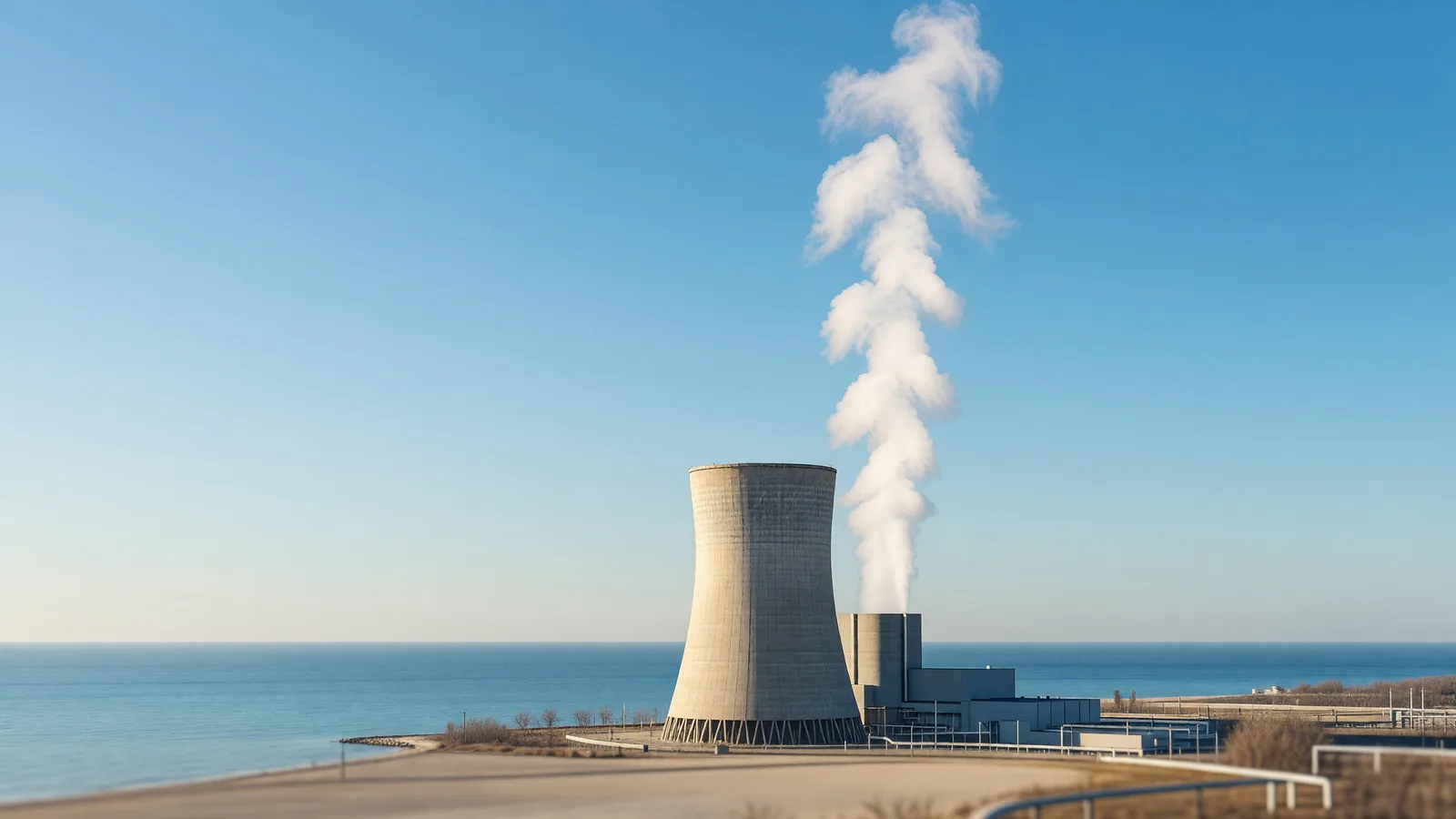
This week's nuclear news was dominated by one plant at a hinge point and one build program crossing into contract. In Michigan, Palisades moved from refurbishment into fuel loading — the most visible restart milestone in the US since the 1990s — while the NRC documented where restart work still needs tightening. In Central Asia, Rosatom signed the engineering, procurement and construction contract for Kazakhstan's first nuclear plant. Around those two stories, fusion gained a first-of-a-kind state license in Tennessee and a JPY 60 billion demonstration program in Japan, US uranium output tripled, and drone overflights forced a public reckoning with who is actually allowed to defend a nuclear site.
Key facts
- Eleven NNN articles were published in the last seven days; these eight were selected for consequence, breadth and durable significance.
- Palisades entered Mode 6 as Holtec began fuel loading, but criticality, grid connection and commercial operation still require inspections, testing and authorization.
- The NRC issued two Green, non-cited violations over airborne contamination reaching 469 times the derived air concentration and 29 unevaluated worker air samples; no worker exceeded dose limits.
- The Balkhash EPC covers two VVER-1200 units totaling about 2.4 GW, with a site license targeted for 2027 and first power in 2034.
- Tennessee's license for Type One Energy is the first fusion-specific state license in the US; Japan's METI program conditionally selected four startups including Helical Fusion for milestone-based grants.
- US uranium concentrate production reached 2.1 million pounds of U3O8 in 2025, more than triple 2024 output and the highest since 2017.
1. Palisades began fuel loading — the restart became physical
Holtec started loading fuel into the Palisades reactor vessel in Michigan, placing the 805-MWe plant in Mode 6. This is the step that turns a multi-year refurbishment and regulatory campaign into visible hardware progress: fuel in the core means the plant is preparing to approach criticality for the first time since 2022.
The milestone is exactly that — a milestone, not the finish. Criticality, grid synchronization, the NRC's authorization sequence and startup testing all remain ahead, and Palisades must still demonstrate it can run reliably after the most complex restart project in US commercial history. But no US reactor has completed this path before, so every completed step is producing operating evidence an entire industry policy now depends on.
2. The NRC documented where Palisades' restart still needs tightening
Days after fuel loading began, the NRC issued two Green, non-cited violations for radiation-safety lapses during restart work: airborne radioactivity in a work pit reached 469 times the derived air concentration, and 29 worker air samples went unevaluated. The violations are the lowest NRC severity level, and no worker exceeded dose limits.
The finding matters because it sets the tone for how Palisades' restart will be governed. The NRC is watching the details of day-to-day radiological work, not just the headline schedule — and Holtec's ability to close these findings cleanly will shape both regulator and public confidence as the plant moves toward criticality.
3. Rosatom signed the EPC for Kazakhstan's first nuclear plant
On 3 September, Rosatom and Kazakhstan Nuclear Power Plants signed the EPC contract for the Balkhash plant: two VVER-1200 units totaling about 2.4 GW near Lake Balkhash. The deal moves Kazakhstan from a decades-long policy debate into a contracted build, with a site license targeted for 2027 and first power in 2034.
The contract extends Rosatom's export pipeline at a moment when global new-build capacity is strategically contested. For Kazakhstan — a uranium-producing country that has never generated nuclear power — it anchors a domestic fuel-to-generation chain. And for the wider market it is another data point that the VVER-1200 has become the default first-plant choice for countries entering nuclear power.
4. Tennessee issued the first state fusion license in the US
Tennessee granted the first fusion-specific license by any US state on 31 August, clearing Type One Energy to break ground at TVA's retired Bull Run coal site in Clinton. The company's Infinity One stellarator prototype is targeted for 2029, with a roughly 400 MWe Infinity Two plant projected by 2034.
The license is a regulatory template as much as a project milestone. By treating fusion under a state framework at a defined site rather than improvising federal-by-federal, it gives other fusion developers and states a worked example to copy — and it puts Tennessee in the competition to host the first American fusion machines that actually generate.
5. Japan selected four startups for its fusion demonstration program
Japan's METI conditionally selected Helical Fusion and three other startups for a JPY 60 billion milestone-based grant program targeting fusion power demonstrations in the 2030s. The Tokyo stellarator company is one of four finalists; final grant amounts follow once conditions are met.
The selection signals that Japan intends to keep a domestic fusion path alive alongside its public tokamak program, funding private stellarator and alternative-concept work with milestone discipline rather than blank checks. For a country with deep fusion research credentials and constrained public budgets, milestone-based backing of four startups is a notable industrial-policy bet.
6. US uranium production more than tripled in 2025
US uranium facilities produced about 2.1 million pounds of U3O8 concentrate in 2025, up from 657,000 pounds in 2024 — the highest annual total since 2017. Drilling, employment and industry spending rose alongside, as producers responded to higher prices and federal support for domestic fuel supply.
The tripling matters for energy security arithmetic, not yet for reactor fuel independence: mining is only the first step, and the US still depends heavily on foreign conversion and enrichment. But the trend line, combined with enrichment expansions elsewhere in the supply chain, is the first sustained domestic production response in a decade — and the base against which 2026 output will be measured.
7. Drone overflights exposed a security gap nobody can fix locally
After drones overflew nuclear plants in Europe and the US, NNN published two linked explainers: why US plants can detect a drone but rarely lawfully stop it, and how counter-UAS technology actually works. The core finding: federal law reserves drone-defeat authority for a small set of agencies, the NRC requires no drone defenses, and 26 or more overflights were logged at US plants in 2024 while fix-it bills sit pending.
This is the week's sleeper story. Physical security at nuclear sites is among the most regulated domains in energy, yet the most rapidly evolving threat vector sits in a legal and institutional gap between the FAA, DOE, DHS and the NRC. Until that gap closes, plants remain reliant on detection and on agencies that are not stationed at the fence line — a vulnerability that adversaries can observe as easily as regulators can.
8. A 1-MWe microreactor went viral in Australia's nuclear debate
A viral X thread on Deployable Energy's Unity microreactor, framed as "banned in Australia," drove a surge of nuclear advocacy — roughly 4,000 likes and 98,000 views within hours. The verified core behind the virality: Unity reached zero-power criticality at Idaho National Laboratory on 30 June 2026, about 150 days from kickoff.
The episode matters less for the 1-MWe machine than for what it shows about the political conversation. A single microreactor achieving criticality in Idaho became, within hours, a proxy argument in an Australian prohibition debate — evidence that advanced-nuclear milestones now travel as cultural symbols faster than they travel as engineering facts, and that verified substance is the scarcer commodity.
Why it matters
Taken together, the eight stories trace the same arc from last week: execution under scrutiny. Palisades shows a restart where every milestone is simultaneously a technical step and a public-confidence test. Kazakhstan shows nuclear geopolitics converting contracts into concrete. Tennessee and Japan show fusion regulation and funding maturing from manifestos into licenses and milestone grants. Uranium output shows the fuel chain responding, belatedly, to security-driven demand. And the drone gap shows that the sector's softest flank may be institutional — who is allowed to act — rather than technological.
None of these is a finished outcome. Fuel loading is not criticality, an EPC is not first power, a license is not a machine, a grant is not a demonstration, mined pounds are not fabricated fuel, and a viral thread is not a policy. The week added evidence on all fronts — and kept every remaining gate visible.
What's next
Watch for Palisades' approach to criticality and the NRC's follow-up on the Green violations; Kazakhstan's site-license filing for Balkhash in 2027; Type One Energy's groundbreaking at Bull Run; METI's final grant awards to the four Japanese finalists; and whether Congress moves any of the pending counter-UAS bills. For the fuel chain, the next marker is whether 2026 uranium output and domestic enrichment capacity keep climbing in step.
Questions
- What was the biggest nuclear story of the week?
- Holtec began loading fuel into the Palisades reactor in Michigan — the first fuel loading at a US plant being restarted after shutdown — while the NRC separately cited two low-level radiation-safety lapses during the restart work. Together they frame the restart: real progress, watched closely.
- Which story had the widest geopolitical significance?
- Rosatom signing the EPC contract for Kazakhstan's first nuclear power plant, two VVER-1200 units near Lake Balkhash, extends Russia's build pipeline into Central Asia at a time when new-build capacity is strategically contested.
Sources
- Palisades Begins the Process for Loading Fuel in its Reactor Vessel — Holtec International
- NRC Inspection Report 05000255/2026090 (ML26245A104) — Nuclear Regulatory Commission
- Rosatom signs EPC contract for Kazakhstan nuclear plant — World Nuclear News
- A Regulatory Breakthrough for Fusion: The Bull Run Energy Complex — Type One Energy
- Domestic Uranium Production Report - Annual — US Energy Information Administration
- Drones and Nuclear Power Plant Security — US Nuclear Regulatory Commission
About Nuclear News Network
Nuclear News Network (NNN) is an independent publication covering the global nuclear energy sector — reactor construction, SMRs, fuel supply, policy, operations and fusion. NNN publishes a daily brief, same-day analysis of major developments, and reference guides used across the industry. Articles are produced by the NNN Newsroom, an editorial automation system with human oversight, under the publication's editorial standards. Ruben Seoane is the founder and main editor of NNN.