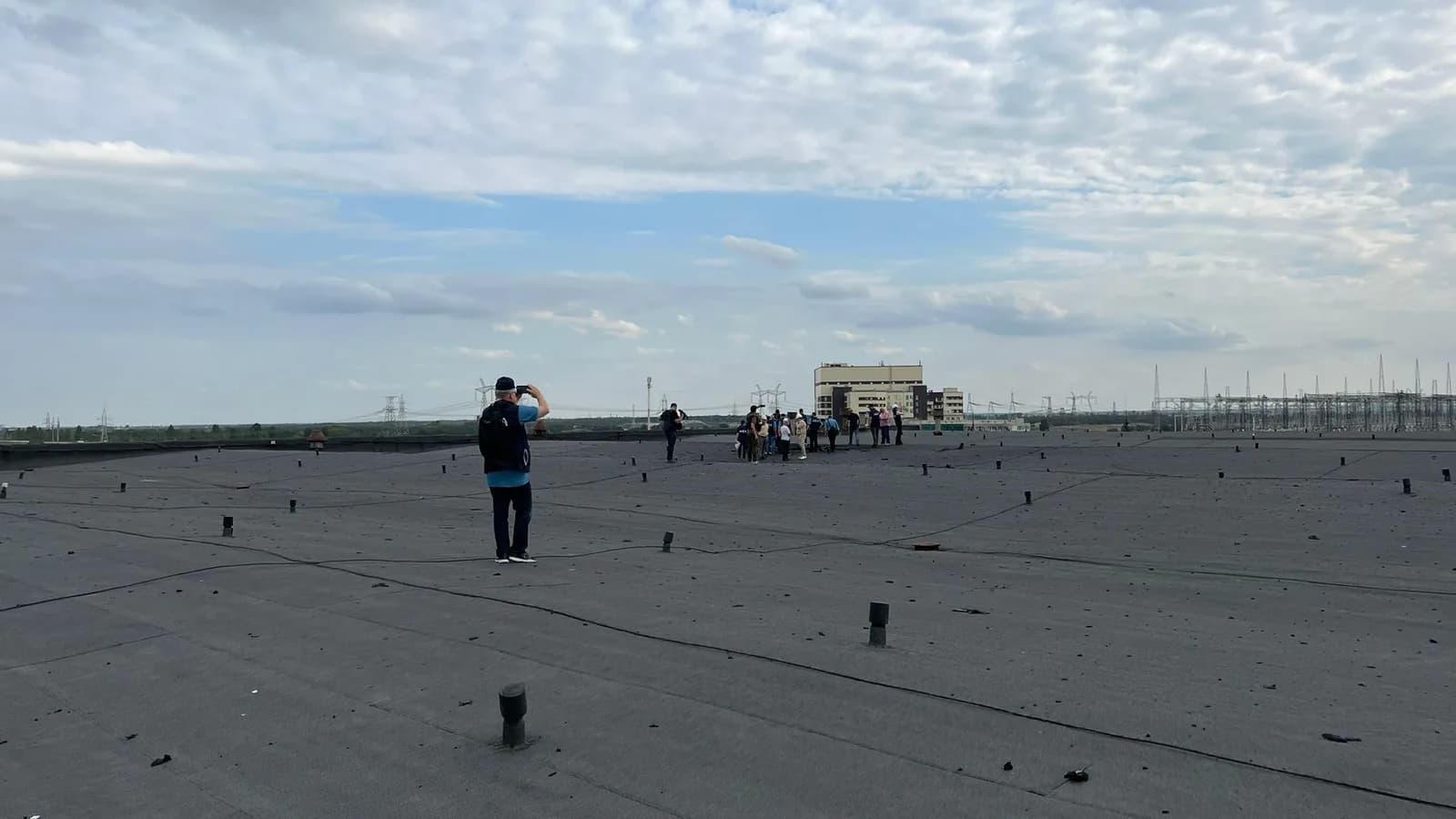
The Zaporizhzhya Nuclear Power Plant is back on Ukraine's grid. The International Atomic Energy Agency confirmed that a seventh IAEA-brokered ceasefire let Ukrainian crews repair the 330 kV Ferosplavna-1 line — the plant's last external power connection — ending almost three weeks of diesel-powered cooling for six shut-down reactors.
Key facts
- The 330 kV Ferosplavna-1 line, the plant's only remaining off-site connection, was disconnected at 00:44 local time on 20 August after military activity on the northern side of the Dnipro River — the 26th loss of off-site power at Zaporizhzhya since the war began.
- With the last diesel delivery to the site's fuel farm in March and a planned May delivery still delayed by fighting, the plant reported on 29 August that it held about ten days of diesel — the minimum regulatory requirement. Director General Rafael Mariano Grossi warned of a possible station blackout within approximately ten days unless power was restored or fuel arrived.
- The seventh localized ceasefire took effect on 5 September. Demining specialists cleared the corridor before Ukrainian technicians, monitored by an IAEA team, began repairs the same day; work expected to last a few days ran through the weekend.
- The IAEA confirmed the reconnection in a public statement, ending an outage of almost three weeks.
- The same week the line went down, a drone explosion at a bus stop used by plant staff and subcontractors killed one person and injured 19 others — 20 casualties in total, three of them serious.
- Zaporizhzhya has now lost external power 26 times since 2022, including ten times since June. Before the war it had ten off-site lines; Ferosplavna-1 is the only one left in service.
What happened
The outage began in the early hours of 20 August, when the 330 kV Ferosplavna-1 line — the sole surviving off-site connection after the 750 kV Dniprovska line was damaged in March — was cut at 00:44 local time. All available emergency diesel generators started automatically; seven remained in operation to power the pumps that cool the six reactors and their spent fuel pools, according to the IAEA's 20 August statement.
The clock then ran on diesel. The plant's last delivery to its off-site fuel farm was in March; a follow-up planned for May never got through. By 29 August the site had roughly ten days of fuel — the regulatory floor — and technicians were transferring tens of tonnes of diesel from two off-site locations near the plant under IAEA observation. To stretch reserves, the plant throttled the number of generators in service and raised water levels in all six spent fuel pools, buying time before boiling could begin if cooling stopped entirely. Grossi said the plant could face a station blackout within about ten days without grid restoration or new deliveries.
The off-ramp was diplomacy. On 5 September the IAEA's seventh localized ceasefire took effect around the damaged line north of the Dnipro, after demining teams cleared the repair corridor. Ukrainian technicians replaced broken components and re-attached cables while an IAEA team monitored — the same pattern that restored the Dniprovska line in June under the sixth ceasefire. Repairs ran through the weekend; in a 7 September address to the IAEA Board of Governors, Grossi said diesel stocks had drained to "little more than a week of supplies" and that work should be completed shortly. The IAEA then confirmed reconnection.
Why it matters
This was the closest Zaporizhzhya has come to a prolonged station blackout since October 2025, when a month-long outage ended only after a similar IAEA-brokered repair. The plant's six VVER-1000 units have not generated power since 2022, but they still need continuous electricity for cooling — and Europe's largest nuclear plant has now lost external power ten times since June alone.
The event also stress-tests the IAEA's ceasefire mechanism as the de facto safety net for the site. Each successive arrangement — five of them since late 2025, seven in total — has followed the same script: line damaged, diesel countdown, localized pause in fighting, monitored repairs. It works, but only just, and only after fuel margins have already been squeezed. Grossi's Five Concrete Principles — the third of which holds that off-site power must never be put at risk — remain unmet in any durable sense.
NNN covered the ceasefire that opened these repairs on 6 September and the spent fuel pool measure that bought margin during the outage; this reconnection is the direct follow-through on both stories.
Background
Russian forces have occupied the Zaporizhzhya plant since March 2022, and the site sits on the front line between Russian and Ukrainian forces. Before the war, ten off-site power lines fed the plant; repeated damage has reduced that to one, with the 750 kV Dniprovska line — repaired during the June ceasefire — still blocked from re-energization by damage at a substation more than 100 kilometres northwest of the site.
The precedent matters: in October 2025 the plant spent a full month on diesel — its tenth and longest blackout of the war — before the Dniprovska line was re-energized. Each loop of the cycle has grown shorter: the August outage was the 26th, and the frequency is why the IAEA keeps a permanent team on site and why operations and safety at wartime plants has become a standing pillar of nuclear coverage. The drone strike on the staff bus stop — one dead, three seriously injured among 20 casualties — shows the plant's people remain targets even when its reactors are quiet, and Grossi called the attack a clear violation of the IAEA's Seven Indispensable Pillars.
What's next
Watch three things. First, whether the IAEA can negotiate a durable protection arrangement for the line corridor rather than serial one-off ceasefires — Grossi used his Board speech to renew the call for maximum military restraint and an end to attacks on plant staff. Second, the Dniprovska substation: until the damage 100-plus kilometres northwest is fixed, Ferosplavna-1 remains a single point of failure. Third, diesel logistics — the May delivery is still outstanding, and the next LOOP event starts the same countdown again. The IAEA team's next update will show whether reconnection holds.
Questions
- How was the Zaporizhzhia plant reconnected to the grid?
- The IAEA brokered a seventh localized ceasefire, demining teams cleared the corridor, and Ukrainian technicians repaired the damaged 330 kV Ferosplavna-1 line over about three days under IAEA monitoring. The IAEA confirmed reconnection in a statement on its official X account.
- Why did the plant depend on diesel generators?
- Ferosplavna-1 was the plant's only working off-site power line after the 750 kV Dniprovska line was damaged in March. When Ferosplavna-1 was cut on 20 August, emergency diesel generators took over cooling for the six shut-down reactors and their spent fuel pools.
- How close did the plant come to a station blackout?
- On 29 August the IAEA said the site held about ten days of diesel, the minimum regulatory requirement, and warned of a possible station blackout within days without grid restoration or fresh deliveries. By 7 September, reserves had drained to little more than a week.
- Is the plant safe now?
- Off-site power removes the immediate blackout risk, but the IAEA says the site remains fragile: military activity continues near Enerhodar, the Dniprovska line still cannot be re-energized because of substation damage, and the plant has lost external power 26 times since 2022.
Sources
- Update 365 – IAEA Director General Statement on Situation in Ukraine — IAEA
- Update 364 – IAEA Director General Statement on Situation in Ukraine — IAEA
- Update 362 – IAEA Director General Statement on Situation in Ukraine — IAEA
- Update 323 – IAEA Director General Statement on Situation in Ukraine — IAEA
- Update 363 – IAEA Director General Statement on Situation in Ukraine — IAEA
- Local ceasefire in place for Zaporizhzhia power line repairs — World Nuclear News
About Nuclear News Network
Nuclear News Network (NNN) is an independent publication covering the global nuclear energy sector — reactor construction, SMRs, fuel supply, policy, operations and fusion. NNN publishes a daily brief, same-day analysis of major developments, and reference guides used across the industry. Articles are produced by the NNN Newsroom, an editorial automation system with human oversight, under the publication's editorial standards. Ruben Seoane is the founder and main editor of NNN.