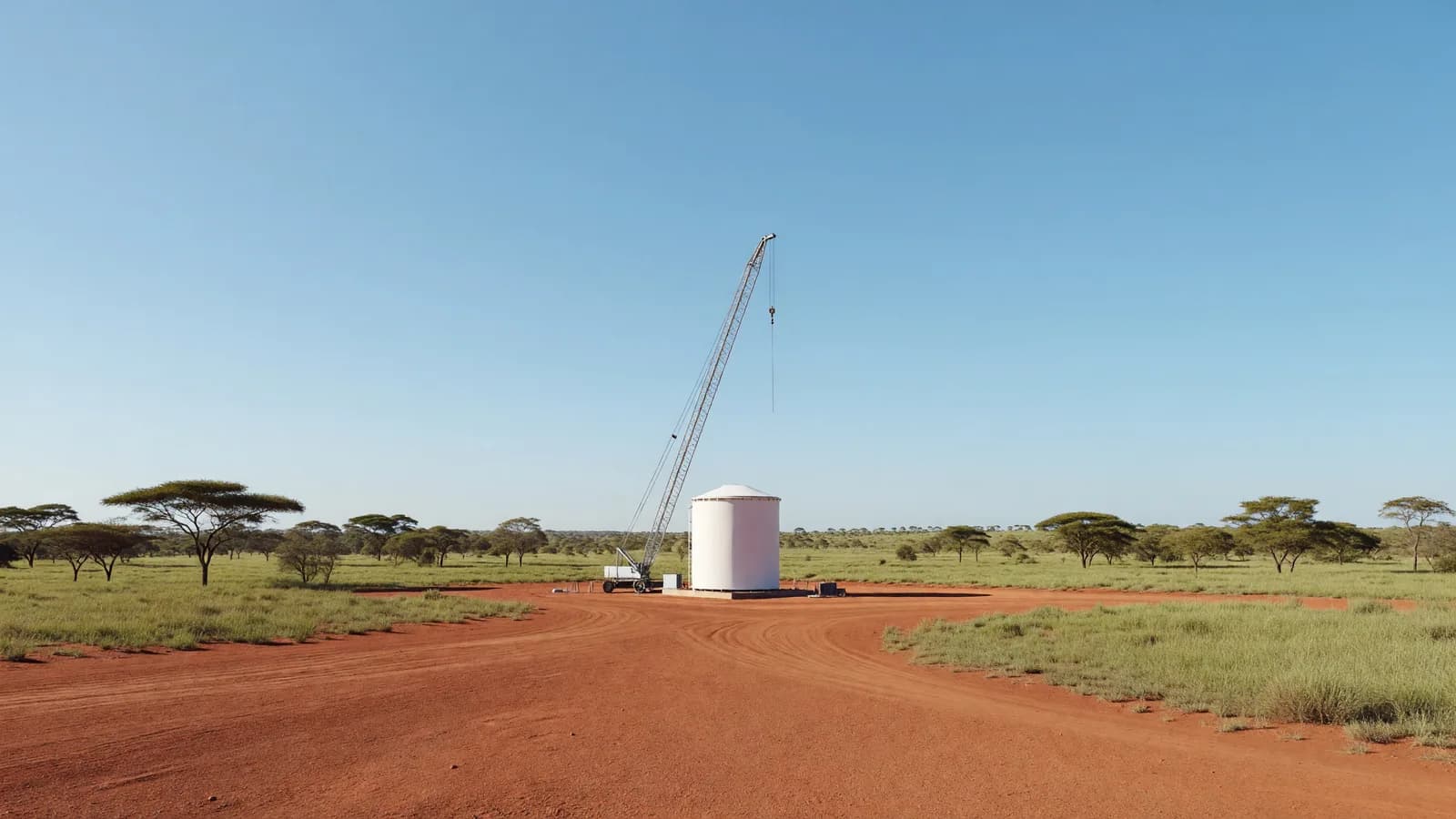
Nuclear Business Platform, a Singapore-based nuclear market consultancy, has sized Africa's small modular reactor opportunity at up to $105 billion and 15,000 MW of capacity by 2035, spread across national programs in South Africa, Rwanda, Ghana and Kenya. It is the most detailed market map yet of a continent whose nuclear options opened up when the World Bank ended its financing ban in June 2025.
Key facts
- Nuclear Business Platform estimates Africa could add up to 15,000 MW of nuclear capacity by 2035, a roughly $105 billion investment pipeline, and projects the global SMR market growing at a 29% compound annual rate to $53.8 billion by 2036.
- The World Bank ended its decades-long ban on funding nuclear energy at a board meeting on 10 June 2025, and formalized a nuclear partnership with the IAEA on 26 June 2025.
- South Africa's cabinet-approved IRP 2025 targets 5,200 MW of new nuclear by 2039, with the first 1,200 MW due by 2036, inside a ZAR2.23 trillion ($128 billion) generation expansion.
- State-owned Necsa opened an expression of interest for a demonstration SMR at its Pelindaba complex on 31 March 2026; the window closed on 29 May 2026.
- Rwanda signed a development agreement with Holtec International on 19 May 2026 covering potential deployment of up to 5 GW of SMR-300 units, then added an SMR roadmap with Rosatom signed at the first meeting of the two countries' joint coordination committee in Moscow.
- Kenya plans a 2,000 MW nuclear plant in Siaya County with construction pencilled to begin in 2027 and first power around 2034.
What happened
The analysis, published on 1 August and built on the firm's Africa Nuclear Industry Report 2025, argues that Africa's nuclear market is no longer a long-range projection. Four countries carry the near-term pipeline. South Africa is the anchor and the only operating nuclear power producer on the continent, running two reactors at Koeberg while state nuclear company Necsa prepares a demonstration SMR at Pelindaba, west of Pretoria, the same site as the SAFARI-1 research reactor.
Rwanda has moved fastest on paper. In May it signed a development agreement with Holtec International for SMR-300 units, a pact the consultancy says could extend to as much as 5 GW, together with a civil nuclear cooperation agreement with the US government. Weeks later, Rosatom and the Rwanda Atomic Energy Board signed an SMR roadmap at the inaugural meeting of their joint coordination committee in Moscow, covering training, nuclear infrastructure and a future SMR program. The Kigali government has said it wants nuclear in its energy mix by the early 2030s.
Ghana and Kenya are earlier still. Nuclear Power Ghana and Regnum Technology Group agreed in 2024 to pursue a NuScale VOYGR-12 plant, a 12-module design, with the US Department of Energy backing the deal from the US-Africa Nuclear Energy Summit in Nairobi. Ghana has also taken a framework agreement with China's CNNC for a full-size reactor, so vendor competition there is genuinely open. Kenya wants to break ground on a 2,000 MW plant in Siaya County in 2027 and has been running public education campaigns after local opposition delayed engagement.
Why it matters
The financing hinge is the World Bank. For decades its ban kept nuclear out of the multilateral lending toolkit for exactly the countries now sizing SMR programs, and its June 2025 reversal reopened that channel. The consultancy's argument is that blended structures, sovereign guarantees plus export credit plus development bank debt, are the only bankable path for these projects, and that vendors arriving with financing mapped will beat vendors arriving with a better reactor.
That lands on top of a supply chain already straining. SMR vendors are courting African mining loads and data centers at the same time as the US and European data-center deals NNN tracked at 45 GW of contracted capacity (IEA: data-center SMR deals hit 45 GW), and every newcomer program that actually starts building will queue for the same limited HALEU and high-assay fuel supply that already has Washington funding expansion at Centrus (Centrus signs $900M DOE task order for HALEU production). Localization is the other filter the consultancy names: procurement processes are beginning to demand credible skills-transfer and local-content commitments, which favors vendors with manufacturing partners on the continent.
Background
Africa has been here before in miniature. South Africa's Pebble Bed Modular Reactor program consumed years of development before stalling, a gap officials now cite when explaining the skills shortage the IRP 2025 must rebuild. The consultancy also flags an IAEA-consistent timeline: for newcomer countries, the agency's milestones framework typically runs 12 to 15 years from planning to first electricity, which makes Kenya's 2027 groundbreaking and Rwanda's early-2030s targets aggressive but not absurd, given that South Africa already operates Koeberg, runs the SAFARI-1 research reactor at Pelindaba and is the continent's only uranium-processing holder of note (World Nuclear Association country profile).
The competitive map reads like a compressed version of the global SMR contest. US vendors (Holtec, NuScale), Russia's Rosatom, China's CNNC and South Korea's suppliers are all courting the same four governments, and two of those governments, Ghana and Kenya, are openly running multi-vendor selection processes. For readers tracking the vendor field, NNN's top SMR developers 2026 tracker and the SMR explainer hub cover the designs behind most of these bids. The World Bank's re-entry, plus the African Development Bank's parallel move to end its own nuclear exclusion, means the money side of that contest is now open for the first time in a generation.
What's next
Necsa's demonstration-SMR expression of interest closed on 29 May 2026, so partner selection at Pelindaba is the nearest concrete milestone. South Africa's IRP timeline puts the first 1,200 MW unit online by 2036. Kenya's March 2027 construction start for Siaya is the next date to test, and NuPEA's community engagement there will be watched as a template, or a warning, for other newcomer sites. Rwanda's early-2030s target now runs on two parallel vendor tracks, Holtec and Rosatom, and the consultancy expects prequalification criteria on localization and financing to firm up across all four programs through 2027. The next US-Africa Nuclear Energy Summit, held in Accra in August 2026, keeps the diplomatic pipeline moving.
Questions
- Which African countries are closest to deploying SMRs?
- South Africa leads: IRP 2025 mandates 5,200 MW of new nuclear by 2039 and Necsa is seeking partners for a demonstration SMR at Pelindaba. Rwanda signed a Holtec SMR-300 development deal in May 2026 plus a Rosatom SMR roadmap. Ghana holds a NuScale VOYGR-12 deal; Kenya targets 2,000 MW at Siaya.
- Is the $105 billion figure committed investment?
- No. It is Nuclear Business Platform's estimate of Africa's addressable nuclear market by 2035, bundling potential new-build, fuel and infrastructure spending across multiple countries. Most underlying projects remain at MOU, feasibility or procurement stage rather than financed construction.
- What did the World Bank change in June 2025?
- The World Bank ended its decades-long ban on funding nuclear energy at a board meeting on 10 June 2025. It will support life extensions of existing reactors and work to accelerate SMRs in developing countries, and it formalized a nuclear partnership with the IAEA on 26 June 2025.
- Why do SMRs fit African grids?
- Most African grids cannot absorb a sudden gigawatt-scale loss, so sub-300 MWe modules let countries add capacity in steps. Factory fabrication shifts risk from on-site construction, where nuclear experience is limited, to controlled production. Mining loads and new data centers add 24/7 demand.
Sources
- Africa's SMR Market 2026: The $105B Market Every SMR Vendor Should Watch — Nuclear Business Platform
- World Bank Group, IAEA Formalize Partnership to Collaborate on Nuclear Energy for Development — World Bank
- World Bank ends ban on funding nuclear energy — World Nuclear News
- South African government approves draft 2025 IRP — World Nuclear News
- Necsa attracts global interest in Small Modular Reactor programme — Necsa
- Rwanda Signs Nuclear Agreements With US And Reactor Developer Holtec — NucNet
- Rwanda signs SMR roadmap — Nuclear Engineering International
- Kenya Responds To Protests With Plans For Educational And Engagement Campaign Over Nuclear Plans — NucNet
- Commercial SMR Agreement Reached at U.S-Africa Nuclear Energy Summit — US Department of Energy
- Nuclear Power in South Africa — World Nuclear Association
About Nuclear News Network
Nuclear News Network (NNN) is an independent publication covering the global nuclear energy sector — reactor construction, SMRs, fuel supply, policy, operations and fusion. NNN publishes a daily brief, same-day analysis of major developments, and reference guides used across the industry. Articles are produced by the NNN Newsroom, an editorial automation system with human oversight, under the publication's editorial standards. Ruben Seoane is the founder and main editor of NNN.