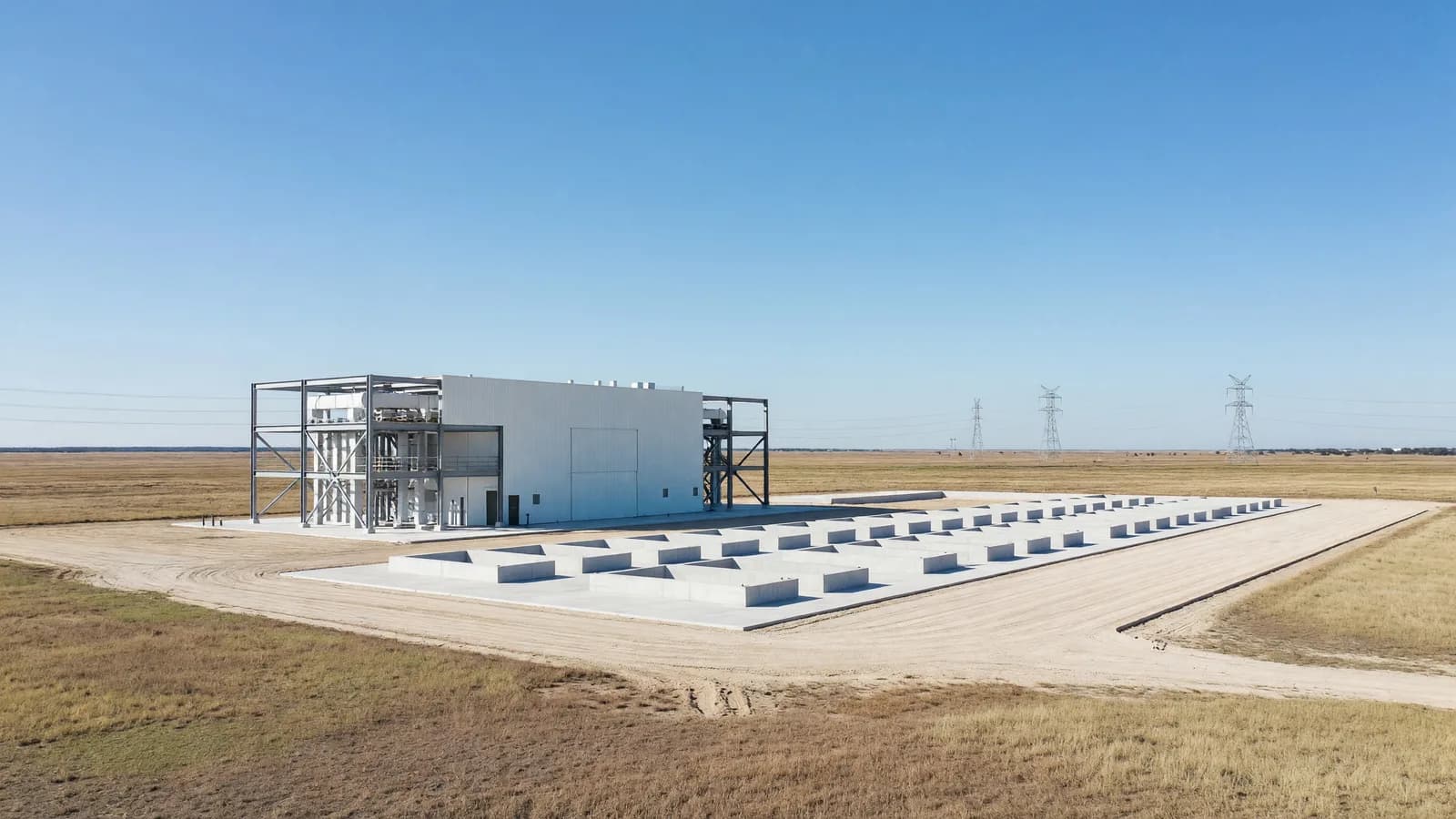
Blue Energy and GE Vernova Hitachi have signed an agreement advancing engineering design, licensing and safety analysis for a 2.5 GW gas-plus-nuclear power plant in Victoria, Texas — a project that would power a nearby data center with gas turbines in 2030 and convert the site to nuclear, with up to five BWRX-300 SMRs, beginning in 2032.
Key facts
- The agreement launches the next phase of collaboration on the Victoria, Texas project, targeting a final investment decision in 2027.
- Phase one: two GE Vernova 7HA.02 gas turbines supplying about 1 GW to a nearby data center in 2030.
- Phase two: up to five BWRX-300 SMRs adding about 1.5 GW from 2032.
- The NRC recently approved Blue Energy's approach to resequencing major construction phases for large-module, gas-to-nuclear schedules.
- The first BWRX-300 is under construction at OPG's Darlington site, with completion expected by the end of the decade.
What happened
The deal combines Blue Energy's project financing and nuclear construction experience with GVH's reactor and turbine technology, according to POWER magazine. Blue Energy CEO Jake Jurewicz said the company is building a "nuclear energy production line" that "finally makes nuclear a financeable, repeatable product."
The companies are also exploring contracting methods and offsite construction of large power-plant modules consistent with the BWRX-300 design, aimed at cutting capital cost and building a prefabrication supply chain. Blue Energy claims its approach can cut "at least half a decade" from conventional ten-year-plus nuclear timelines, with time to power of 48 months or less via the gas bridge.
GVH's own framing points the same direction. "Meeting the surging demand for electricity requires proven, scalable technologies and the ability to bring them together as integrated solutions," said Eric Gray, CEO of GE Vernova's Power segment, calling the pairing of flagship HA turbines with BWRX-300 SMRs a blueprint for deploying baseload at speed. The agreement covers engineering, licensing and safety analysis — the pre-FID package — rather than construction, which the 2027 investment decision would unlock.
Why it matters
Gas-plus-nuclear is the industry's most direct answer to the AI load-growth calendar. Data centers cannot wait for a 2032 nuclear schedule, and grids cannot absorb gigawatt blocks on intermittent supply — so the plan is to sell power with gas first and swap in reactors as they arrive. If Victoria reaches its 2027 FID, it becomes the test of whether that sequencing is a financing tool or a way to make the nuclear half optional.
Note what this deal joins. The same week, TerraPower locked guaranteed-price EPC delivery for a Natrium fleet. Blue Energy's angle is complementary: standardize the BWRX-300 as a module and put a gas bridge in front of the schedule risk. Both are attempts to turn reactors from projects into products — one at the contract layer, one at the construction-sequence layer.
There is also a supply-chain bet embedded in the deal. The companies say they are exploring contracting and offsite fabrication of large modules consistent with the BWRX-300 design — the same prefabrication thesis Blue Energy runs its whole "production line" pitch on. Offsite modules are where the claimed 48-month time-to-power lives or dies: Darlington's first BWRX-300 will set the empirical baseline for what the design actually costs to build once, before Victoria tries to build five.
Background
Blue Energy is a developer of prefabricated nuclear plants betting that offsite fabrication and NRC-sanctioned schedule resequencing change nuclear's cost curve. The BWRX-300 it plans to deploy is the most advanced SMR build in the West: first unit under construction at Darlington, with Tennessee Valley Authority and Polish projects among the announced followers. Victoria would be the first U.S. pairing of the reactor with a dedicated data-center gas bridge.
What's next
The gates are dated: FID in 2027, gas turbines energized by 2030, first SMR power from 2032. Between now and FID, watch for the data-center anchor customer, the nuclear contracting structure for the modules, and how the NRC-approved resequencing is applied on an actual site. The failure mode to watch is the one the concept invites: a gas plant that delivers in 2030 and a nuclear second phase that quietly never reaches FID — leaving a data center on gas and a blueprint unreplicated.
Background
The BWRX-300 is GE Vernova Hitachi's 300 MWe boiling-water small modular reactor, derived from the NRC-licensed ESBWR and fueled with GNF2 fuel already in commercial use. Unit 1 at Ontario Power Generation's Darlington site — the first Western SMR to reach construction — is being built with four units approved there totalling about 1,200 MW, and Poland's Orlen Synthos Green Energy is seeking state financing for 14 units across three sites. (As of August 2026.) Read the BWRX-300 explainer.
Questions
- What did Blue Energy and GE Vernova Hitachi sign?
- An agreement advancing engineering design, licensing and safety analysis for a 2.5 GW gas-plus-nuclear power plant in Victoria, Texas, subject to a final investment decision targeted for 2027.
- What is the gas-plus-nuclear concept?
- Energize the site first with gas turbines — two GE Vernova 7HA.02 units supplying about 1 GW to a nearby data center in 2030 — then add up to five BWRX-300 SMRs totaling about 1.5 GW beginning in 2032, converting the bridge to firm nuclear power.
- What regulatory position does Blue Energy hold?
- The NRC recently approved Blue Energy's approach to resequencing major phases of nuclear plant construction to support large-module, gas-to-nuclear delivery schedules. Blue Energy claims this can cut 'at least half a decade' from conventional timelines.
- Where is the first BWRX-300 being built?
- At Ontario Power Generation's Darlington site in Canada, with completion expected by the end of the decade — potentially the first grid-scale SMR in the Western world.
Sources
About Nuclear News Network
Nuclear News Network (NNN) is an independent publication covering the global nuclear energy sector — reactor construction, SMRs, fuel supply, policy, operations and fusion. NNN publishes a daily brief, same-day analysis of major developments, and reference guides used across the industry. Articles are produced by the NNN Newsroom, an editorial automation system with human oversight, under the publication's editorial standards. Ruben Seoane is the founder and main editor of NNN.