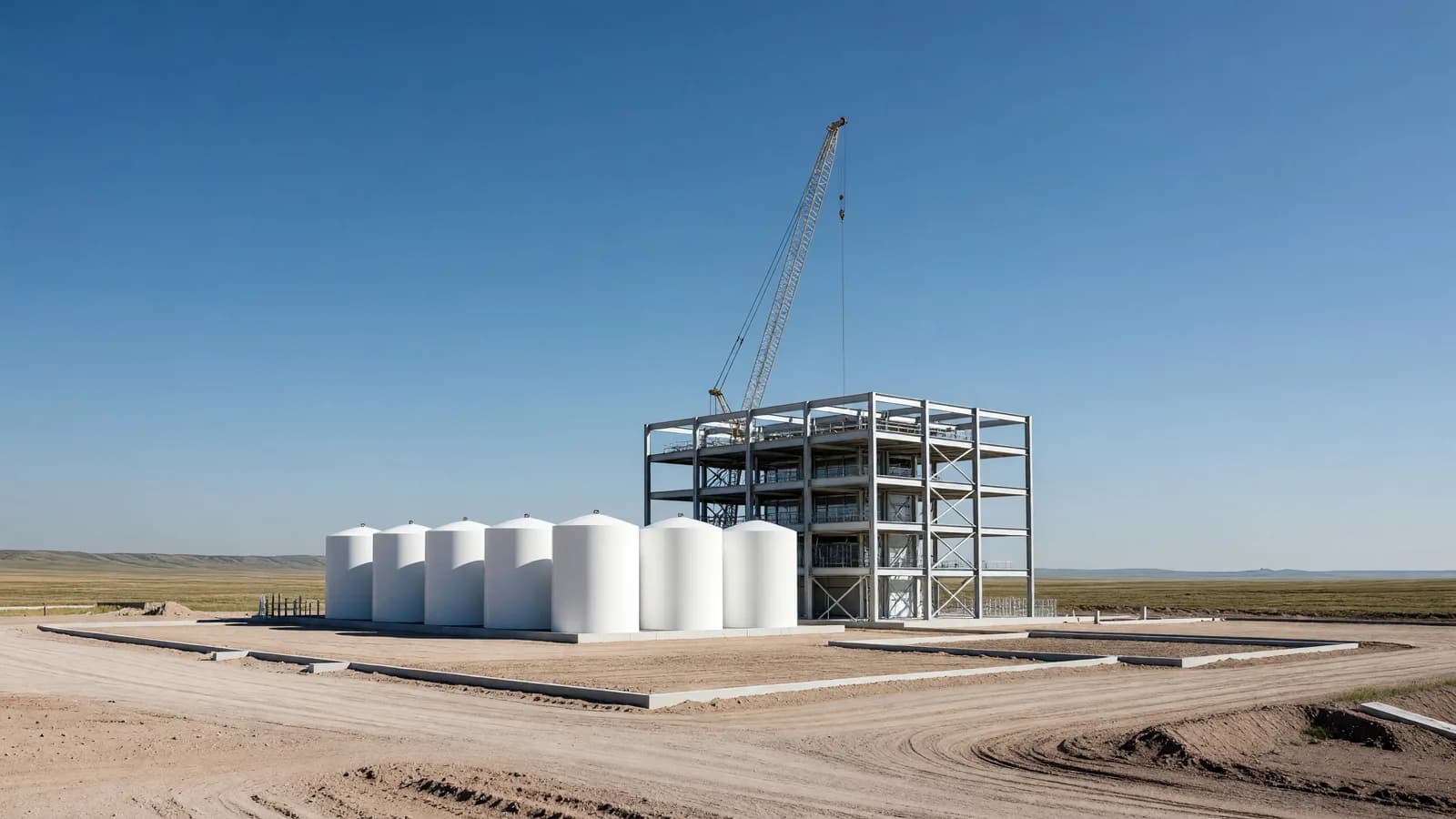
TerraPower has selected Hyundai Engineering & Construction as engineering, procurement and construction contractor for up to eight future Natrium reactors — with completion, price and performance guarantees — and signed a term sheet with SK Innovation to develop Korea's first commercial Natrium plant. The guarantees are the story: they are the contractual mechanism conventional lenders have always demanded and nuclear construction has rarely offered.
Key facts
- TerraPower announced both agreements on August 14, 2026, during a Seoul visit by founder and Chairman Bill Gates and President and CEO Chris Levesque.
- The HDEC framework agreement covers up to eight future Natrium reactors across the United States and select international markets, with completion, price and performance guarantees intended to enable conventional commercial financing.
- The SK Innovation term sheet targets Korea's first commercial Natrium plant, plus collaboration on digital twin technology and artificial intelligence for operations and maintenance.
- The Natrium design pairs a 345 MWe sodium-cooled fast reactor with molten salt storage that can boost output to 500 MW for more than five hours.
- TerraPower already holds a commercial agreement with Meta for up to eight Natrium plants, signed January 9, 2026, with initial units targeted as early as 2032.
What happened
TerraPower's leadership spent August 14 in Seoul, where Gates and Levesque met Prime Minister Han Seong-sook and leaders from the Export-Import Bank of Korea, HD Hyundai, HDEC and SK Innovation. Two agreements followed.
The first is a framework agreement making HDEC the EPC contractor for up to eight future Natrium reactors. TerraPower says the deal is structured around completion, price and performance guarantees and is intended to streamline costs, improve design and construction efficiency, and strengthen global supply chains for a fleet of Natrium plants in the United States and select international markets, according to the company's announcement.
The second is a term sheet with SK Innovation formalizing intent to develop Korea's first commercial Natrium plant and to expand internationally. The companies plan to explore engineering and digital collaboration, including digital twins and AI tools for optimizing operations and maintenance.
"Combining TerraPower's innovative advanced nuclear technology with Korea's nuclear construction and operational expertise will strengthen our global cooperation and accelerate the deployment of a Natrium fleet," Levesque said in the announcement. World Nuclear News confirmed the agreements cover commercialization across the USA, Korea and select international markets.
Why it matters
Nuclear construction in the West has not customarily come with meaningful completion and price guarantees. Vogtle's overruns landed on utility balance sheets and ratepayers; the first Natrium unit at Kemmerer is backed by the Department of Energy's Advanced Reactor Demonstration Program. A fleet financed by ordinary project lenders requires someone creditworthy to own construction risk. That is precisely what TerraPower says this agreement does — and why the announcement reads less like a construction contract and more like a financing instrument.
The choice of counterparty follows the same logic. Korean EPC firms carry the industry's strongest recent record for on-time, on-budget nuclear delivery, anchored by the UAE's four-unit Barakah program. TerraPower is effectively importing that delivery model for its fleet — while Bechtel remains the EPC contractor building Kemmerer Unit 1. This is a bifurcation of the supply chain for scale, not a replacement.
The demand side already exists on paper: the Meta agreement provides funding support and rights covering up to eight Natrium plants — up to 2.8 GW of baseload, boostable to 4 GW — with initial units as early as 2032. Guaranteed-price construction is the missing piece that turns such offtake interest into bankable projects.
Background
This is the third escalation of TerraPower's Korea strategy in 2026. In January, Korea Hydro & Nuclear Power joined TerraPower's investor base. In May, TerraPower signed manufacturing agreements with HD Hyundai, naming its shipbuilding arm preferred manufacturer for the Natrium Reactor Enclosure System. The HDEC and SK Innovation agreements extend that supply-chain relationship into construction delivery and plant ownership.
Meanwhile the first Natrium plant is under construction at Kemmerer, Wyoming, with completion expected in 2030 — the first utility-scale advanced nuclear plant in the United States. TerraPower was also accepted into INPO in July, the first advanced-reactor company inside the industry's safety-culture institution. NNN's SMR hub tracks the broader deployment race.
What's next
Watch for three concretions: a definitive EPC contract with named units and sites under the HDEC framework; a siting and licensing pathway for the SK Innovation plant in Korea, where regulatory treatment of a sodium-cooled fast reactor will be first-of-a-kind; and whether the guarantee structure survives into signed, financeable contracts at specific projects. TerraPower says work under both agreements begins now. The company's stated fleet targets — Meta units from 2032, deployment across three markets — will test whether guaranteed-delivery nuclear construction can scale beyond a press release.
Background
Natrium is TerraPower's advanced plant design: a 345 MWe sodium-cooled fast reactor coupled to molten-salt thermal storage that can boost output to 500 MWe for more than five hours. Its March 2026 NRC construction permit was the first for a commercial non-light-water US power reactor in more than 40 years, and construction of the first unit began in April 2026 at Kemmerer, Wyoming, on the site of a retiring coal plant, with completion expected by early 2031. The announced pipeline beyond Kemmerer includes agreements covering up to eight plants for Meta's data centers, further PacifiCorp units, and UK deployment through the Generic Design Assessment. (As of August 2026.) Read the Natrium explainer.
Questions
- What did TerraPower and HDEC agree?
- Under a framework agreement announced August 14, 2026, TerraPower selected Hyundai Engineering & Construction as its EPC contractor to build up to eight future Natrium reactors, with completion, price and performance guarantees intended to enable conventional commercial financing of the fleet.
- What is the SK Innovation agreement?
- A term sheet to develop Korea's first commercial Natrium plant, with plans to expand internationally and to collaborate on digital twin technology and AI for plant operations and maintenance.
- Why do EPC guarantees matter for nuclear financing?
- Completion, price and performance guarantees shift construction risk to the contractor. That risk transfer is what conventional lenders require — its absence has forced past US nuclear projects to rely on balance sheets, ratepayers or government support.
- What is the Natrium reactor?
- A 345 MWe sodium-cooled fast reactor paired with a molten salt energy storage system that can boost output to 500 MW for over five hours. The first unit is under construction in Kemmerer, Wyoming, with completion expected in 2030.
Sources
- TerraPower Accelerates Natrium Reactor Deployment Following Landmark Meetings with Korean Leaders — TerraPower
- TerraPower expands cooperation with Korean partners — World Nuclear News
- TerraPower and Meta Enter Agreement for 8 Natrium Advanced Nuclear Plants — TerraPower
- TerraPower Announces Key Commercialization Agreements for Natrium Plants with Korean Counterparts — TerraPower
About Nuclear News Network
Nuclear News Network (NNN) is an independent publication covering the global nuclear energy sector — reactor construction, SMRs, fuel supply, policy, operations and fusion. NNN publishes a daily brief, same-day analysis of major developments, and reference guides used across the industry. Articles are produced by the NNN Newsroom, an editorial automation system with human oversight, under the publication's editorial standards. Ruben Seoane is the founder and main editor of NNN.