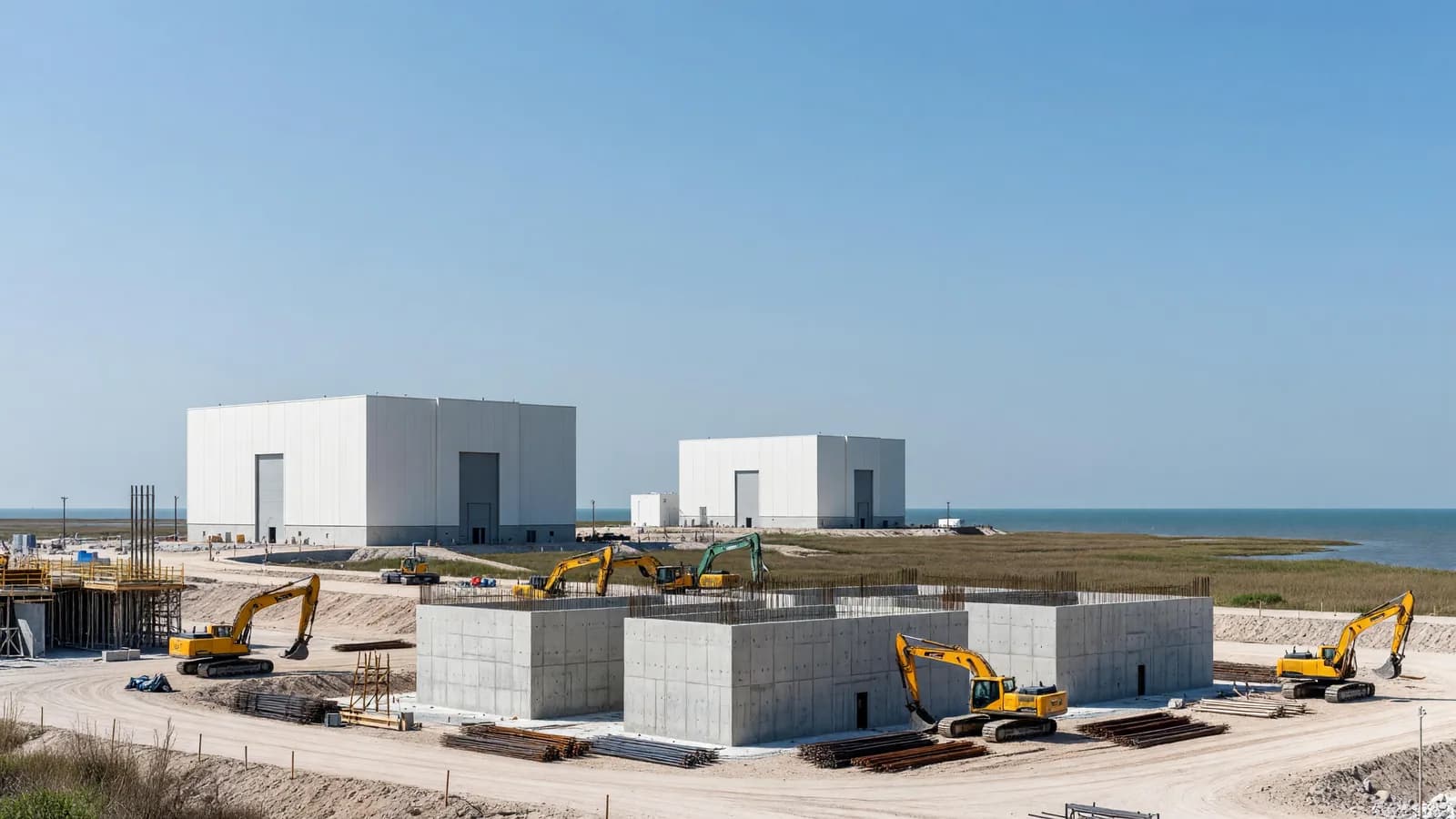
Blue Energy has filed the first half of its US Nuclear Regulatory Commission construction permit application for a first-of-a-kind gas-to-nuclear plant at the Port of Victoria, Texas. The project leads with roughly 1 GW of GE Vernova gas turbines and follows with up to five GE Vernova Hitachi BWRX-300 small modular reactors, anchored to a Crusoe AI data-center campus.
Key facts
- Part 1 of the construction permit application went to the NRC on September 15, 2026, covering the first nuclear unit at the Port of Victoria site.
- The plant pairs two GE Vernova 7HA.02 gas turbines (about 1 GW) with up to five BWRX-300 SMRs adding 1.5 GW.
- Blue Energy says the filing makes it one of five companies to submit a construction permit application in the current US new-build wave.
- Anchor customer Crusoe is planning a 1,600-acre AI factory campus at the site, with gas power from 2028 and a nuclear transition targeted by 2031.
- The NRC approved Blue Energy's "Blue Bridge" licensing topical report in December 2025, the regulatory basis for the gas-first build sequence.
- Part 2 of the application is due in the second half of 2027, after a mandated year of site-specific data collection; final investment decision is slated for 2027.
What happened
Blue Energy submitted Part 1 of its construction permit application to the NRC late on September 15, the company announced. The filing covers the first nuclear unit at the Port of Victoria, on the Texas Gulf Coast, and it asks the regulator for two things at once: permission to start limited construction activities, including deep foundation and shaft work for the plant's first SMR, and approval of the company's plan to build the natural gas portion and balance-of-plant first so the nuclear units can reuse that infrastructure later.
The submission also includes a nearly 300-page environmental report covering the gas portion of the project, which concluded there are no significant impacts to endangered species, tribal lands or other environmental and historical concerns. On financing, the filing describes a project-finance structure the company says will not be paid for by ratepayers.
The speed of the filing is part of the story. Blue Energy selected the BWRX-300 as its reactor technology only five months ago, in April 2026, and its regulatory team compiled the package in that window. "This is serious work done by serious people for a serious project," co-founder and CEO Jake Jurewicz said in the company's statement.
Why it matters
This is the first time a gas-first, nuclear-follow construction sequence has entered a formal US licensing docket. The model matters because it attacks the two costs that dominate nuclear builds: time and capital. Blue Energy's argument, stated in its filing and prior announcements, is that reactors make up less than 10% of a nuclear plant's cost, with most of the money and risk sitting in the surrounding construction and regulatory work. Build the gas plant and shared balance-of-plant first, the logic goes, and power starts flowing within 36 months instead of the roughly decade-long timeline of a conventional greenfield nuclear project.
The filing also fuses three storylines NNN has been tracking separately. The first is data-center demand: the International Energy Agency has already logged 4.5 GW of data-center SMR deals, and Crusoe's Texas campus is one of the largest single-site bets in that pipeline. The second is the gas-to-nuclear bridge: gas turbines as a stopgap baseload source while SMR fleets scale. The third is BWRX-300 commercialization — the same reactor design that Poland's Orlen Synthos wants to deploy in a 14-unit build. One docket now carries all three.
There is a financing signal here too. Blue Energy has raised more than $400 million, including a strategic investment from Constellation Technology Ventures, the venture arm of the largest US nuclear fleet operator. Earlier this month the company retained Societe Generale to structure project financing for the Victoria pilot. If that structure holds, it would be a rare project-financed nuclear plant in a market where regulated cost-of-service models still dominate.
Background
Blue Energy is a Chevy Chase, Maryland developer founded in 2023 by Jake Jurewicz and Matt Slotkin out of MIT's Nuclear Science and Engineering Department, backed by VXI Capital, Engine Ventures, At One Ventures and Tamarack Global. Its core pitch is a standardized, prefabricated plant architecture, built partly in shipyards, that is reactor-agnostic — the same balance-of-plant can house different SMR designs. The company outlined the approach when it signed its project acceleration agreement with GE Vernova Hitachi in August.
The regulatory groundwork was laid in December 2025, when the NRC approved the company's licensing topical report supporting the resequenced construction approach behind today's filing. That approval is why the company can now ask the NRC to bless building gas first inside a construction permit application, rather than treating the gas plant as a separate project. For context on the reactor technology and the wider SMR field, see NNN's SMRs explained hub and top SMR developers to watch in 2026.
The Port of Victoria site itself came out of a November 2025 agreement with Crusoe, which secured land for an up-to-1.5 GW plant to power the AI infrastructure firm's nearby factory campus. GE Vernova Hitachi has supported the application with technical information, and the two companies advanced engineering, licensing and safety analysis work in August.
What's next
The near-term milestones are procedural but consequential. The NRC must accept the application and docket it, which starts the formal review clock for Part 1. Blue Energy then owes a year of site-specific data collection at Victoria before it can file Part 2, expected in the second half of 2027. The company's final investment decision is targeted for 2027, gas-fired power for the Crusoe campus from 2028, and nuclear generation by 2031.
Watch three things. First, how the NRC staff handles the gas-first construction sequence in review — approval would give other developers a licensing template for hybrid gas-nuclear projects. Second, whether the Societe Generale-arranged project financing closes on terms that hold without ratepayer backing. Third, whether the Crusoe campus itself reaches final investment decision on schedule, since the power contract underpins the entire build. A slip on any one of the three moves the 2031 nuclear date.
Background
The BWRX-300 is GE Vernova Hitachi's 300 MWe boiling-water small modular reactor, derived from the NRC-licensed ESBWR and fueled with GNF2 fuel already in commercial use. Unit 1 at Ontario Power Generation's Darlington site — the first Western SMR to reach construction — is being built with four units approved there totalling about 1,200 MW, and Poland's Orlen Synthos Green Energy is seeking state financing for 14 units across three sites. (As of August 2026.) Read the BWRX-300 explainer.
Questions
- What did Blue Energy file with the NRC?
- Part 1 of its construction permit application for the first nuclear unit at the Port of Victoria, Texas, filed on September 15, 2026. It requests early foundation work and NRC approval of the gas-first construction sequence.
- What is a gas-to-nuclear plant?
- A plant that starts with natural gas turbines and shared balance-of-plant, then adds small modular reactors that reuse the same turbines, cooling and grid infrastructure. Gas delivers power early while the nuclear units are built and licensed.
- Who will buy the power?
- Crusoe. Blue Energy agreed in November 2025 to build up to 1.5 GW at the Port of Victoria to supply Crusoe's proposed 1,600-acre AI factory campus, with gas power from 2028 and a transition to nuclear by 2031.
- What happens next?
- Blue Energy must collect one year of site-specific data before filing Part 2 in the second half of 2027. A final investment decision is targeted for 2027, gas power in 2028 and nuclear generation by 2031.
Sources
- Blue Energy Submits Construction Permit Application to Nuclear Regulatory Commission — Blue Energy (PR Newswire)
- Blue Energy submits first construction application to NRC — World Nuclear News
About Nuclear News Network
Nuclear News Network (NNN) is an independent publication covering the global nuclear energy sector — reactor construction, SMRs, fuel supply, policy, operations and fusion. NNN publishes a daily brief, same-day analysis of major developments, and reference guides used across the industry. Articles are produced by the NNN Newsroom, an editorial automation system with human oversight, under the publication's editorial standards. Ruben Seoane is the founder and main editor of NNN.