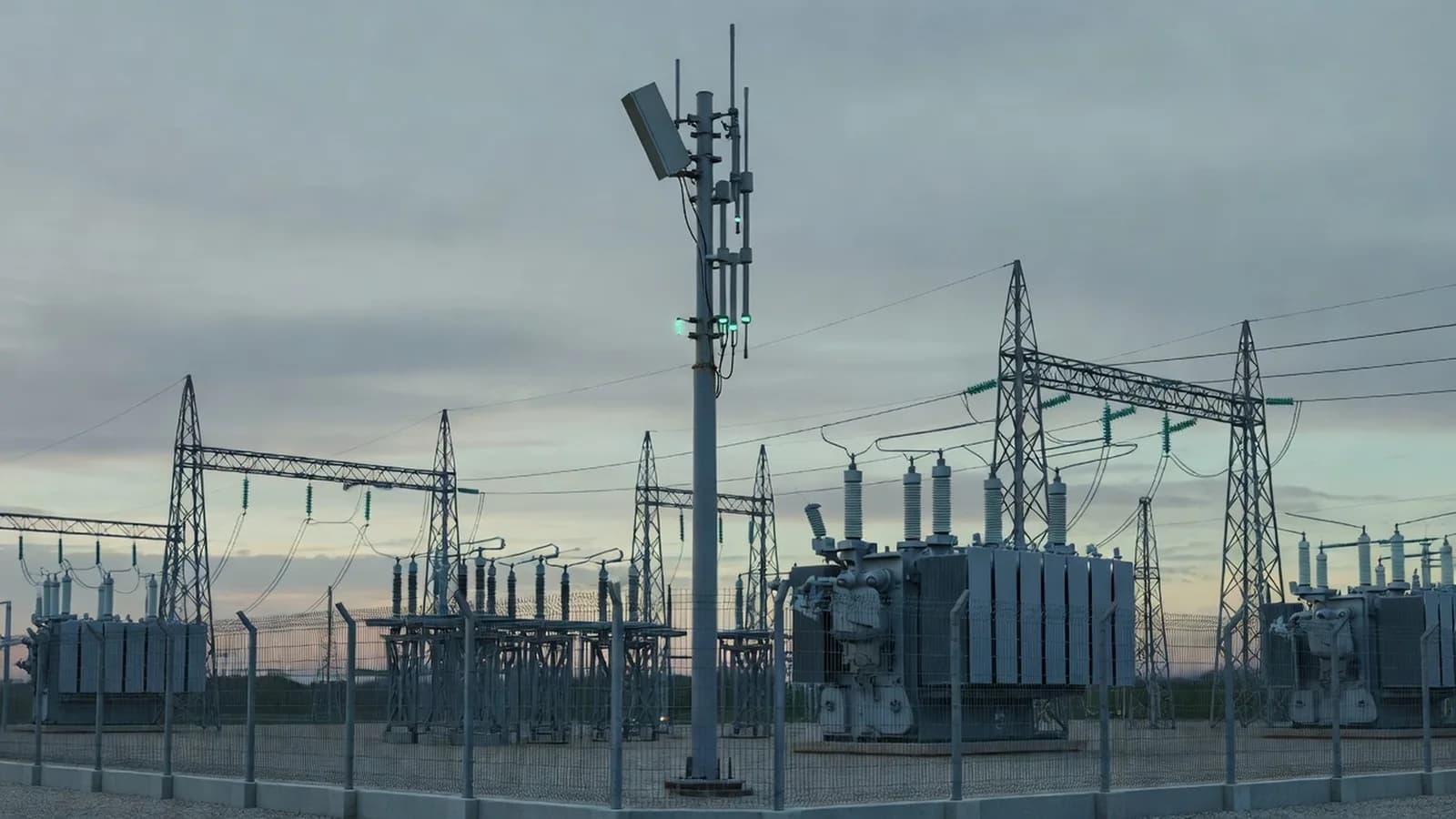
Counter-UAS — counter-unmanned aircraft systems, C-UAS, counter-drone defense — is the technology stack that detects, tracks, identifies and, where the law allows, defeats unauthorized drones. It matters to the energy sector because the threat stopped being theoretical: unidentified drones overflew the Doel nuclear plant in Belgium, surveyed German power plants during the 2025 European drone wave, and have repeatedly struck the Zaporizhzhia plant in Ukraine — while the market for defending against them heads toward $29.7 billion by 2031.
Key facts
- C-UAS systems chain four functions: detect → track → identify → mitigate; most civilian deployments legally stop at identify
- The US Department of Homeland Security awarded a $1.5 billion unified counter-UAS contract to 12 companies in August 2026
- Europe's counter-drone build-out — the European Drone Defence Initiative or "drone wall" — targets initial capability by end-2026
- Germany passed laws giving police and the Bundeswehr shoot-down authority after drones overflew its plants and airports
- The global C-UAS market is forecast to reach $29.7 billion by 2031
How it works
A C-UAS installation is a layered sensor web wrapped around a site, feeding a command-and-control (C2) system that decides what is a bird, what is a hobbyist, and what is a threat.
Detection and tracking combines four sensor families, because each one fails somewhere: radio-frequency (RF) sensors listen for the control link between drone and pilot — cheap and passive, but blind to autonomous drones flying without one; radar sees everything that moves, including autonomous aircraft, but struggles with small, slow, low targets; electro-optical and infrared cameras confirm and classify what the other sensors flag; acoustic sensors fill gaps at short range. Fused, they produce a track and — via RF fingerprinting or remote-ID — often the drone model and the pilot's location.
Mitigation is where engineering meets law. The effector ladder runs from soft to hard: jamming severs the control or GPS link; protocol takeover hijacks the drone and lands it intact (prized for forensics); interceptor drones capture or ram the target; and kinetic and directed-energy options — guns, missiles, high-power microwaves, lasers — exist mostly at the military end. Soft kill is cheap but fails against autonomous or fiber-guided drones, which is why layered sites pair a jammer with at least one physical interceptor.
The unsolved problem is not any single sensor but economics and airspace: telling one threat from a thousand legitimate flights, and defeating a $2,000 drone without a $2 million missile — at a power plant where the airspace above is legally not the operator's to defend (see NNN's companion explainer on why nuclear plants can't shoot down drones).
The numbers
| Metric | Value | Context |
|---|---|---|
| Global C-UAS market by 2031 | $29.7 billion | critical infrastructure among fastest-growing segments |
| DHS unified C-UAS contract | $1.5 billion / 5 years | 12 awardees, ordering through July 2031 |
| Parallel DoD domestic program | $500 million | JIATF-401 "Domestic Shield" (AeroVironment) |
| EU drone-wall timeline | initial capability end-2026 | full functionality targeted 2027–28 |
| European drone wave, 2025 | 8+ countries affected | nuclear plants, airports, air bases overflown |
Who builds counter-drone defense
The vendor landscape splits into detection specialists, effector makers, and the integrators who won the DHS contract. A consolidation signal worth watching: Axon bought Dedrone and Motorola is acquiring D-Fend — counter-drone is being folded into the enterprise security stack utilities already buy.
| Company | Specialty | HQ | Energy-infrastructure relevance |
|---|---|---|---|
| Dedrone (Axon) | RF/radar detection, C2 platform | US | DHS Track 1 awardee; utility and airport deployments |
| DroneShield | Detection + handheld/fixed defeat | Australia | Publicly listed; markets directly to energy sector |
| Fortem Technologies | Radar + DroneHunter interceptor | US | DHS Track 1; Lockheed and Microsoft as subs |
| D-Fend Solutions | RF protocol takeover | Israel | DHS Track 1; being acquired by Motorola |
| Anduril | Lattice C2 + Anvil interceptor | US | DHS Track 2 managed services |
| AeroVironment | Effectors, domestic-defense integration | US | Sole awardee of DoD's $500M Domestic Shield |
| Epirus | High-power microwave (Leonidas) | US | Drone-swarm defeat for fixed sites |
| Rafael | Drone Dome (radar, jammer, laser) | Israel | Deployed national C-UAS reference system |
| Hensoldt | Radar/spectrum sensing | Germany | European drone-wall industrial base |
| Rheinmetall | Skyranger gun-based air defense | Germany | Hard-kill layer for site defense |
| MyDefence | Wearable/fixed RF detection | Denmark | Deployed around Danish critical sites |
| Sentrycs | Protocol-takeover C-UAS | Israel | Civilian-safe defeat for sensitive sites |
| Leidos / BAE / Booz Allen / GDIT / Parsons / CACI | Integration & managed services | US/UK | DHS awardees running end-to-end site defense |
| Terra Drone | Peacetime infrastructure C-UAS | Japan | Announced critical-infra system, Aug 2026 |
Common misconceptions
"Detection means protection." Most civilian C-UAS deployments are legally detect-only. A site can know a drone is overhead, log it, and still have no lawful way to make it leave — the gap the current legislative push aims to close.
"Jammers solve it." Jamming fails against autonomous drones flying a pre-programmed route with no RF link, and against fiber-optic-guided drones — both now common in Ukraine. It is also flatly illegal for private operators in most jurisdictions.
"This is a military problem." The 2025 incursions targeted civilian airports and power plants precisely because they sit outside military air defense. The institutional answer — Germany's shoot-down laws, the DHS contract, the EU drone wall — is about civil infrastructure, not the front line.
Current state (September 2026)
The procurement wave is cresting now. DHS's $1.5 billion IDIQ became orderable in August 2026; Europe's drone wall enters implementation with initial capability targeted by year-end; Germany is standing up its legal framework and buying systems. What remains unsettled is exactly the piece that matters for the nuclear and grid sectors: who may pull the trigger over a civilian power plant. NNN tracks drone incursions at energy facilities in its incident tracker and the legal side in the companion explainer below.
Related reading
Start with why nuclear plants can't shoot down drones for the legal gap this technology runs into, and the NRC licensing explainer for how US nuclear regulation assigns responsibility. NNN's drone-incident tracker logs overflights and attacks on energy infrastructure as structured data.
Questions
- What is a counter-UAS system?
- A counter-UAS (C-UAS) system detects, tracks, identifies and — where legally permitted — defeats unauthorized drones. It layers sensors (radio-frequency detection, radar, cameras, acoustics) with effectors ranging from jammers and protocol takeover to interceptor drones and high-power microwaves.
- Can a power plant legally use counter-drone systems?
- Detection is generally legal everywhere. Defeat mostly is not: in the US, jamming or downing a drone is a federal crime for private operators, including utilities. Only a handful of federal agencies hold counter-UAS authority, though pending legislation would extend it to critical-infrastructure operators.
- Why is energy infrastructure suddenly a counter-drone priority?
- The 2025 European drone wave put unidentified drones over the Doel nuclear plant, German power plants and multiple airports, while US reactors logged 26+ overflights in 2024 and drones have repeatedly struck the Zaporizhzhia plant in Ukraine. Regulators and budgets followed.
- How big is the counter-UAS market?
- Forecasts put the global C-UAS market at roughly $30 billion by 2031, up from single-digit billions in 2026, with critical-infrastructure protection among the fastest-growing segments alongside a $1.5 billion DHS procurement and Europe's drone-wall build-out.
Sources
- Counter-UAS System (C-UAS) Market worth $29.70 billion by 2031 — MarketsandMarkets
- DHS $1.5 Billion Counter-UAS Contract Explained: 12 Companies, Two Tracks — Drone Intelligence
- Europe's Drone Wall – Ready, EDDI, Go! — European Security & Defence
- Unidentified Drone Incursions at Belgium Nuclear Plant Highlight Growing Critical Infrastructure Threat — DroneLife
- German Cabinet Approves Law To Shoot Down Threatening Drones — The War Zone
- 2025 European drone sightings — Wikipedia
About Nuclear News Network
Nuclear News Network (NNN) is an independent publication covering the global nuclear energy sector — reactor construction, SMRs, fuel supply, policy, operations and fusion. NNN publishes a daily brief, same-day analysis of major developments, and reference guides used across the industry. Articles are produced by the NNN Newsroom, an editorial automation system with human oversight, under the publication's editorial standards. Ruben Seoane is the founder and main editor of NNN.