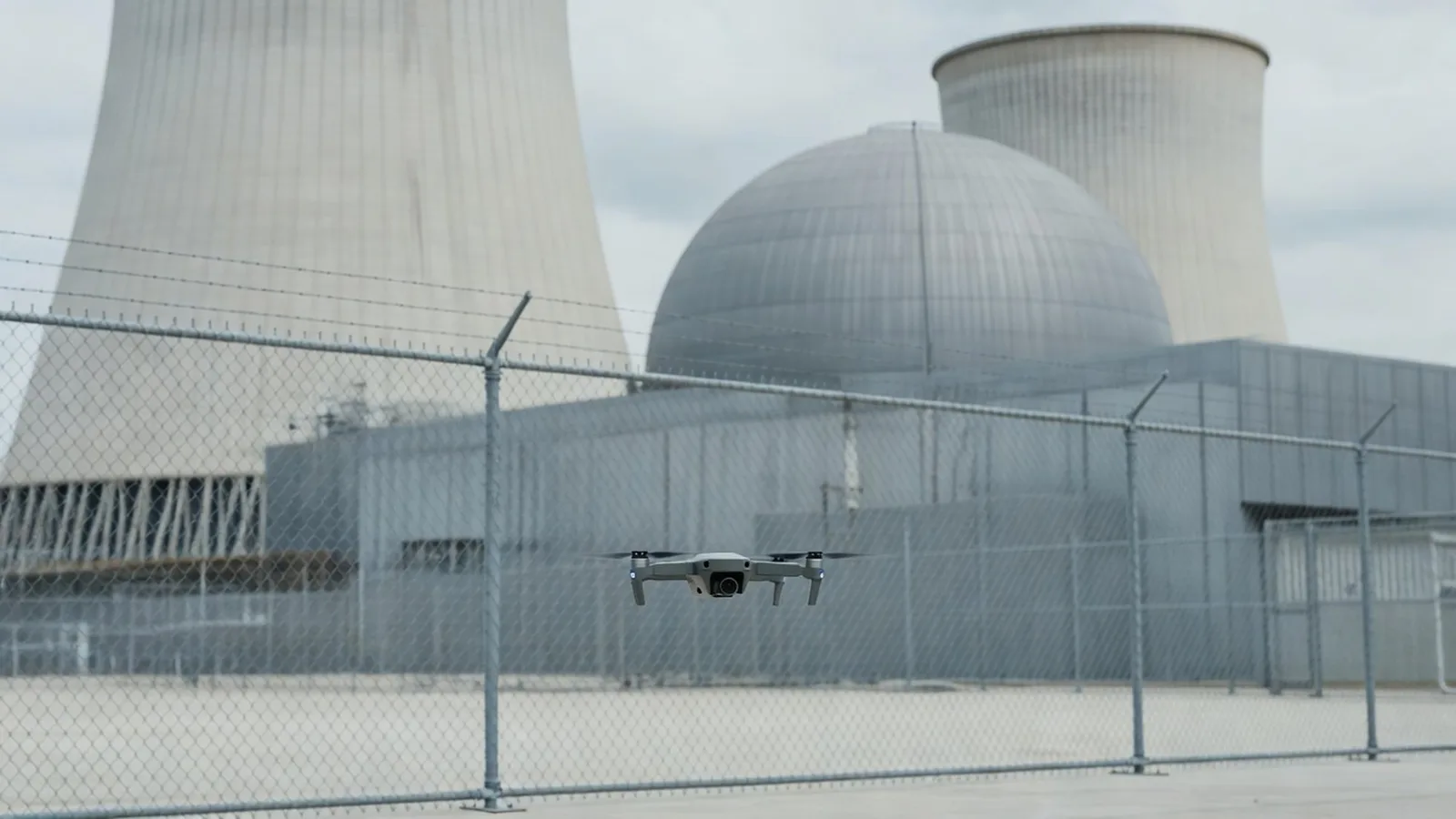
A drone over a US nuclear power plant can be detected, tracked and reported — but in almost every case it cannot lawfully be stopped, because federal law treats drones as aircraft and reserves the authority to disable them for a short list of federal agencies that does not include plant operators. That is the central fact of the drone-security debate, and it survived 26+ documented overflights of US reactors in 2024 and a European wave that put drones over the Doel plant in Belgium.
Key facts
- US law makes downing or jamming a drone a federal crime for private parties — drones are aircraft, and utilities have no counter-UAS defeat authority
- The NRC requires no drone defenses at commercial plants and has reaffirmed that position over sustained criticism
- 26+ drone overflights of US power reactors were documented in 2024; four drones were sighted over Prairie Island (MN) in early 2025
- The FY2026 NDAA gives the DOE Secretary defeat authority over DOE's own nuclear facilities only — roughly 100 civilian reactors, 19% of US electricity, sit outside it
- Germany has moved further, giving police and the Bundeswehr shoot-down authority
The law today
United States. Three legal walls stand between a plant security force and a hostile drone. First, drones are aircraft under federal aviation and criminal law, so physically downing one carries the same exposure as attacking a crewed plane. Second, the electronic route is equally closed: jamming or hijacking a control link violates federal communications law. Third, the narrow exception — statutory counter-UAS authority to detect and defeat drones — was granted only to a handful of federal agencies, and nuclear utilities are not among them. During the December 2024 drone wave, even NORTHCOM's commander acknowledged the military lacked authority to engage the objects over US facilities.
The regulator's position. The NRC's fact sheet is explicit: plants must detect and report overflights, vital areas are hardened against aircraft impact, and defending US airspace is the federal government's job — not the licensee's. The commission declined to require drone-defeat capability, a decision the Union of Concerned Scientists and the Nonproliferation Policy Education Center have attacked as leaving a documented gap unaddressed.
Europe. The 2025 drone wave forced the issue faster. Germany passed a police shoot-down law in October 2025 and cabinet-approved Bundeswehr authority to down threatening drones; Belgium scrambled national assets after Doel. The pattern is the same on both continents: authority is being pulled upward to the state, not delegated to operators.
The numbers
| Metric | Value | Context |
|---|---|---|
| US reactor overflights, 2024 | 26+ | documented; attribution mostly unresolved |
| Prairie Island sighting, 2025 | 4 drones | Minnesota, early 2025 |
| Doel incursion, Nov 2025 | 3 drones | Belgian nuclear plant, unattributed |
| Civilian reactors outside new DOE authority | ~100 units, 19% of US electricity | FY2026 NDAA covers DOE sites only |
| Federal agencies with defeat authority | handful | pending bills would add infrastructure operators |
Common misconceptions
"Plants are hardened, so drones don't matter." Containment structures are designed against aircraft impact, but a plant is more than its containment: spent-fuel pools, switchyards, transformers, intake structures and control-building rooftops are softer targets, and Ukraine's Zaporizhzhia strikes showed drones reaching operating plant buildings. The Bulletin's assessment is that hardening does not answer the surveillance and standoff-attack problem.
"Security officers could just jam it." Jamming is a federal offense for private operators — and increasingly useless anyway against autonomous or fiber-guided drones that fly without a link to sever (see counter-UAS, explained).
"If it were serious, the military would handle it." The December 2024 New Jersey wave demonstrated the opposite: military commanders reported neither identification nor engagement authority over the drones crossing US installations. There is no standing air-defense umbrella over civilian plants in peacetime.
Current state (September 2026)
Congress is closing the gap from two directions at once — but neither has reached civilian plants yet. The FY2026 NDAA package gives the Energy Secretary authority to disable or destroy drones over DOE nuclear facilities, and a Senate bill would let vetted critical-infrastructure operators run detect-and-mitigate systems under federal oversight. Until one of those becomes law for commercial reactors, the operating reality stands: US plants may watch, log and report — and nothing more. NNN logs each new incursion in its drone-incident tracker.
Related reading
The technology side — sensors, jammers, interceptors and who builds them — is covered in counter-UAS, explained. For how responsibility is assigned in US nuclear regulation more broadly, see the NRC licensing explainer. Incursions at energy facilities are tracked as structured data in NNN's incident tracker.
Questions
- Is it illegal for a nuclear plant to shoot down a drone?
- In the US, effectively yes. Drones are aircraft under federal law, so downing one — or jamming its link — is a federal crime for private parties, utilities included. Counter-UAS defeat authority currently belongs to a short list of federal agencies, and commercial plants are not on it.
- Does the NRC require nuclear plants to defend against drones?
- No. The NRC requires plants to detect and report overflights but has declined to require drone-defeat capability, reasoning that vital areas are hardened and defense against aerial attack is the federal government's job. Critics including the Union of Concerned Scientists have challenged that position.
- How often do drones overfly US nuclear plants?
- More than 26 drone overflights of US power reactors were documented in 2024, and four drones were sighted over the Prairie Island plant in Minnesota in early 2025. Attribution is rarely established.
- What would change the legal situation?
- Pending US legislation: the FY2026 NDAA gives the Energy Secretary drone-defeat authority over DOE's own nuclear facilities, and a Senate bill would extend detect-and-mitigate authority to critical-infrastructure operators such as utilities. In Europe, Germany has already given police and the Bundeswehr shoot-down authority.
Sources
- It's past time to start protecting US nuclear power reactors from drones — Bulletin of the Atomic Scientists
- Drones and Nuclear Power Plant Security — US Nuclear Regulatory Commission
- NRC Decision Leaves Nuclear Plants Vulnerable to Terrorist Drones — Union of Concerned Scientists
- Senate Bill Would Give Critical Infrastructure Sites Counter-UAS Authority — Commercial UAV News
- German Cabinet Approves Law To Shoot Down Threatening Drones — The War Zone
- Unidentified Drone Incursions at Belgium Nuclear Plant Highlight Growing Critical Infrastructure Threat — DroneLife
About Nuclear News Network
Nuclear News Network (NNN) is an independent publication covering the global nuclear energy sector — reactor construction, SMRs, fuel supply, policy, operations and fusion. NNN publishes a daily brief, same-day analysis of major developments, and reference guides used across the industry. Articles are produced by the NNN Newsroom, an editorial automation system with human oversight, under the publication's editorial standards. Ruben Seoane is the founder and main editor of NNN.