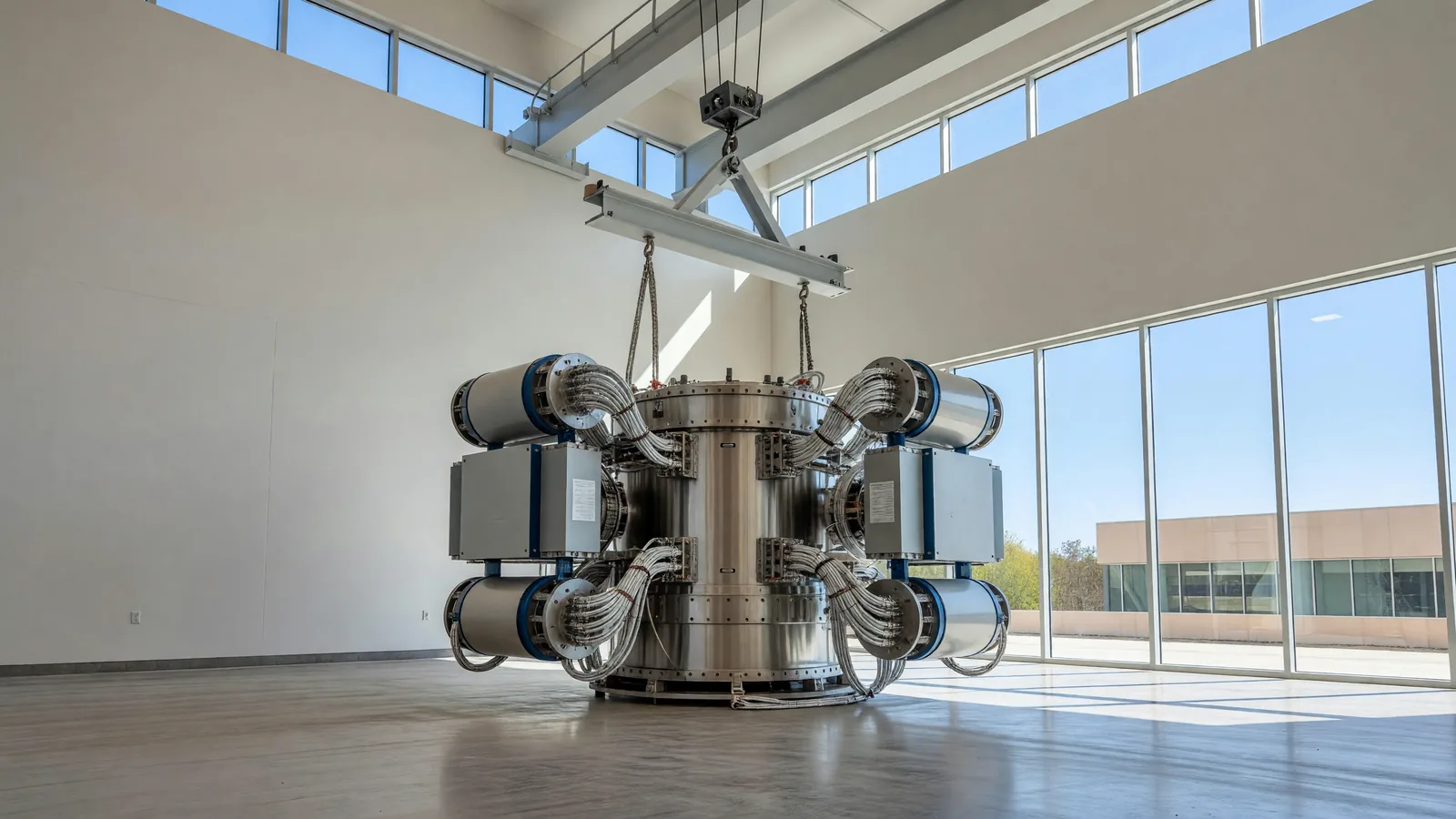
The US Department of Energy has added 12 Phase II awards worth $159 million to its Genesis Mission AI-for-science program. The only nuclear project in the round, fission or fusion, is a digital twin of Commonwealth Fusion Systems' SPARC tokamak. Nuclear fission received nothing new: INL's $60 million Prometheus project is still the program's only fission award and is still in negotiation.
Key facts
- DOE announced 12 new Phase II projects totaling $159 million on October 8, bringing the Phase II portfolio to 14 projects. It did not give per-project amounts.
- Commonwealth Fusion Systems (CFS) leads the AI-enabled digital twin for SPARC, the round's only fusion or fission award.
- The SPARC twin targets full plasma-pulse predictions in under 20 minutes, fast enough to inform decisions between pulses.
- The two earlier Phase II awards are INL's Prometheus nuclear project and the Office of Electricity's $11.5 million GridFM 2.0.
- Prometheus holds a $60 million, three-year award subject to appropriations, and NNN's Prometheus tracker still lists it as in negotiation.
What happened
DOE's Office of Science announced the new round on October 8. It added 12 Phase II projects and six Phase I awards to the Genesis Mission, which DOE now describes as a first-year cohort of 297 projects. Under Secretary for Science Darío Gil called the awards "a critical step in turning the promise of Super Intelligence for science into transformative scientific capability."
Most of the new money goes to science, not energy. DOE's list includes an RNA structure database at UC San Diego and lattice quantum chromodynamics at MIT. It also covers rare-earth extraction at the University of Illinois, enzyme design at the University of Washington, radiation-hardened microchips at Fermilab, and particle-accelerator control at Lawrence Berkeley. Rounding it out are quantum error correction at Harvard, supercomputing software at Argonne, quantum magnet design at Oak Ridge, and an operating assistant for the Facility for Rare Isotope Beams separator, led by Northeastern University. UC Irvine's MAESTRO, a platform for managing deep underground reservoirs for geothermal energy, is the other energy-adjacent award.
CFS is the only company leading one of the 12. Its project brings in PPPL, Oak Ridge, Lawrence Livermore and SLAC, along with General Atomics, NVIDIA, Google DeepMind, MIT and Carnegie Mellon, according to the Princeton Plasma Physics Laboratory. PPPL will contribute its M3D-C1, TRANSP and XGC physics codes, historical tokamak data and computing. Before applying the methods to SPARC, the team will test them on PPPL's NSTX-U.
Why it matters
For NNN readers, the round is mostly a story about fusion. Mirroring a tokamak closely enough to predict a full pulse before running it would cut the trial and error involved in operating a first-of-a-kind machine. PPPL says the team also plans to use the twin to speed development of ARC, CFS's planned commercial power plant. The award builds on CFS's private funding: the company raised another $1 billion this year as SPARC assembly neared completion. Federal AI money now also pays for the software that will run the machine.
For fission, the round brings no new funding. The Office of Nuclear Energy's only Phase II project is still Prometheus, the INL-led consortium that aims to use AI to cut reactor design, licensing and operating costs. When the program was first announced in July, Prometheus's $60 million award was the largest in the Genesis cohort, and DOE's original call capped Phase II awards at $6 million to $15 million over three years. The October list does not show Prometheus moving from selection to a signed award.
The distinction matters because DOE counted Prometheus toward its 14-project Phase II total. An award that is counted is not necessarily funded. INL's own release describes the $60 million as subject to appropriations, and DOE must finish negotiating with the selectee before any money is released.
Background
The Genesis Mission is DOE's AI-for-science program, launched in November 2025. Phase II awards are the larger, multi-year grants that follow the smaller Phase I seed awards. The first Phase II tranche, announced on July 22 alongside 278 Genesis selections, named Prometheus and GridFM. NNN tracks Prometheus as a dataset, recording its partners, workstreams and program events with sources. The tracker counts 33 named partners, although press materials say 32.
NNN's fusion explainer sets out where SPARC fits in the race to demonstrate net energy from magnetic confinement. The DOE funding explainer maps the other federal programs paying for the fission buildout, most of which run through the Office of Nuclear Energy rather than the Office of Science.
What's next
For Prometheus, the next milestones are a signed award, appropriations language that funds it, and the first deliverables. INL targets an initial production deployment on the Genesis Mission platform by March 2027. For the SPARC twin, it is the first coupling to live machine data once SPARC operates. DOE has not said whether further Phase II tranches will follow this fiscal year. Its October release gives no timeline beyond pointing to the Office of Science's award pages.
Questions
- What did DOE announce on October 8, 2026?
- DOE selected 12 new Phase II projects worth a combined $159 million under its Genesis Mission AI-for-science program, plus six new Phase I awards. That brings the Phase II portfolio to 14 projects.
- Is any of the new Phase II money for nuclear energy?
- Not for fission. The only nuclear award goes to Commonwealth Fusion Systems for an AI digital twin of its SPARC fusion device. The other 11 cover areas such as biology, particle physics, geothermal, quantum and supercomputing software.
- Did INL's Prometheus project get more funding?
- No. Prometheus is one of the two earlier Phase II awards counted in the 14-project total. Its $60 million, three-year award remains in negotiation with DOE and subject to appropriations.
- What will the SPARC digital twin do?
- It will mirror the SPARC tokamak and update as the machine runs. The team aims to predict a full plasma pulse in under 20 minutes, fast enough to inform decisions between pulses, and to use the results for CFS's planned ARC power plant.
Sources
- Energy Department Announces New Genesis Mission Awards to Advance Super Intelligence for Science — U.S. Department of Energy
- PPPL Data, Simulation Codes and Compute Power Will Be Used in Phase II Genesis Mission Project to Build Digital Twin of Fusion Energy System — Princeton Plasma Physics Laboratory
- Genesis Mission funds AI innovation to speed up safe, affordable nuclear energy — Idaho National Laboratory
- Prometheus — Idaho National Laboratory
- Energy Department Announces $293 Million in Funding to Support Genesis Mission National Science and Technology Challenges — U.S. Department of Energy
About Nuclear News Network
Nuclear News Network (NNN) is an independent publication covering the global nuclear energy sector — reactor construction, SMRs, fuel supply, policy, operations and fusion. NNN publishes a daily brief, same-day analysis of major developments, and reference guides used across the industry. Articles are produced by the NNN Newsroom, an editorial automation system with human oversight, under the publication's editorial standards. Ruben Seoane is the founder and main editor of NNN.