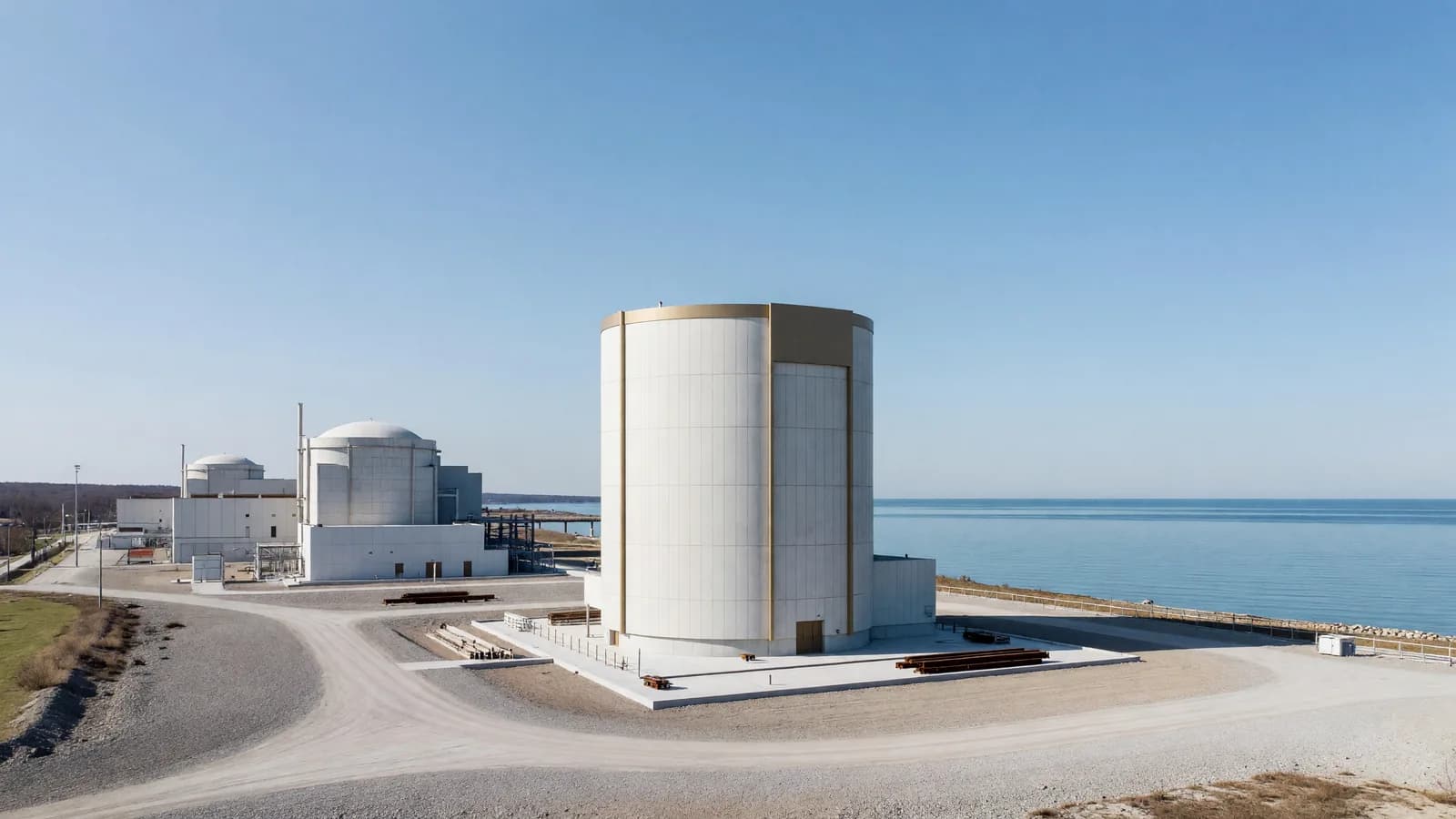
Holtec International says it has filed a Preliminary Safety Analysis Report with the U.S. Nuclear Regulatory Commission for two proposed SMR-300 reactors at Michigan's Palisades Energy Center, completing the second phase of its construction permit application. The filing supplies technical safety material for the review, but it is not permission to build; each planned unit is designed for 340 megawatts electric.
Key facts
- Holtec says it submitted the Preliminary Safety Analysis Report on September 30, 2026.
- The two Pioneer SMR-300 units are designed to add 680 MWe combined to the Palisades site, according to Holtec.
- The first phase, submitted on December 31, 2025, included the limited work authorization request and environmental report.
- The NRC lists the project under docket numbers 50-616 and 50-617.
- Holtec says the units are planned to enter service in the early 2030s; that is a company timeline, not an NRC-approved schedule.
What happened
Holtec's September 30 announcement says its engineering business submitted the Preliminary Safety Analysis Report, or PSAR, to the NRC. The report describes technical and safety aspects of Pioneer 1 and Pioneer 2, two proposed pressurized-water SMR-300 units at the Palisades Energy Center in Covert Township, Michigan. The company says the planned pair would add 680 MWe at the site.
The filing completes what Holtec calls the second phase of its construction permit application. The process began with Part 1, submitted at the end of 2025. That phase contained an application for a limited work authorization, three exemption requests and a comprehensive environmental report, according to the NRC's Federal Register notice. The NRC's October 1 notice records receipt and availability of the Part 1 application; it does not announce acceptance or approval of a construction permit for the two reactors.
Holtec says the PSAR gives regulators technical information supporting the construction application. Its release also lists work still underway on the applicant's side: a Class 2 construction estimate, a 4D simulation showing the proposed construction sequence, and confirmatory safety analyses intended to support a later Final Safety Analysis Report.
Those are company-reported project details. The NRC's Pioneer project page tracks the agency's review of the earlier limited-work-authorization application, with separate dockets for Pioneer 1 and Pioneer 2. The agency page does not yet describe an issued construction permit for either unit.
Why it matters
The PSAR filing moves Holtec's proposed new build into a more substantive licensing exchange: the regulator now has another major technical submission to examine. That is progress in the application, not a regulatory verdict on whether the reactors can be built or operated. A construction permit and, later, an operating licence are distinct authorizations; the NRC says the applicant will need a separate operating licence application after construction.
The distinction matters at Palisades because the site has two nuclear projects with different purposes and regulatory paths. Holtec is also working to restart the existing large reactor, which shut down in 2022. The proposed SMR-300s are new units, not part of that restart. NNN's coverage of fuel loading at the existing Palisades reactor follows the restart sequence; this application concerns future construction at the same energy site.
For the U.S. small modular reactor pipeline, the project will be judged by the detail regulators can resolve, not by the filing date alone. The NRC's public record allows readers to distinguish submissions and review milestones from approvals. Holtec's release describes the PSAR as a major step, while the agency record provides the formal docket and the status of the earlier application. Both are useful, but they are not interchangeable evidence.
Background
Holtec submitted the first part of its phased application on December 31, 2025. The NRC accepted that Part 1 for docketing in February 2026 and began a detailed technical review of its limited-work-authorization request. The October Federal Register notice explains that the initial package included environmental material covering the proposed construction and operation as well as the requested early work.
The limited work authorization is a specific request to perform certain construction activities before a construction permit or combined construction and operating licence is issued. It is not blanket permission to construct the reactor plant. The NRC project page describes the application as a review of the first part of a phased construction permit package. In August, the agency separately granted an exemption for specified excavation-support and cutoff-wall work, as reported in the NRC's environmental-review coverage. That limited early-work decision does not amount to authorization to build or operate the proposed reactors.
The SMR-300 program also sits within a wider debate about how quickly new nuclear projects can move from design work to licensed construction. The proposal is covered in NNN's small modular reactor explainer, which sets out how modular reactor projects differ from conventional large-reactor builds. Palisades offers a concrete case to follow because the NRC's filings, safety reviews and environmental process create public checkpoints against which company schedules can be measured.
What's next
The next milestones are the NRC's review of the submitted safety material and progress on the remaining application documents. Holtec says it will complete its cost estimate, construction simulation and confirmatory safety analyses. The NRC's project page lists environmental and safety review steps for the earlier Part 1 package, while the company's early-2030s target remains a projection.
The practical test is whether the application record advances through safety and environmental review toward a construction authorization. Until the NRC issues the necessary permits, Pioneer 1 and Pioneer 2 remain proposed reactors at Palisades, not units under construction.
Questions
- Has Holtec received permission to build the Palisades SMRs?
- No. Holtec says it submitted the safety report as part of its construction permit application. The NRC must review the application, complete required safety and environmental reviews, and issue the relevant authorization before construction can proceed.
- How much electricity are the proposed Pioneer units designed to produce?
- Holtec says the two planned units together would add 680 megawatts electric at Palisades, or 340 MWe each.
- What happens after Holtec files the safety report?
- The NRC reviews the application. Holtec says it is also preparing a Class 2 construction estimate, a 4D construction simulation and confirmatory safety analyses for a later Final Safety Analysis Report.
Sources
- Major Regulatory Developments in the Palisades Pioneer Unit 1 & 2 Program — Holtec International
- Pioneer Units 1 and 2 Limited Work Authorization Application — U.S. Nuclear Regulatory Commission
- SMR, LLC; Palisades SMR, LLC; Pioneer Units 1 and 2; Phased Construction Permit Application-Limited Work Authorization — Federal Register / U.S. Nuclear Regulatory Commission
About Nuclear News Network
Nuclear News Network (NNN) is an independent publication covering the global nuclear energy sector — reactor construction, SMRs, fuel supply, policy, operations and fusion. NNN publishes a daily brief, same-day analysis of major developments, and reference guides used across the industry. Articles are produced by the NNN Newsroom, an editorial automation system with human oversight, under the publication's editorial standards. Ruben Seoane is the founder and main editor of NNN.