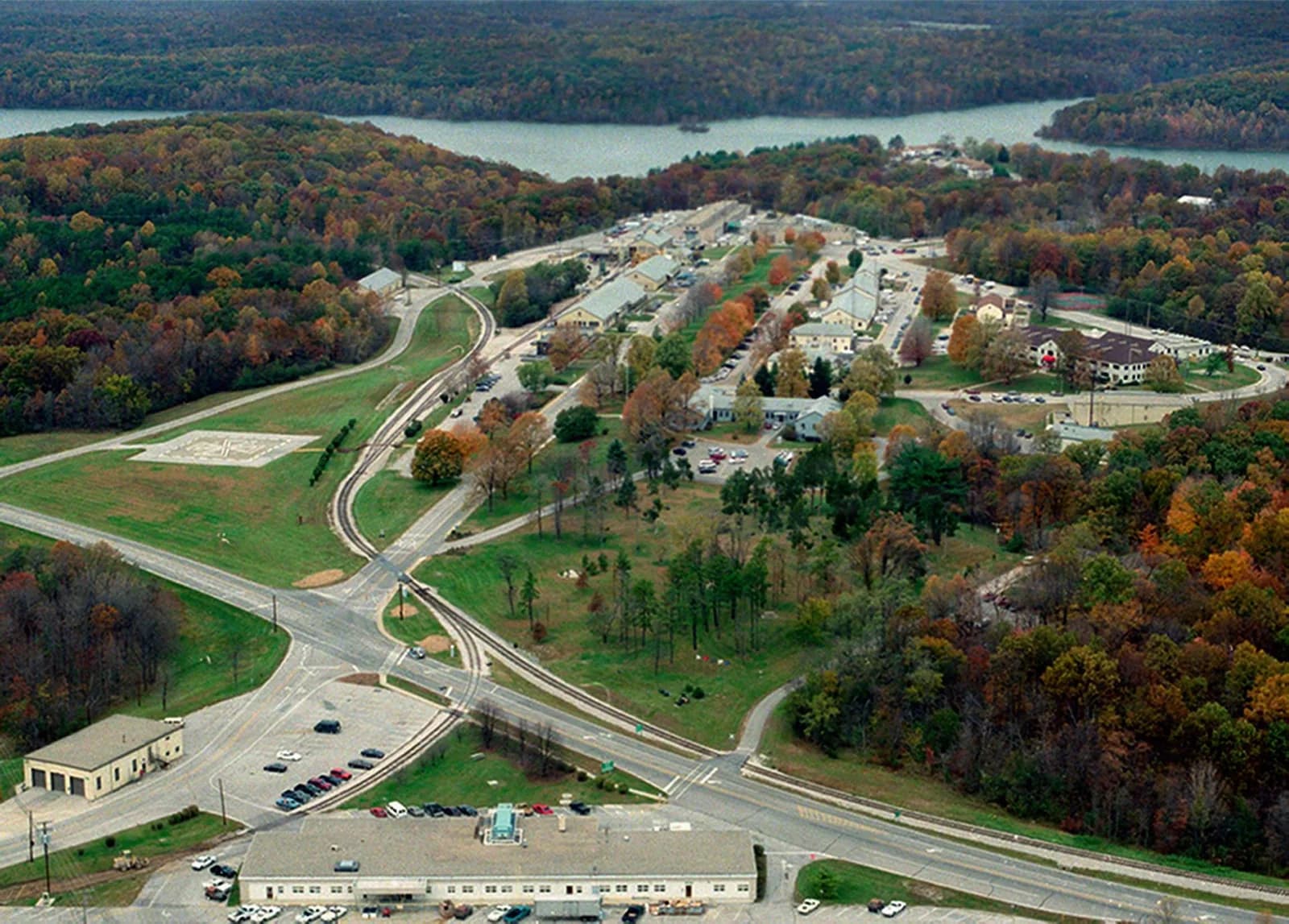
The Department of War has selected Naval Weapons Station Crane, Indiana, for the US Navy's first shore-based advanced nuclear microreactor, a commercially owned and operated unit targeted to be running no later than September 2028. The reactor will be the first power-producing reactor in Indiana history.
Key facts
- The Department of War selected NWS Crane for the Navy's first shore-based advanced microreactor, with an operational target no later than September 2028.
- The unit will be commercially owned and operated, giving the installation power independent of the commercial electric grid.
- The project is executed through the Army's Janus Program alongside the Navy and the State of Indiana, and implements Executive Order 14299 on advanced reactors for national security.
- The selection follows the Army's August move to pair five microreactor vendors with five installations under the same program.
- Nine candidate installations have been advanced for microreactor deployment across the Department of War to date.
What happened
The Department of War announced on September 9 that Naval Weapons Station Crane, a Naval Surface Warfare Center installation in southwestern Indiana, will host the Navy's first shore-based advanced nuclear Micro Modular Reactor. The department describes Crane as one of the nation's "premier warfighting innovation and capability development hubs," and the reactor is meant to sustain its research, development and manufacturing missions through grid outages and other disruptions.
The unit is structured as a commercial asset: commercially owned and operated, rather than a government-owned plant. Delivery runs through the Army's Janus Program — launched last October to bring resilient nuclear power to defense installations — in coordination with the Office of the Assistant Secretary of the Navy for Energy, Installations and Environment, the Office of the Under Secretary of War for Research and Engineering, the DoW Innovation Unit and the State of Indiana. The Office of the Assistant Secretary of War for Critical Technologies is leading stakeholder integration for the Crane project.
Senior officials framed the timeline as the point. "Our standard is to field and deploy capability within 24 months or less," said Mike Dodd, Assistant Secretary of War for Critical Technologies, in the department's release. Brendan Rogers, the Navy's assistant secretary for energy, installations and environment, tied the project directly to shore-infrastructure hardening: "Energy security is warfighting capability," he said, pointing to physical, cyber and grid vulnerabilities.
The announcement lands weeks after the Army selected five microreactor vendors — Antares, BWXT Advanced Technologies, General Atomics Electromagnetic Systems, Radiant Industries and Westinghouse Government Services — for five Army installations under Janus. It also carries a substantial Indiana political footprint: the department credited Senator Jim Banks, Governor Mike Braun, Senator Todd Young, Representative Erin Houchin and Representative Mark Messmer with clearing the path for the project.
Why it matters
This is the first time the Janus model crosses service lines. The Army built the program and holds the department's executive-agent role for installation nuclear energy; Crane is the proof that the Navy can plug into the same framework, with a commercially owned reactor sited on a Navy installation. If the September 2028 target set by Executive Order 14299 holds, it would put an operational advanced reactor on a domestic military base roughly three years after the order was signed in May 2025 — a pace no civilian SMR project has matched.
For Indiana, the symbolic weight is just as large. The state has never had a power-producing reactor, and Crane's unit gives it one without a utility-scale construction program — a microreactor, privately financed, on federal land. For the wider advanced-reactor sector, a paying defense customer with a fixed deadline is precisely the kind of anchor order that pulls designs from licensing limbo into hardware. NNN has tracked that arc through the Army's five-vendor, five-base selection, the DOME microreactor test bed opening in Idaho and Radiant's Kaleidos unit heading toward Idaho testing.
Background
The Janus Program, launched in October 2025, is the Department of War's bet that advanced reactors can do for base energy security what distributed generation has done for data centers: guarantee firm power independent of a strained commercial grid. The Army is the department's executive agent for installation nuclear energy, and Janus is its delivery vehicle — roughly $2.2 billion in awards across fiscal 2027–2031, structured as milestone-based Other Transactions Authority agreements so vendors get paid against technical progress, not promises.
Executive Order 14299, "Deploying Advanced Nuclear Reactor Technologies for National Security," set the pace: an Army-regulated reactor operating at a domestic installation no later than 30 September 2028. A companion order, Executive Order 14302, targets the nuclear industrial base itself — supply chains, workforce and manufacturing capacity. Crane sits at the intersection of both: a microreactor procurement that leans on the same vendor pool the Army is cultivating, installed at a Navy site whose microelectronics and high-voltage work depends on uninterrupted power. The SMR landscape these units will compete in has narrowed in 2026 to a handful of credible microreactor designs, and the Janus pipeline is now the single largest test of whether any of them can deploy on a warfighter's clock.
What's next
The department says it will work through the required safety, environmental, regulatory and installation processes with federal, state and local partners, with nuclear safety, physical security and cybersecurity "central at every stage." The announced schedule points to installation activity through 2027 and an operational target of September 2028. Watch for the vendor identity behind the Crane unit — the department has not yet named which Janus-linked design will be built — and for the remaining Janus site announcements, with nine installations screened and more pairings expected to follow the Army's first five.
Questions
- What did the Department of War announce?
- On September 9 the Department of War announced that Naval Weapons Station Crane, Indiana, will host the US Navy's first shore-based advanced nuclear microreactor, with an operational target no later than September 2028.
- Who will own and operate the Crane microreactor?
- The Department of War says the microreactor will be commercially owned and operated, executed through the Army's Janus Program in coordination with the Department of the Navy, the DoW Innovation Unit and the State of Indiana.
- Will this be Indiana's first nuclear reactor?
- Yes. The Department of War describes the unit as the first power-producing reactor installed in Indiana, adding firm capacity to a state that currently has no operating nuclear power plants.
- Why was NWS Crane selected?
- NWS Crane is one of the US Navy's premier warfighting innovation and capability development hubs, covering high-voltage systems, microelectronics and weapons work. The reactor is intended to provide round-the-clock power independent of the commercial grid.
Sources
- Department of War Announces Navy's First Advanced Nuclear Microreactor Deployment at Naval Weapons Station Crane, Indiana — U.S. Department of War
- Indiana to get its first power-producing nuclear reactor — World Nuclear News
- DOW Selects NWS Crane for First Navy Shore-Based Microreactor Deployment — ExecutiveGov
About Nuclear News Network
Nuclear News Network (NNN) is an independent publication covering the global nuclear energy sector — reactor construction, SMRs, fuel supply, policy, operations and fusion. NNN publishes a daily brief, same-day analysis of major developments, and reference guides used across the industry. Articles are produced by the NNN Newsroom, an editorial automation system with human oversight, under the publication's editorial standards. Ruben Seoane is the founder and main editor of NNN.