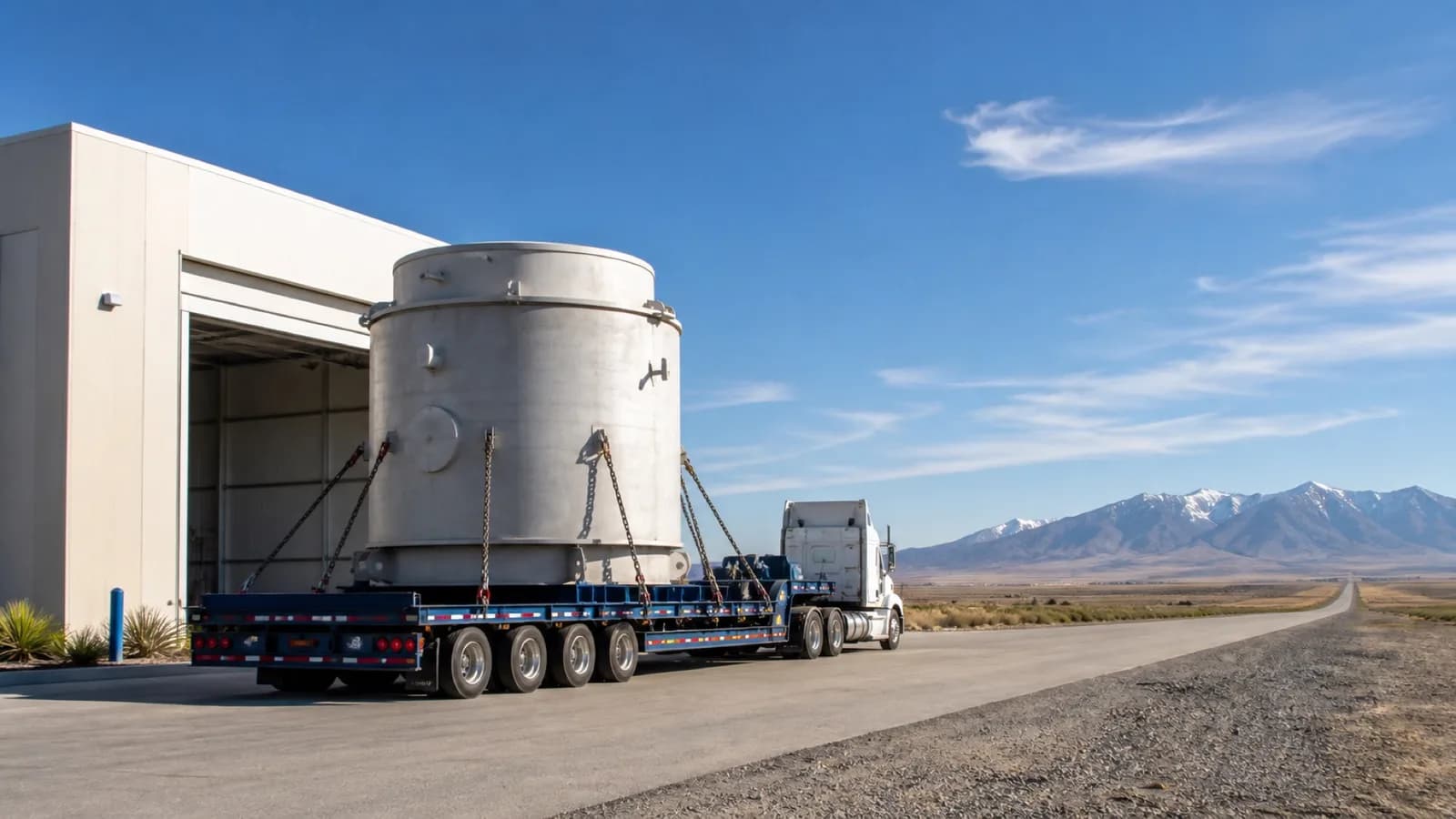
Radiant’s 1 MWe Kaleidos microreactor has begun its more than 1,000-mile trip from California to Idaho National Laboratory (INL). The move matters because the same transportable unit intended for customers is now entering DOME, a test bed built to take a commercial microreactor design from paper performance to measured operation.
Key facts
- Kaleidos is a 1 MWe transportable microreactor.
- Radiant said the unit is travelling more than 1,000 miles on a trailer.
- The DOME programme has five testing phases, from zero-power criticality to full heat and power.
- The final target is 150 continuous hours without operator assistance.
- Radiant is targeting completion of the campaign in the third quarter of 2026.
What happened
Radiant Industries moved its Kaleidos microreactor out of California on a trailer bound for the DOME, or Demonstration of Microreactor Experiments, test bed at INL. The company said the reactor left its El Segundo facility on August 12. Its point was deliberately concrete: the unit was not a reduced demonstration mock-up, but the design and scale Radiant says it plans to manufacture and ship to customers.
That claim will now be tested under controlled conditions. DOME uses the repurposed containment structure of a former experimental breeder reactor at INL. The facility gives developers a defined place to install experimental microreactors, collect operating data and work through a staged test programme without first building a commercial customer site.
Radiant’s five-phase sequence starts with zero-power criticality. It then moves through heat generation and electricity production, ultimately reaching full-power operation and a capstone run of 150 hours without operator intervention. That last stage is not a substitute for commercial licensing, but it is a useful demonstration of how the design behaves when it is asked to run continuously rather than simply reach a laboratory milestone.
The reactor is expected to be loaded with tri-structural isotropic, or TRISO, fuel under the oversight of the US Department of Energy and INL. World Nuclear News reported that Standard Nuclear fabricated the fuel to Radiant’s specifications earlier in 2026.
Why it matters
Transport is part of Radiant’s product proposition. The company has designed Kaleidos to be moved by land, sea and air, so the trailer journey is itself a first commercial test of the deployment model. A reactor that can leave a factory as a complete unit could reduce the amount of nuclear construction work required at a customer site. It could also move power to remote bases, industrial users and other locations where grid extension is costly or slow.
But transportability alone does not make a product deployable. The reactor has to demonstrate that its fuel, heat-transfer systems, controls and safety case work together at the intended scale. DOME is where Radiant can generate the operating evidence needed for its licensing and manufacturing claims.
The campaign also places Radiant inside the broader US microreactor push. NNN’s coverage of the DOME test bed explains why a shared national-laboratory facility matters: developers get an established nuclear test environment, while regulators and future customers get more comparable performance data. The TRISO fuel explainer covers the coated-particle fuel technology used by several advanced-reactor designs.
Radiant has also connected the test schedule to a customer commitment. The company has an agreement with the US Air Force to deliver its first commercial microreactor to Buckley Space Force Base by 2028, according to World Nuclear News. That target makes the 2026 test campaign more than a research exercise: it is intended to support a product schedule.
Background
A microreactor is smaller than a conventional power reactor and is designed for transport, factory production or deployment in places without large grid connections. The appeal is a shorter site programme and a compact power source. The hard part is proving that a small unit can retain robust safety margins while also being manufactured economically.
Kaleidos is a high-temperature design using TRISO fuel. Each fuel particle contains multiple protective layers, but the commercial case still depends on the complete system: fuel qualification, manufacturing repeatability, reactor controls, heat removal and an acceptable licensing path.
Radiant is pursuing a Part 70 licence application for its R-50 production facility in Oak Ridge, Tennessee. The NRC review is separate from the DOME operating campaign, but the two tracks are connected. Testing can provide evidence for the design and operating basis, while licensing determines whether the factory can make the units under an approved framework.
What’s next
The immediate milestone is installation at DOME, followed by fuel loading and the five test phases. Radiant says the campaign is targeted for completion in the third quarter. The most consequential results will be the transition from criticality to power, the duration of autonomous operation and the data that can be used in the company’s NRC application.
After that, watch two clocks: the review of Radiant’s R-50 production-facility application and the 2028 Buckley delivery target. The trailer has shown that Kaleidos can travel. The test programme must now show that it can operate.
Questions
- What happened to Radiant’s Kaleidos microreactor?
- Radiant shipped the 1 MWe transportable Kaleidos unit more than 1,000 miles from California to Idaho National Laboratory’s DOME test bed.
- What will DOME test?
- Radiant plans five phases from zero-power criticality through heat and power generation, ending with a 150-hour continuous run without operator assistance.
- What fuel will Kaleidos use?
- The reactor is expected to be loaded under DOE and INL oversight with TRISO fuel fabricated by Standard Nuclear to Radiant’s specifications.
Sources
- Kaleidos microreactor begins journey to Idaho — World Nuclear News
- First-of-a-kind microreactor test bed open for business — World Nuclear News
About Nuclear News Network
Nuclear News Network (NNN) is an independent publication covering the global nuclear energy sector — reactor construction, SMRs, fuel supply, policy, operations and fusion. NNN publishes a daily brief, same-day analysis of major developments, and reference guides used across the industry. Articles are produced by the NNN Newsroom, an editorial automation system with human oversight, under the publication's editorial standards. Ruben Seoane is the founder and main editor of NNN.