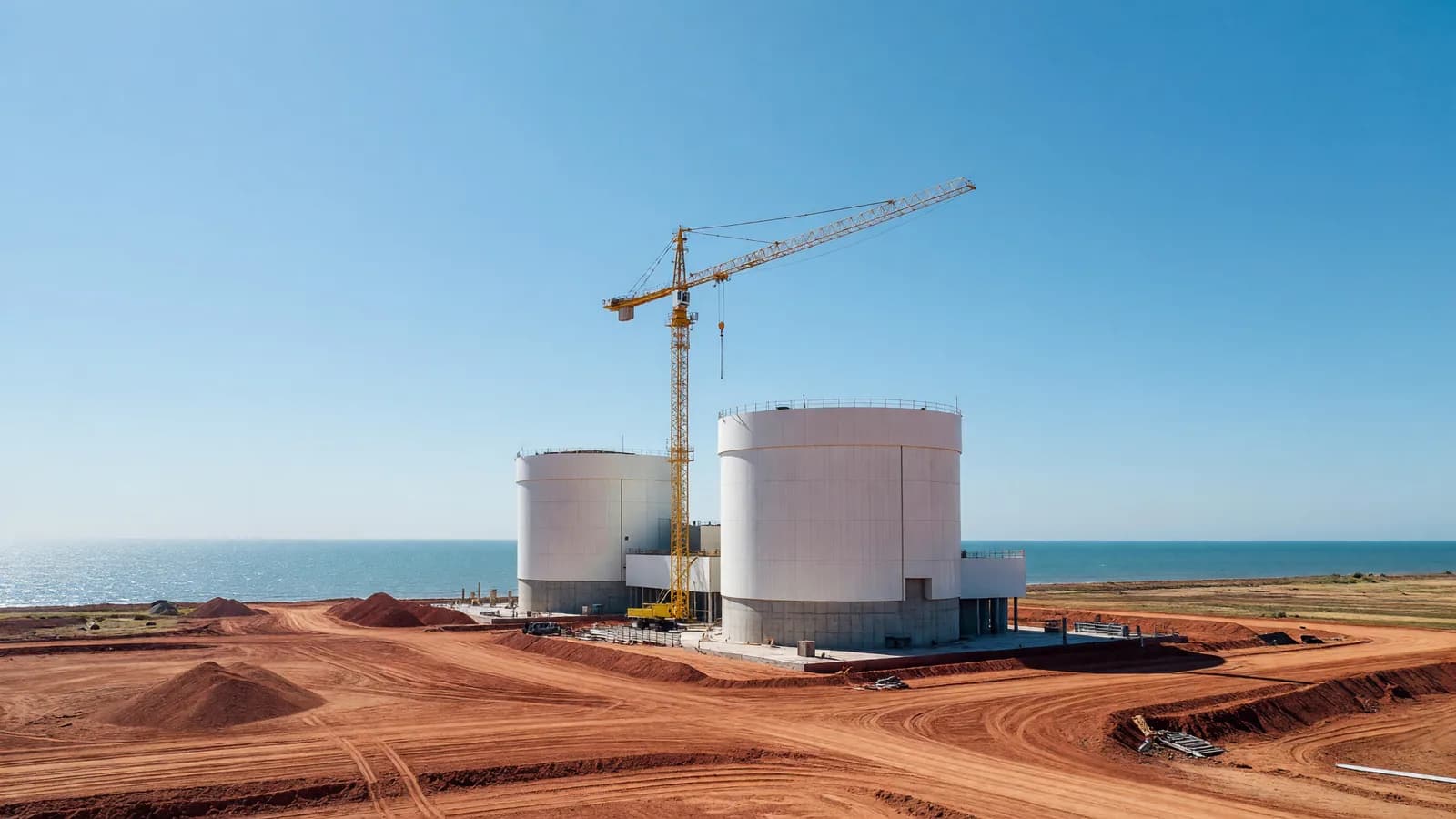
Vietnam's nuclear restart has moved from paperwork to construction footing. Russia's Rosatom holds the intergovernmental agreement for two VVER-1200 units at Ninh Thuan 1, South Korea's KEPCO is accelerating toward Ninh Thuan 2, and the IAEA has delivered the Phase 2 infrastructure review — making Vietnam the only ASEAN country at that stage.
Key facts
- An intergovernmental agreement for Ninh Thuan 1 was signed in Moscow on 23 March 2026, covering two VVER-1200 reactors with the new Leningrad NPP-2 units as the reference project.
- The IAEA delivered its INIR Phase 2 report in Hanoi on 22 April 2026, after a mission that ran 1–11 December 2025 and reviewed 19 nuclear-infrastructure issues. Vietnam is the only ASEAN country to complete Phase 2.
- On 9 September 2026, Petrovietnam and Korea Electric Power Corp agreed to accelerate talks on building Ninh Thuan 2; Petrovietnam has acquired almost all the land the plant requires.
- Vietnam's National Assembly approved restarting Ninh Thuan in November 2024, and Prime Minister Pham Minh Chinh set a target to complete both plants by the end of 2030.
- The combined capacity of the two plants is estimated at 4,000–6,400 MW; the 2025 Atomic Energy Law created special financing and contracting mechanisms for the build.
What happened
The pieces of Vietnam's nuclear comeback have been falling into place for 20 months; this week the program's shape became clear enough to call it a supply-chain story, not just a policy one.
The anchor is the 23 March 2026 intergovernmental agreement with Russia. Signed in Moscow during Prime Minister Pham Minh Chinh's official visit — by Rosatom Director General Alexey Likhachev and Minister Tran Van Son, in the presence of Chinh and Russian Prime Minister Mikhail Mishustin — it regulates the conditions and key areas of cooperation for Ninh Thuan 1, a two-unit VVER-1200 plant at Phuoc Dinh commune in Thuan Nam district. Rosatom named Leningrad NPP-2 units 1 and 2 as the reference project, and Likhachev framed the deal as "the foundation for a long-term industrial partnership."
The second track sharpened this month. Reuters reported on 9 September that Petrovietnam and KEPCO had agreed to accelerate discussions on one of Vietnam's first two nuclear plants, as Hanoi pushes its revived program forward. The plant in question is Ninh Thuan 2, at Vinh Hai commune in Ninh Hai district — the slot originally earmarked for Japanese vendors before the 2016 suspension. Vietnam had said it would select the Ninh Thuan 2 partner in the third quarter of this year, and Petrovietnam has now acquired almost all the land the project needs.
Underneath both tracks sits the IAEA's INIR Phase 2 report, delivered 22 April 2026 by IAEA Deputy Director General Mikhail Chudakov to Science and Technology Minister Vu Hai Quan. The December 2025 mission concluded Vietnam has taken major steps to restart and accelerate Ninh Thuan, singling out the 2025 Atomic Energy Law and special financing mechanisms as good practices other newcomer countries could learn from.
Why it matters
Vietnam is the only ASEAN country to complete INIR Phase 2 — the milestone at which the IAEA judges a country ready to invite bids or negotiate contracts for its first plant. That puts Vietnam roughly two stages ahead of anywhere else in Southeast Asia and turns it into the region's test case for a full-size, two-vendor national program.
A dual Russian-Korean supply chain also breaks the single-vendor pattern that defines most first-time nuclear builds. Rosatom arrives with a state-backed financing playbook it has already used in Turkey (Akkuyu follows the same build-own-operate model) and Kazakhstan, where it signed an EPC contract for the Balkhash plant. Korea arrives with a demonstrated export product — the APR-1400 — and an unusually deep bench: Korean vendors are simultaneously finalizing a US reactor package reportedly worth more than $100 billion.
One analyst following the program pegs the supplier opportunity — equipment, consulting, and workforce training across both plants — at roughly $22 billion over the build window, a figure NNN could not independently verify but that is consistent with recent VVER-1200 and APR-1400 contract values.
Background
This is Vietnam's second attempt at the same two sites. The government approved the Ninh Thuan project in principle in 2009: Ninh Thuan 1 was to host Russian VVER-1200s and Ninh Thuan 2 Japanese reactors. Site work advanced far enough to relocate two villages and upgrade local infrastructure before Hanoi suspended the program in 2016, citing economic conditions. The World Nuclear Association's country profile documents the original two-plant, four-reactor layout and the Japanese role at Ninh Thuan 2.
The revival moved fast once it started. The Communist Party Central Committee decided in 2024 to restart Ninh Thuan; the National Assembly authorized government spending that November; and in February 2025 the prime minister set the end-2030 completion target for both plants. Vietnam requested the INIR Phase 2 mission on 10 February 2025 — three months after the parliamentary vote — and enacted the new Atomic Energy Law later that year.
Russia and Vietnam are not starting from zero. The two countries have longstanding nuclear ties through the planned Centre for Nuclear Science and Technology — including a Russian-designed research reactor — and Vietnam's existing Dalat research reactor runs on Russian-supplied fuel and produces medical isotopes. For Rosatom, Ninh Thuan 1 adds to an export order book that already spans Akkuyu-2 welding milestones in Turkey and Central Asia.
What's next
Three dates frame the rest of 2026. Vietnam wants to select the Ninh Thuan 2 foreign partner — with KEPCO the clear frontrunner — in the current quarter. The IAEA and Vietnam will update their Integrated Workplan to act on the Phase 2 report's recommendations, which cover regulatory independence, nuclear liability, and construction readiness. And the first concrete at Phuoc Dinh will mark the point at which a program suspended for a decade formally becomes Southeast Asia's first full-scale reactor construction site.
Questions
- Who is building Vietnam's Ninh Thuan nuclear plants?
- Rosatom holds the March 2026 intergovernmental agreement for Ninh Thuan 1, two VVER-1200 units. For Ninh Thuan 2, Petrovietnam and South Korea's KEPCO agreed on 9 September 2026 to accelerate talks; Vietnam wants to select the foreign partner for that plant.
- What did the IAEA's INIR Phase 2 report say about Vietnam?
- The IAEA team found Vietnam has taken major steps to restart and accelerate Ninh Thuan, citing the 2025 Atomic Energy Law and special financing mechanisms. Its recommendations cover regulatory independence, liability, contracting and construction readiness. Vietnam is the only ASEAN country to complete Phase 2.
- When does Vietnam want the plants operating?
- Prime Minister Pham Minh Chinh set a target in February 2025 to complete the two Ninh Thuan plants by the end of 2030. The IAEA frames the wider commissioning window as 2030–2035, with a combined 4,000–6,400 MW across the two plants.
- What happened to the original Ninh Thuan project?
- A two-plant Ninh Thuan project was approved in 2009 — Russian VVERs for Ninh Thuan 1, Japanese reactors for Ninh Thuan 2 — and halted in 2016 on economic grounds after site work and village relocation. Vietnam's Communist Party Central Committee decided to revive it in 2024 and the National Assembly authorized funding in November 2024.
Sources
- Vietnam, Russia sign agreement on new nuclear plant — World Nuclear News
- IAEA Delivers Report to Viet Nam on its Nuclear Power Infrastructure Development — IAEA
- Petrovietnam, KEPCO step up talks on nuclear power project — Reuters
- Nuclear Power in Vietnam — World Nuclear Association
About Nuclear News Network
Nuclear News Network (NNN) is an independent publication covering the global nuclear energy sector — reactor construction, SMRs, fuel supply, policy, operations and fusion. NNN publishes a daily brief, same-day analysis of major developments, and reference guides used across the industry. Articles are produced by the NNN Newsroom, an editorial automation system with human oversight, under the publication's editorial standards. Ruben Seoane is the founder and main editor of NNN.