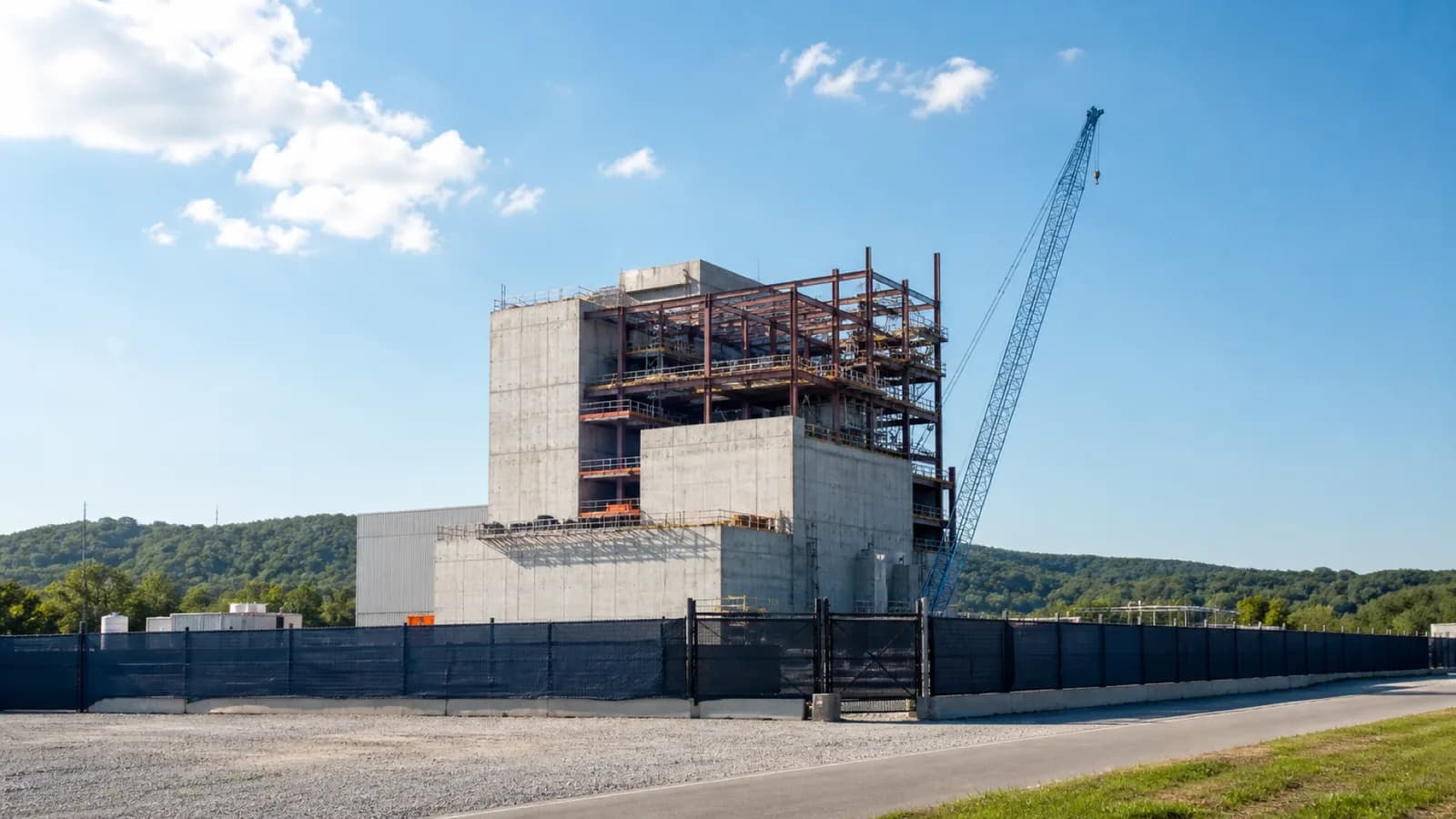
Nature published a nuclear-power Outlook on Aug. 26 that puts small modular reactors (SMRs) in the middle of the argument over how to meet rising electricity demand from artificial-intelligence data centers. The report is a synthesis, not a new project announcement: it presents SMRs as a possible source of low-carbon power while spelling out the unresolved cost, fuel, waste and regulatory problems.
Key facts
- SMRs can produce up to 300 megawatts electric (MWe), according to Nature's reporting.
- Nuclear power supplies about 9% of the world's electricity, Nature says.
- The U.S. Department of Energy opened a $900 million solicitation in March 2025 to support deployment of American-made Gen III+ light-water SMRs.
- Kairos Power's Hermes 2 demonstration plant is rated at 50 MWe and is expected to begin commercial operations in 2030.
What's driving the conversation
The Nature Outlook arrived as a high-velocity X lead from @OperadorNuclear, which described the package as a broad look at SMRs, advanced reactors, fuel, regulation, waste, fusion and AI-related electricity demand. That post is useful as the trigger for the story. The reporting underneath it is Nature's Aug. 26 collection and its main feature on smaller reactors.
The distinction matters. There is no new reactor order, license, construction approval or power contract in the Outlook itself. Nature's editors describe the collection as editorially independent while disclosing financial support from Oklo. The package should therefore be read as reported analysis and commentary, not as an industry announcement or an independent forecast of deployment.
The central commercial argument is easy to understand. Conventional reactors can deliver large amounts of steady electricity, but they take a long time and a lot of money to build. SMRs promise smaller units, factory-made components and more flexible siting. Nature quotes nuclear engineer Jacopo Buongiorno comparing the modular approach to connecting prefabricated bricks at the site.
That pitch now overlaps with the power needs of AI infrastructure. Data centers need electricity around the clock, and developers are looking for firm supplies near large loads. The Outlook presents nuclear as one option. It does not claim that SMRs have already solved the data-center problem.
The substance beneath the promise
Nature's numbers show why the technology attracts attention. An SMR producing up to 300 MWe is much smaller than a conventional light-water reactor, which typically produces about 1,000 MWe, according to the feature. A smaller unit may fit demand at a remote industrial site or a large data center more closely than a gigawatt-scale plant. The tradeoff is that developers may need many units and a repeatable manufacturing system before the economics work.
The article points to Kairos Power's Hermes program as one concrete test of that model. The company is building Hermes 1 in Oak Ridge, Tennessee, and started construction of the 50-MWe Hermes 2 demonstration plant in April. Nature reports that Kairos expects commercial operations in 2030 and has a deal to sell power to Google. That is a proposed commercial path, not evidence that a commercial SMR fleet is operating today.
Fuel is another bottleneck. Kairos's Hermes design uses TRISO fuel and a molten-salt coolant. Nature says TRISO relies on high-assay low-enriched uranium (HALEU), with roughly 15–20% uranium-235. The United States is still building the enrichment and fuel-manufacturing base needed for wider use. Nature reports that the U.S. Department of Energy awarded $2.7 billion to three companies in January for domestic HALEU enrichment capacity.
Other designs use different materials. TerraPower's Natrium reactor, which Nature describes as a 345-MWe plant under construction in Wyoming, uses uranium-zirconium alloy fuel, liquid sodium coolant and molten sodium chloride for heat storage. That design is slightly above the usual 300-MWe SMR threshold, a reminder that labels do not always line up neatly with engineering or commercial plans.
Why the industry is watching
The Outlook connects several debates that are often covered separately. The SMR companies tracked by NNN need factories, fuel and customers, not only reactor designs. The economics also sit beside the question of whether nuclear or natural gas is better for baseload power, especially when a data-center developer wants electricity on a fixed schedule.
The regulatory issue is just as practical. Nature reports that the U.S. Nuclear Regulatory Commission approved a rule in 2023 allowing emergency planning zones for SMRs to be set case by case, depending on the technology. A smaller zone could make some projects easier to place near customers. It does not remove the need to prove that a specific design can operate safely or that its fuel and waste can be handled.
Waste remains in the Outlook because the political problem has outlasted many of the technical arguments. Nature's collection says long-term storage is difficult to approve even though the engineering questions are better understood than the public debate often suggests. Its separate features also cover regulatory oversight and the possibility that pressure to approve new designs quickly could weaken scrutiny.
What's next
The immediate watch points are physical and bureaucratic: whether Hermes 2 advances from construction toward its 2030 operating target, whether HALEU suppliers can deliver at commercial scale, and whether regulators can review new reactor designs without treating speed as a substitute for evidence. AI data-center demand may create customers for nuclear power, but it cannot by itself settle the cost, licensing, fuel and waste questions that Nature has put on the record.
Questions
- What did Nature's nuclear-power Outlook say about SMRs?
- The Aug. 26 Outlook says smaller reactors could provide low-carbon power for data centers and remote locations, while reporting that cost, fuel, waste and regulation remain unresolved.
- Are SMRs already supplying AI data centers?
- No. Nature describes projects, funding and proposed power deals. Kairos Power's Hermes 2 demonstration plant is expected to begin commercial operations in 2030, according to the report.
- What is the main constraint on advanced-reactor fuel?
- Some designs need high-assay low-enriched uranium, or HALEU, enriched to about 15–20% uranium-235. Nature reports that domestic supply is still being developed.
Sources
About Nuclear News Network
Nuclear News Network (NNN) is an independent publication covering the global nuclear energy sector — reactor construction, SMRs, fuel supply, policy, operations and fusion. NNN publishes a daily brief, same-day analysis of major developments, and reference guides used across the industry. Articles are produced by the NNN Newsroom, an editorial automation system with human oversight, under the publication's editorial standards. Ruben Seoane is the founder and main editor of NNN.