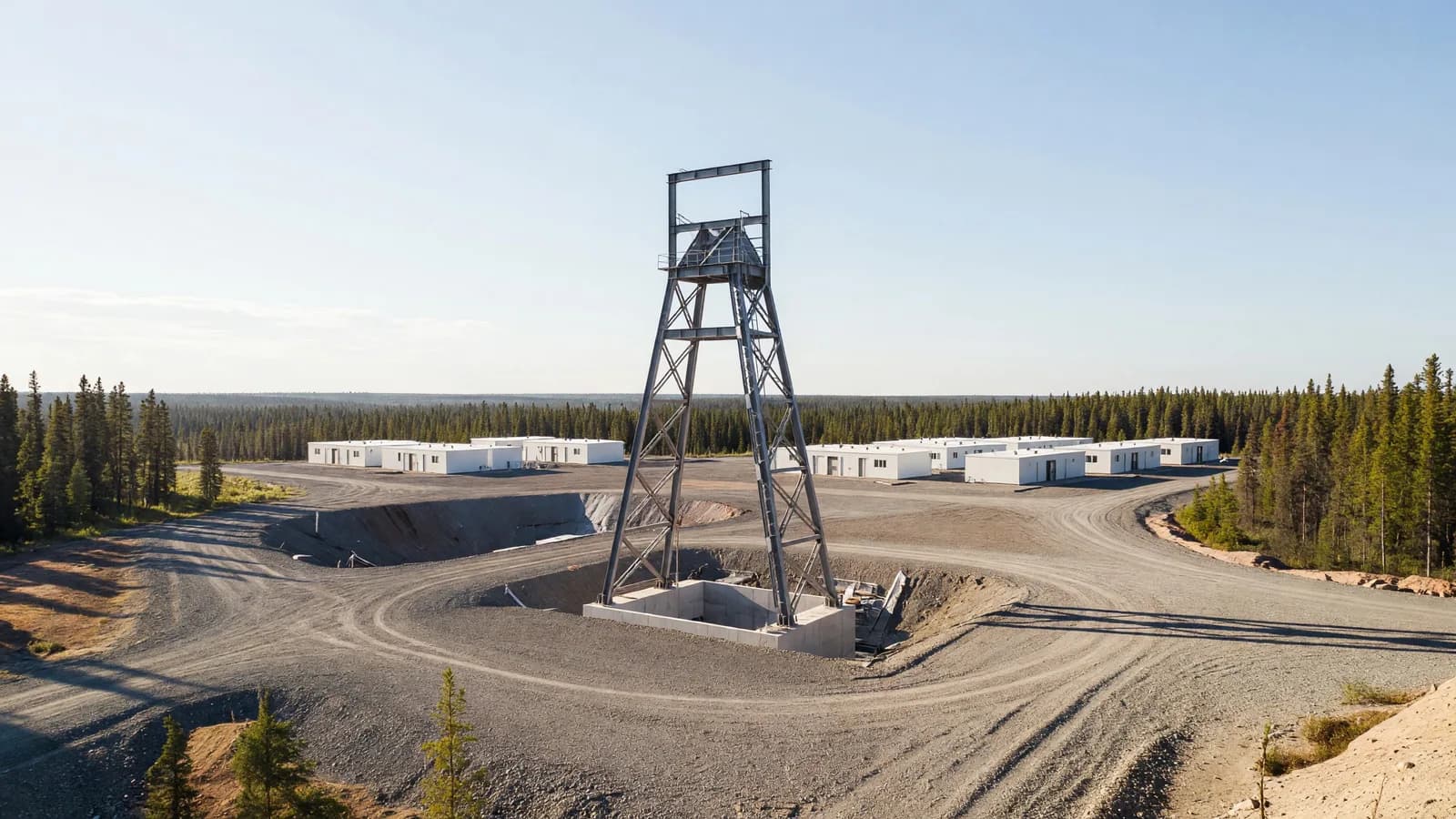
NexGen Energy has begun construction at the Rook I uranium project in northern Saskatchewan, starting a four-year build toward a mine expected to produce 30 million pounds of uranium a year. In a market trading at roughly $86 a pound, the Arrow deposit is the largest single supply-side answer the industry has under development — and the only Western mine of its scale with final approvals in hand.
Key facts
- NexGen marked the official start of construction at Rook I, about 155 km north of La Loche in the southern Athabasca Basin.
- The Arrow deposit holds a probable reserve of 239.6 million pounds U3O8 at an average grade of 2.37%, within a 256.7-million-pound Measured and Indicated resource.
- The project received its final regulatory approval in March 2026 and is described by NexGen as the largest development-stage uranium project in Canada.
- About 300 people are on site, with shaft development planned for 2027 and the full 5,840-foot airstrip due by December.
- Former Prime Minister Stephen Harper said the completed project would deliver 20% of the world's uranium supply.
What happened
The groundbreaking brought Indigenous leaders, federal and provincial representatives, investors and contractors to the site on Treaty 8 territory, including Harper, Saskatchewan Premier Scott Moe and Métis Nation–Saskatchewan President Glen McCallum. The project holds Benefit Agreements with all four Indigenous communities identified within its Local Priority Area.
"Today, we transition from demonstrating what this project will be to delivering it," NexGen founder and CEO Leigh Curyer said, calling uranium "one of the world's most strategic resources" as electricity demand rises on artificial intelligence, electrification and energy security.
Physical work is already underway. A Clearwater River Dene Nation-partnered business has crushed and stockpiled more than 575,000 tonnes of aggregate, supporting up to 50 local jobs. The initial 3,000-foot airstrip is commissioned, and expanded accommodations are occupied, according to World Nuclear News.
Curyer's framing put the demand side in view as clearly as the supply side: nuclear energy has become key to meeting "unprecedented" electricity demand from artificial intelligence, advanced manufacturing and electrification, and uranium with it has become strategic. The presence of a former prime minister and the sitting premier at a mine groundbreaking in the remote Athabasca region underlines that Ottawa and Regina now treat uranium the way they once treated potash and oil — as provincial economic policy with global leverage.
Why it matters
The reactor buildout has a fuel problem, and the fuel problem starts at the mine. NNN has tracked the downstream pressure — the HALEU commitments underpinning advanced-reactor pipelines and the fleet-scale offtake agreements now being signed, like TerraPower's eight-reactor arrangements. All of those contracts ultimately presume mines that exist. Rook I is the largest single project in the Western pipeline that now has final approval, broken ground and a dated construction sequence.
The deposit's grade does the economic work. At 2.37% U3O8, Arrow is an order of magnitude richer than most operating mines outside the Athabasca Basin, which is what lets NexGen talk about 30 million pounds a year — a figure that would make one Saskatchewan project larger than several producer countries combined. Whether the market needs all of it at once is a question the four-year construction window will answer.
Background
Arrow was discovered by NexGen in 2014. Per the company's 2021 feasibility study, the ore body lies roughly 300 to 700 metres underground and will be accessed by two shafts — an 8-metre production shaft and a 5.5-metre exhaust shaft providing second egress — using conventional longhole mining, with mill capacity targeted at 1,300 tonnes of ore per day. The project spent more than a decade in exploration, engineering and permitting before the March construction approval cleared the final regulatory gate.
What's next
The watchpoints are sequential and dated: the full airstrip by December, shaft development in 2027, then the production ramp the feasibility study maps over the early 2030s. The strategic question is contracting — which utilities and which advanced-reactor developers lock in Arrow pounds on long terms, and at what price. With fuel security now a stated reason for plant extensions from Spain's Almaraz outward, a sanctioned, financed, construction-stage Athabasca mine is the asset every utility fuel desk is watching.
Questions
- What did NexGen start building at Rook I?
- NexGen Energy marked the official start of construction at its Rook I uranium project in Saskatchewan in August 2026, beginning a four-year construction pathway toward a mine expected to produce about 30 million pounds of uranium per year.
- How big is the Rook I deposit?
- The Arrow deposit carries a Measured and Indicated resource of 256.7 million lb U3O8 including a probable reserve of 239.6 million lb at 2.37% grade, with a further 80.7 million lb in the Inferred category.
- When will Rook I produce uranium?
- The construction pathway is about four years. Shaft development is planned for 2027, and the full 5,840-foot airstrip is expected by December 2026; production timing follows completion of the build.
- What approvals does Rook I have?
- The project received its final regulatory approval in March 2026, and holds Benefit Agreements with all four Indigenous communities in its Local Priority Area.
Sources
- Construction starts at Saskatchewan uranium mine — World Nuclear News
- Rook I uranium project gets construction approval — World Nuclear News
About Nuclear News Network
Nuclear News Network (NNN) is an independent publication covering the global nuclear energy sector — reactor construction, SMRs, fuel supply, policy, operations and fusion. NNN publishes a daily brief, same-day analysis of major developments, and reference guides used across the industry. Articles are produced by the NNN Newsroom, an editorial automation system with human oversight, under the publication's editorial standards. Ruben Seoane is the founder and main editor of NNN.